



Scorpaenopsis crenulata Motomura & Causse, 2011
Serrated deepwater scorpionfish
Uploaden van uw Foto's en video's
Afbeeldingen | Google afbeelding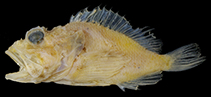 Scorpaenopsis crenulata
Afbeelding van Motomura, H.
Afbeeldingen | Google afbeelding
Afbeelding van Motomura, H.
Classificatie / Namen Lokale namen | Synoniemen | Catalog of Fishes(Genus, Soort(en)) | ITIS | CoL | WoRMS | Cloffa
> Perciformes/Scorpaenoidei (Scorpionfishes) > Scorpaenidae (Scorpionfishes or rockfishes) > Scorpaeninae
Etymology: Scorpaenopsis: Latin, scorpaena = a kind of fish, 1706 + Greek, opsis = appearance (Ref. 45335); crenulata: Name from Latin meaning serrated, referring to the serrated spines on the dorsal part of the head of the new species.
Etymology: Scorpaenopsis: Latin, scorpaena = a kind of fish, 1706 + Greek, opsis = appearance (Ref. 45335); crenulata: Name from Latin meaning serrated, referring to the serrated spines on the dorsal part of the head of the new species.
Milieu: milieu / Klimaatzone / Diepte / verspreidingsgebied Ecologie
marien benthopelagisch. Tropical
Verspreiding Gebieden | FAO regio's | Ecosystemen | Voorkomen | Verspreidingskaart | Introducties | Faunafri
Southwestern Pacific: Wallis and Futuna Islands.
Grootte / Gewicht / Leeftijd
Korte beschrijving Determinatiesleutels | Morfologie | Morfometrie
Dorsale stekels (totaal) : 12; Dorsale zachte stralen (totaal) : 9; Anale stekels: 3; Anale zachte stralen: 5. This species is distinguished by the following characters: 17 pectoral-fin rays; 37 scale rows in longitudinal series; 19 pored lateral-line scales; posterior margin of maxilla extending well beyond a vertical through posterior margin of orbit; an additional spine arising from a low median ridge of anterior lacrimal spine; posterior lacrimal spine divided into 2 spinous points; poorly developed interorbital ridges, covered with skin (not visible if skin is not removed); upper opercular spine divided into three spinous points; postocular, tympanic, nuchal, pterotic, posttemporal, and supracleithral spines serrated; extremely deep occipital pit, its depth greater than pupil diameter; space between ventral margin of orbit and suborbital ridge broad, its distance 4.1% SL ; extremely deep suborbital pit, its depth subequal to pupil diameter; a pair of pores behind a symphysial knob on lower jaw; nape and anterior body not highly arched; a narrow interorbital space, its width (7.2% SL ) less than orbit diameter; a large head, its length 50.5% SL ; short snout, length 13.7% SL ; large eye, orbit diameter 11.5% SL ; inner surface of pectoral fin with a poorly defined, large black blotch distally between third and seventh rays; a large black blotch on the upper one-third of pectoral-fin axil (Ref. 56405).
Body shape (shape guide): short and / or deep; Cross section: compressed.
Body shape (shape guide): short and / or deep; Cross section: compressed.
Levenscyclus en paargedrag Maturiteit | Voortplanting | Paaien | Eieren | Fecunditeit | Larven
Hoofdreferentie
Upload uw referenties | Referenties | Coördinator | Medewerkers
Motomura, H. and R. Causse, 2011. A new deepwater scorpionfish of the genus Scorpaenopsis (Scorpaenidae) from Wallis and Futuna Islands, southwestern Pacific Ocean. Bull. Mar. Sci. 87(1):45-53. (Ref. 86405)
Status op de Rode Lijst van het IUCN (Ref. 130435: Version 2025-2 (Global))
Onvoldoende gegevens (DD) ; Date assessed: 04 March 2015
CITES
Not Evaluated
Gevaar voor de mens
Harmless
Gebruik door de mens
FAO - Publication: search | FishSource |
Meer informatie
Trofische ecologie
Voedsel (prooien)
Dieetsamenstelling
Voedselconsumptie
Voedselrantsoenen
Predatoren
Voedsel (prooien)
Dieetsamenstelling
Voedselconsumptie
Voedselrantsoenen
Predatoren
Ecologie
Ecologie
Ecologie
Populatiedynamica
Groeiparameters
Max. leeftijden / maten
Lengte-gewicht rel.
Lengte-lengte rel.
Lengtefrequenties
Massaconversie
Rekrutering
Abundantie
Groeiparameters
Max. leeftijden / maten
Lengte-gewicht rel.
Lengte-lengte rel.
Lengtefrequenties
Massaconversie
Rekrutering
Abundantie
Levenscyclus
Voortplanting
Maturiteit
Rijpheid/kieuwen rel.
Fecunditeit
Paaien
Paaibestanden
Eieren
Ontwikkeling van de eieren
Larven
Larvale populatiedynamiek
Voortplanting
Maturiteit
Rijpheid/kieuwen rel.
Fecunditeit
Paaien
Paaibestanden
Eieren
Ontwikkeling van de eieren
Larven
Larvale populatiedynamiek
Anatomie
Kieuwoppervlak
Hersenen
Otoliet
Kieuwoppervlak
Hersenen
Otoliet
Fysiologie
Lichaamssamenstelling
Voedingsstoffen
Zuurstofverbruik
Type zwemmen
Zwemsnelheid
Visuele pigmenten
Vis geluid
Ziekten en parasieten
Toxiciteit (LC50)
Lichaamssamenstelling
Voedingsstoffen
Zuurstofverbruik
Type zwemmen
Zwemsnelheid
Visuele pigmenten
Vis geluid
Ziekten en parasieten
Toxiciteit (LC50)
Genetica
genoom
Genetica
Heterozygositeit
Erfelijkheid
Genetische diversiteit
genoom
Genetica
Heterozygositeit
Erfelijkheid
Genetische diversiteit
Menselijk gerelateerd
Aquacultuursystemen
Aquacultuurprofielen
Kweeklijnen
Ciguatera gevallen
Postzegels, munten, diversen.
Aquacultuursystemen
Aquacultuurprofielen
Kweeklijnen
Ciguatera gevallen
Postzegels, munten, diversen.
Tools
E-boek | Veldgids | Determinatiesleutels | Lengtefrequentie Tool | Levenscyclus tool | Verspreidingskaart |
Vangst-MSY |
Speciale rapporten
Bekijk gegevens voor het houden in een aquarium | Bekijk Fact Sheets voor de soort | Bekijk Aquacultuur Fact Sheets
Download XML
Internetbronnen
AFORO (otoliths) | Aquatic Commons | BHL | Cloffa | Websites from users | Bekijk FishWatcher | CISTI | Catalog of Fishes: Genus, Soort(en) | DiscoverLife | ECOTOX | FAO - Publication: search | Faunafri | Fishipedia | Fishtrace | GloBI | Google Books | Google Scholar | Google | IGFA World Record | OneZoom | Open Tree of Life | Otolith Atlas of Taiwan Fishes | PubMed | Reef Life Survey | Socotra Atlas | TreeBase | Tree of Life | Wikipedia: ga naar, zoek | World Records Freshwater Fishing | Zoobank | Zoological Record
Schattingen op basis van modellen
Fylogenetische diversiteitsindex (Ref. 82804): PD50 = 0.5000 [Uniqueness, from 0.5 = low to 2.0 = high].
Bayesian length-weight: a=0.01622 (0.00658 - 0.03999), b=3.07 (2.85 - 3.29), in cm total length, based on LWR estimates for this (Sub)family-body shape (Ref. 93245).
Trofisch niveau (Ref. 69278): 3.5 ±0.6 se; based on size and trophs of closest relatives