



Acanthopagrus pacificus Iwatsuki, Kume & Yoshino, 2010
Pacific seabream
Uploaden van uw Foto's en video's
Afbeeldingen | Google afbeelding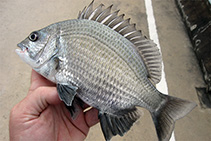 Acanthopagrus pacificus
Afbeelding van Jean-Francois Helias / Fishing Adventures Thailand
Afbeeldingen | Google afbeelding
Afbeelding van Jean-Francois Helias / Fishing Adventures Thailand
Classificatie / Namen Lokale namen | Synoniemen | Catalog of Fishes(Genus, Soort(en)) | ITIS | CoL | WoRMS | Cloffa
> Eupercaria/misc (Various families in series Eupercaria) > Sparidae (Porgies)
Etymology: Acanthopagrus: Greek, akantha = thorn + Greek, pagros, a kind of fish (Ref. 45335); pacificus: Name refers to its distribution in the western Pacific.
Etymology: Acanthopagrus: Greek, akantha = thorn + Greek, pagros, a kind of fish (Ref. 45335); pacificus: Name refers to its distribution in the western Pacific.
Milieu: milieu / Klimaatzone / Diepte / verspreidingsgebied Ecologie
marien; brak water pelagic-neritic. Tropical
Verspreiding Gebieden | FAO regio's | Ecosystemen | Voorkomen | Verspreidingskaart | Introducties | Faunafri
Western Pacific: Japan to Australia.
Lengte bij maturiteit / Grootte / Gewicht / Leeftijd
Maturiteit: Lm ?, range 21 - ? cm
Max length : 50.0 cm SL mannelijk / geslacht onbekend; (Ref. 86288); 34.8 cm SL (female)
Max length : 50.0 cm SL mannelijk / geslacht onbekend; (Ref. 86288); 34.8 cm SL (female)
Korte beschrijving Determinatiesleutels | Morfologie | Morfometrie
Dorsale stekels (totaal) : 11; Dorsale zachte stralen (totaal) : 11; Anale stekels: 3; Anale zachte stralen: 8 - 9. This species is distinguished from its congeners by the following set of characters: 3.5 scale rows between fifth dorsal-fin spine base and lateral line; ventral edge of first two infraorbitals above rear end of maxilla straight in fish less than ca 30 cm SL, but a moderate concavity of the ventral edge of the first two infraorbitals above the posterior part of upper jaw obvious in specimens about 35 cm SL; front edge of dorsal scaly area on head slightly curved (convex) without small scales; total gill rakers 15-19, modally 17; deeper body, 45-48% SL (mean 47% SL); A III, 8-9, usually III, 8; smaller orbit diameter, 2.9-4.9 (mean 3.7) in head length/orbit diameter; second anal-fin spine (2AS) clearly longer than third anal-fin spine (3AS), 2AS/3AS 1.2-1.56 (mean 1.4); scales on preopercle flange absent; pelvic and anal fins uniformly dark black (Ref. 86288).
Body shape (shape guide): fusiform / normal; Cross section: compressed.
Body shape (shape guide): fusiform / normal; Cross section: compressed.
Mainly in brackish waters of estuaries and inlets, coastal rivers and tidal creeks, occasionally entering lower sections of freshwater streams (Ref. 44894). Juveniles inhabit protected bays and estuaries (Ref. 47715). Usually occurs singly or small groups, but may migrate in schools (Ref. 48635). A popular angling species, often caught with hook and line (Ref. 44894).
Levenscyclus en paargedrag Maturiteit | Voortplanting | Paaien | Eieren | Fecunditeit | Larven
Hoofdreferentie
Upload uw referenties | Referenties | Coördinator | Medewerkers
Iwatsuki, Y., M. Kume and T. Yoshino, 2010. A new species, Acanthopagrus pacificus from the Western Pacific (Pisces, Sparidae). Bull. Natl. Mus. Nat. Sci., Ser. A, 36(4):115-130. (Ref. 86288)
Status op de Rode Lijst van het IUCN (Ref. 130435: Version 2025-2 (Global))
Niet bedreigd (LC) ; Date assessed: 17 March 2014
CITES
Not Evaluated
Gevaar voor de mens
Harmless
Gebruik door de mens
Visserij: commercieel; Aquacultuur: commercieel; Aquarium: Publieke aquaria
FAO - Publication: search | FishSource |
Meer informatie
Trofische ecologie
Voedsel (prooien)
Dieetsamenstelling
Voedselconsumptie
Voedselrantsoenen
Predatoren
Voedsel (prooien)
Dieetsamenstelling
Voedselconsumptie
Voedselrantsoenen
Predatoren
Populatiedynamica
Groeiparameters
Max. leeftijden / maten
Lengte-gewicht rel.
Lengte-lengte rel.
Lengtefrequenties
Massaconversie
Rekrutering
Abundantie
Groeiparameters
Max. leeftijden / maten
Lengte-gewicht rel.
Lengte-lengte rel.
Lengtefrequenties
Massaconversie
Rekrutering
Abundantie
Levenscyclus
Voortplanting
Maturiteit
Rijpheid/kieuwen rel.
Fecunditeit
Paaien
Paaibestanden
Eieren
Ontwikkeling van de eieren
Larven
Larvale populatiedynamiek
Voortplanting
Maturiteit
Rijpheid/kieuwen rel.
Fecunditeit
Paaien
Paaibestanden
Eieren
Ontwikkeling van de eieren
Larven
Larvale populatiedynamiek
Anatomie
Kieuwoppervlak
Hersenen
Otoliet
Kieuwoppervlak
Hersenen
Otoliet
Fysiologie
Lichaamssamenstelling
Voedingsstoffen
Zuurstofverbruik
Type zwemmen
Zwemsnelheid
Visuele pigmenten
Vis geluid
Ziekten en parasieten
Toxiciteit (LC50)
Lichaamssamenstelling
Voedingsstoffen
Zuurstofverbruik
Type zwemmen
Zwemsnelheid
Visuele pigmenten
Vis geluid
Ziekten en parasieten
Toxiciteit (LC50)
Menselijk gerelateerd
Aquacultuursystemen
Aquacultuurprofielen
Kweeklijnen
Ciguatera gevallen
Postzegels, munten, diversen.
Aquacultuursystemen
Aquacultuurprofielen
Kweeklijnen
Ciguatera gevallen
Postzegels, munten, diversen.
Tools
Speciale rapporten
Bekijk gegevens voor het houden in een aquarium | Bekijk Fact Sheets voor de soort | Bekijk Aquacultuur Fact Sheets
Download XML
Internetbronnen
AFORO (otoliths) | Aquatic Commons | BHL | Cloffa | Websites from users | Bekijk FishWatcher | CISTI | Catalog of Fishes: Genus, Soort(en) | DiscoverLife | ECOTOX | FAO - Publication: search | Faunafri | Fishipedia | Fishtrace | GloBI | Google Books | Google Scholar | Google | IGFA World Record | Nationale databanken | OneZoom | Open Tree of Life | Otolith Atlas of Taiwan Fishes | PubMed | Reef Life Survey | Socotra Atlas | TreeBase | Tree of Life | Wikipedia: ga naar, zoek | World Records Freshwater Fishing | Zoobank | Zoological Record
Schattingen op basis van modellen
Fylogenetische diversiteitsindex (Ref. 82804): PD50 = 0.5000 [Uniqueness, from 0.5 = low to 2.0 = high].
Bayesian length-weight: a=0.01698 (0.01067 - 0.02703), b=3.06 (2.93 - 3.19), in cm total length, based on LWR estimates for this species & (Sub)family-body (Ref. 93245).
Trofisch niveau (Ref. 69278): 3.6 ±0.5 se; based on diet studies.
Weerstandsvermogen (Ref. 120179): Gemiddeld, minimale populatieverdubbelingstijd 1,4-4,4 jaar (tm=1.15).