



Pogonophryne brevibarbata Balushkin, Petrov & Prutko, 2011
Shortbeard plunderfish
Envoyez vos Photos et vidéos
Images | Images Google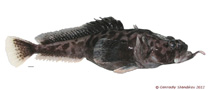 Pogonophryne brevibarbata
Female Photo de Shandikov, G.A.
Images | Images Google
Female Photo de Shandikov, G.A.
Classification / Noms Noms communs | Synonymes | Catalog of Fishes(Genre, Espèce) | ITIS | CoL | WoRMS | Cloffa
> Perciformes/Notothenioidei (Icefishes) > Artedidraconidae (Barbled plunderfishes)
Etymology: Pogonophryne: Greek, pogon = beard + Greek, phrynos = toad (Ref. 45335).
Etymology: Pogonophryne: Greek, pogon = beard + Greek, phrynos = toad (Ref. 45335).
Environnement : milieu / zone climatique / profondeur / gamme de distribution Écologie
marin bathydémersal; profondeur 1036 - 1157 m (Ref. 86286). Polar; 71°S - 72°S, 179°W - 178°W (Ref. 92304)
Distribution Territoires | Zones FAO | Écosystèmes | Occurrences | Carte par point | Introductions | Faunafri
Southern Ocean, East Antarctica: Ross Sea.
Taille / Poids / Âge
Maturité: Lm ? range ? - ? cm
Max length : 21.9 cm SL mâle / non sexé; (Ref. 86286); 26.2 cm SL (female)
Max length : 21.9 cm SL mâle / non sexé; (Ref. 86286); 26.2 cm SL (female)
Description synthétique Clés d'identification | Morphologie | Morphométrie
Épines dorsales (Total) : 2; Rayons mous dorsaux (Total) : 27 - 28; Rayons mous anaux: 17 - 18; Vertèbres: 37. This dorsally-spotted and short-barbeled species is distinguished from other in 'mentella' group by this set of characters: a short (about 8-12% SL) bicolored mental barbel with uniformly dorsally dark-pigmented or spotted stem and rather long (65-68% of barbel length), inexpressive (barely wider than stem), light (creamy, whitish or light-orange in live specimens) and pointed terminal expansion, reaching nostrils or anterior edge of orbit in backward extended mode over the snout with mouth closed; terminal expansion composed of low, densely distributed folds with serrated or scalloped ridges and rosettes of leaf-like processes; lower jaw evidently protruding with visible teeth on symphysis when mouth closed; interorbital distance wide (about 7% SL); second dorsal fin with straight (not sinuous distally) rays, medium in height within males of the genus (about 21% SL), with conspicuous blackish-colored anterior elevated lobe, dark basally and lightish or somewhat variegated distally in posterior part; dorsal surface of head and area anterior to first dorsal fin covered by dark-brown spots and irregular markings; breast and belly dark-brown and blackish, both lacking in evident dark sharp spots or markings; mandibular and maxillar oral valves light or light-brownish; caudal and pectoral fins dark or blackish anteriorly, sometime with several inconspicuous stripes, and uniformly light in posterior narrow margin, anal and pelvic (both sides) fins blackish basally and light distally (Ref. 92304).
Body shape (shape guide): elongated; Cross section: other (see remarks).
Body shape (shape guide): elongated; Cross section: other (see remarks).
Deep-water species collected by bottom long-line at depths 1036-1163 m by hooks. Visual observations of both type specimens, which were keeping alive in container filled with marine water, demonstrate the maintaining of the mental barbel in a horizontal position parallel to the ground when fishes were immovable. In swimming fishes, the mental barbel was pushed back over or alongside the snout by flowing water. P. brevibarbata evidently belongs to the mostly predatory species, which also opportunistically feeds as necrophage. The stomach of the female, captured 20 January 2010, contained (besides the bait, giant Peruvian squid, Dosidicus gigas) the remains of a large crustacean, probably Antarctic shrimp, Notocrangon antarcticus. State of ovaries with traces of recent spawning corresponds to early SGM VI-III, GSI 1.3. The length, width and depth of the left ovary attain about 44, 18 and 6.5 mm correspondently. The liver fills in length about 1/3 of the abdominal cavity; hepatosomatic index reaches 1.6 (Ref. 92304).
Cycle de vie et comportement reproducteur Maturité | Reproduction | Frai | Œufs | Fécondité | Larves
Référence principale
Téléchargez vos références | Références | Coordinateur | Collaborateurs
Balushkin, A.V., A.F. Petrov and V.G. Prutko, 2010. Pogonophyrne brevibarbata sp. nov. (Artedidraconidae, Notothenioidei, Perciformes) -a new species of toadlike plunderfish from the Ross Sea, Antarctica. Proc. Zool. Institute Russian Acad. Sci. 314(4):381-386. (Ref. 86286)
CITES
Not Evaluated
Menace pour l'homme
Harmless
Utilisations par l'homme
Pêcheries: sans intérêt
FAO - Publication: search | FishSource |
Plus d'informations
Écologie trophique
Aliments (proies)
Composition du régime alimentaire
Consommation alimentaire
Rations alimentaires
Prédateurs
Aliments (proies)
Composition du régime alimentaire
Consommation alimentaire
Rations alimentaires
Prédateurs
Écologie
Écologie
Écologie
Dynamique des populations
Paramètres de croissance
Âges / tailles maximales
Longueur-poids rel.
Rel. longueur-longueur.
Fréquences de longueurs
Conversion de masse
Recrutement
Abondance
Paramètres de croissance
Âges / tailles maximales
Longueur-poids rel.
Rel. longueur-longueur.
Fréquences de longueurs
Conversion de masse
Recrutement
Abondance
Cycle de vie
Reproduction
Maturité
Maturité/épines rel.
Fécondité
Frai
Agrégats de frai
Œufs
Développement de l'œuf
Larves
Dynamique des populations larvaires
Reproduction
Maturité
Maturité/épines rel.
Fécondité
Frai
Agrégats de frai
Œufs
Développement de l'œuf
Larves
Dynamique des populations larvaires
Anatomie
Surface branchiale
Cerveau
Otolithe
Surface branchiale
Cerveau
Otolithe
Physiologie
Composition corporelle
Nutriments
Consommation d'oxygène
Type de natation
Vitesse de nage
Pigments visuels
Son de poisson
Maladies et parasites
Toxicité (CL50)
Composition corporelle
Nutriments
Consommation d'oxygène
Type de natation
Vitesse de nage
Pigments visuels
Son de poisson
Maladies et parasites
Toxicité (CL50)
Génétique
génôme
Génétique
Hétérozygotie
Héritabilité
Diversité génétique
génôme
Génétique
Hétérozygotie
Héritabilité
Diversité génétique
Liées à l'homme
Systèmes d'aquaculture
Profils d'aquaculture
Souches
Cas de ciguatera
Timbres, pièces de monnaie, divers
Systèmes d'aquaculture
Profils d'aquaculture
Souches
Cas de ciguatera
Timbres, pièces de monnaie, divers
Outils
E-book | Guide de terrain | Clés d'identification | Générateur de fréquences de longueur | Outil de dynamique de population | Carte par point |
Capture-MSY |
Articles particuliers
Télécharger en XML
Sources Internet
AFORO (otoliths) | Aquatic Commons | BHL | Cloffa | Websites from users | FishWatcher | CISTI | Catalog of Fishes: Genre, Espèce | DiscoverLife | ECOTOX | FAO - Publication: search | Faunafri | Fishipedia | Fishtrace | GloBI | Google Books | Google Scholar | Google | IGFA World Record | OneZoom | Open Tree of Life | Otolith Atlas of Taiwan Fishes | PubMed | Reef Life Survey | Socotra Atlas | TreeBase | Arbre de Vie | Wikipedia: aller à, chercher | World Records Freshwater Fishing | Zoobank | Zoological Record
Estimations basées sur des modèles
Indice de diversité phylogénétique (Réf. 82804): PD50 = 0.5000 [Uniqueness, from 0.5 = low to 2.0 = high].
Bayesian length-weight: a=0.00513 (0.00244 - 0.01080), b=3.13 (2.95 - 3.31), in cm total length, based on LWR estimates for this (Sub)family-body shape (Ref. 93245).
Niveau trophique (Réf. 69278): 3.3 ±0.5 se; based on size and trophs of closest relatives