



Tải lên của bạn hình ảnh Và Video
Các tranh (Ảnh) | Google image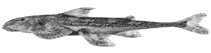 Doumea reidi
Hình ảnh của Ferraris Jr., C.J.
Các tranh (Ảnh) | Google image
Hình ảnh của Ferraris Jr., C.J.
Phân loại / Tên Tên thường gặp | Các synonym ( Các tên trùng) | Catalog of Fishes(Giống, Các loài) | ITIS | CoL | WoRMS | Cloffa
> Siluriformes (Catfishes) > Amphiliidae (Loach catfishes) > Doumeinae
Etymology: Doumea: Taken form a locality, Doumé, in Congo (Ref. 45335); reidi: The species name, reidi, honors Dr. Gordon McGregor Reid, of the North of England Zoological Society, who collected the holotype and who has dedicated a large portion of his career helping to protect, and improve our understanding of, wildlife and freshwater fishes worldwide (Ref. 85844).
Eponymy: Professor Dr Gordon McGregor Reid (d: 1948) is a British ichthyologist, zoologist and zoo director. [...] (Ref. 128868), visit book page.
More on authors: Ferraris, Skelton & Vari.
Etymology: Doumea: Taken form a locality, Doumé, in Congo (Ref. 45335); reidi: The species name, reidi, honors Dr. Gordon McGregor Reid, of the North of England Zoological Society, who collected the holotype and who has dedicated a large portion of his career helping to protect, and improve our understanding of, wildlife and freshwater fishes worldwide (Ref. 85844).
Eponymy: Professor Dr Gordon McGregor Reid (d: 1948) is a British ichthyologist, zoologist and zoo director. [...] (Ref. 128868), visit book page.
More on authors: Ferraris, Skelton & Vari.
Môi trường: môi trường / vùng khí hậu / Mức độ sâu / phạm vi phân phối Sinh thái học
; nước ngọt gần đáy. Tropical
Sự phân bố Lãnh thổ | Các khu vực của FAO | Các hệ sinh thái | Những lần xuất hiện | Bản đồ điểm | Những chỉ dẫn | Faunafri
Africa: upper Mbam River in eastern Nigeria, not far from border with Cameroon (Ref. 85844).
Bộ gần gũi / Khối lượng (Trọng lượng) / Tuổi
Chín muồi sinh dục: Lm ? range ? - ? cm
Max length : 9.3 cm SL con đực/không giới tính; (Ref. 85844)
Max length : 9.3 cm SL con đực/không giới tính; (Ref. 85844)
Mô tả ngắn gọn Khóa để định loại | Hình thái học | Sinh trắc học
Các tia vây lưng cứng (tổng cộng) : 0; Các vây lưng mềm (tổng cộng) : 7; Tia cứng vây hậu môn: 0; Tia mềm vây hậu môn: 11. Diagnosis: Doumea reidi is distinguished from its congeners, except D. chappuisi and D. stilicauda, by having the dorsolateral and ventrolateral vertebral processes extending through the dermis to form longitudinal bony ridges from the base of the adipose fin posteriorly to the caudal-fin base and from slightly posterior of the anal-fin origin to the caudal-fin base; the exposed processes are in the shape of longitudinal bars with slightly corrugated surfaces that together form an irregular longitudinal ridge (Ref. 85844). Doumea reidi differs from differs from D. chappuisi in having caudal-peduncle length 31% of standard length, vs. 22-29%; the posterior extent of the adpressed pelvic fin in specimens over 90 mm extending distinctly beyond anterior limit of the anal fin, vs. falling short of that point; the anterior extent of the exposed vertebral processes along the ventral surface of the body extending to the area lateral to the anal-fin base, vs. extending to slightly posterior of pelvic-fin origin; and the pigmentation pattern of the dorsal surface of the unbranched rays of the pectoral and pelvic fins with a series of irregular dark spots against a lighter background, vs. uniformly pigmented (Ref. 85844). Doumea reidi differs from D. stilicauda in predorsal length 33% of standard length, vs. 27-30%; head length 18% of standard length, vs. 15-17%; caudal-peduncle length 31% of standard length, vs. 35-41%; and caudal-peduncle depth 11.8 times in caudal-peduncle length, vs. 19.6-25.8 times (Ref. 85844).
Body shape (shape guide): elongated.
Body shape (shape guide): elongated.
The type locality of Doumea reidi is a cool, briskly flowing, upland stream less than 4 m wide and less than 1.5 m maximum depth; substratum was reported to consist of large, granitic boulders interspersed among deposits of coarse sand, mud, and leaf litter (Ref. 85844).
Vòng đời và hành vi giao phối Chín muồi sinh dục | Sự tái sinh sản | Đẻ trứng | Các trứng | Sự sinh sản | Ấu trùng
Tài liệu tham khảo chính
Tải lên tài liệu tham khảo của bạn | Các tài liệu tham khảo | Người điều phối | Người cộng tác
Ferraris, C.J., P. Skelton and R.P. Vari, 2010. Species of the Doumea chappuisi complex (Siluriformes, Amphiliidae) with the descriptions of new species from the upper Sanaga River and Nyong River basins. Copeia 2010(4):705-715. (Ref. 85844)
CITES
Not Evaluated
Mối đe dọa đối với con người
Harmless
Sử dụng của con người
Các nghề cá: không ích lợi (thú vị)
FAO - Publication: search | FishSource |
Thêm thông tin
Sinh thái dinh dưỡng
Thức ăn (con mồi)
Thành phần thức ăn
Thành phần thức ăn
Khẩu phần ăn
Các động vật ăn mồi
Thức ăn (con mồi)
Thành phần thức ăn
Thành phần thức ăn
Khẩu phần ăn
Các động vật ăn mồi
Biến động dân số
Các thông số tăng trưởng
Độ tuổi / kích thước tối đa
Chiều dài-trọng lượng tương đối
Chiều dài-chiều dài tương đối.
Chiều dài-tần số
Chuyển đổi khối lượng
Bổ xung
Sự phong phú
Các thông số tăng trưởng
Độ tuổi / kích thước tối đa
Chiều dài-trọng lượng tương đối
Chiều dài-chiều dài tương đối.
Chiều dài-tần số
Chuyển đổi khối lượng
Bổ xung
Sự phong phú
Vòng đời
Sự tái sinh sản
Chín muồi sinh dục
Độ trưởng thành/Mang liên quan
Sự sinh sản
Đẻ trứng
Tập hợp sinh sản
Các trứng
Sự phát triển của trứng
Ấu trùng
Sự biến động ấu trùng
Sự tái sinh sản
Chín muồi sinh dục
Độ trưởng thành/Mang liên quan
Sự sinh sản
Đẻ trứng
Tập hợp sinh sản
Các trứng
Sự phát triển của trứng
Ấu trùng
Sự biến động ấu trùng
Sự phân bố
Lãnh thổ
Các khu vực của FAO
Các hệ sinh thái
Những lần xuất hiện
Những chỉ dẫn
BRUVS - Video
Lãnh thổ
Các khu vực của FAO
Các hệ sinh thái
Những lần xuất hiện
Những chỉ dẫn
BRUVS - Video
Giải phẫu
Vùng mang
Não
sỏi tai
Vùng mang
Não
sỏi tai
Sinh lý học
Thành phần cơ thể
Chất dinh dưỡng
Thành phần ô-xy
Kiểu bơi
Tốc độ bơi
Sắc tố thị giác
Tiếng cá
Bệnh tật & Ký sinh trùng
Độc tính (LC50)
Thành phần cơ thể
Chất dinh dưỡng
Thành phần ô-xy
Kiểu bơi
Tốc độ bơi
Sắc tố thị giác
Tiếng cá
Bệnh tật & Ký sinh trùng
Độc tính (LC50)
Di truyền
Bộ gen
Di truyền
Sự dị hợp tử
Di sản
Đa dạng di truyền
Bộ gen
Di truyền
Sự dị hợp tử
Di sản
Đa dạng di truyền
Liên quan đến con người
Hệ thống nuôi trồng thủy sản
Các tổng quan nuôi trồng thủy sản
Các giống
Các trường hợp ngộ độc Ciguatera
Tem, tiền xu, v.v.
Hệ thống nuôi trồng thủy sản
Các tổng quan nuôi trồng thủy sản
Các giống
Các trường hợp ngộ độc Ciguatera
Tem, tiền xu, v.v.
Các công cụ
Sách điện tử | Hướng dẫn hiện trường | Tần suất chiều dài Wizard | Công cụ của vòng đời | Bản đồ điểm |
Bắt-MSY |
Báo cáo đặc biệt
Kiểm tra bảo trì bể cá | Kiểm tra các tờ thông tin về loài | Kiểm tra các tờ thông tin về nuôi trồng thủy sản
Tải xuống XML
Các nguồn internet
AFORO (otoliths) | Aquatic Commons | BHL | Cloffa | Websites from users | Check FishWatcher | CISTI | Catalog of Fishes: Giống, Các loài | DiscoverLife | ECOTOX | FAO - Publication: search | Faunafri | Fishipedia | Fishtrace | GloBI | Google Books | Google Scholar | Google | IGFA World Record | OneZoom | Open Tree of Life | Otolith Atlas of Taiwan Fishes | PubMed | Reef Life Survey | Socotra Atlas | TreeBase | Cây Đời sống | Wikipedia: Go, tìm | World Records Freshwater Fishing | Zoobank | Tạp chí Zoological Record
Ước tính dựa trên mô hình
Chỉ số đa dạng phát sinh loài (Tài liệu tham khảo 82804): PD50 = 0.5020 [Uniqueness, from 0.5 = low to 2.0 = high].
Bayesian length-weight: a=0.00389 (0.00180 - 0.00842), b=3.12 (2.94 - 3.30), in cm total length, based on all LWR estimates for this body shape (Ref. 93245).
Mức dinh dưỡng (Tài liệu tham khảo 69278): 3.1 ±0.4 se; based on size and trophs of closest relatives