



Mastacembelus simbi Vreven & Stiassny, 2009
Uploaden van uw Foto's en video's
Google afbeelding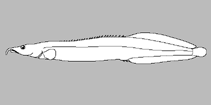 No image available for this species;
drawing shows typical species in Mastacembelidae.
Google afbeelding
drawing shows typical species in Mastacembelidae.
Classificatie / Namen Lokale namen | Synoniemen | Catalog of Fishes(Genus, Soort(en)) | ITIS | CoL | WoRMS | Cloffa
> Synbranchiformes (Spiny eels) > Mastacembelidae (Spiny eels)
Etymology: Mastacembelus: Greek, mastax, -agos = bite + Greek, emballo = to throw oneself (Ref. 45335); simbi: Named after "simbi" (simbi singular; basimbi plural) or "water spirit", once considered an ancient ancestor in the Bakongo region of Congo where the species is discovered. A noun in apposition.
Etymology: Mastacembelus: Greek, mastax, -agos = bite + Greek, emballo = to throw oneself (Ref. 45335); simbi: Named after "simbi" (simbi singular; basimbi plural) or "water spirit", once considered an ancient ancestor in the Bakongo region of Congo where the species is discovered. A noun in apposition.
Milieu: milieu / Klimaatzone / Diepte / verspreidingsgebied Ecologie
; zoet water benthopelagisch. Tropical; 27°C - 29°C (Ref. 84205)
Verspreiding Gebieden | FAO regio's | Ecosystemen | Voorkomen | Verspreidingskaart | Introducties | Faunafri
Africa: lower Congo River (Ref. 84205) and the lower reaches of the Middle Congo River, just upstream of Pool Malebo (Ref. 104438).
Grootte / Gewicht / Leeftijd
Korte beschrijving Determinatiesleutels | Morfologie | Morfometrie
Dorsale stekels (totaal) : 23 - 26; Dorsale zachte stralen (totaal) : 47 - 55; Anale stekels: 2; Anale zachte stralen: 46 - 56; Wervels: 68 - 71. Distinguished from all other species of Mastacembelidae by the following characters: no pterosphenoid bone in the neurocranium; no supracleithral sensory canal; no post-temporal tubules; and an infraorbital series represented by the first infraorbital only. Can be further separated from all other members belonging to Mastacembelus crassus species complex by the following combination of characters (where +1 denotes the presence of a short spine covered by skin and not externally visible): 22-25+1 dorsal spines (vs. 18-21+ in Mastacembelus aviceps and Mastacembelus crassus; eye visible at the surface of the head and relatively well developed, eye diameter 10.0-15.3% HL (vs. 4.8-7.2% HL in Mastacembelus latens; fully pigmented with a color pattern characterized by an oblique bar on the cheek and a series of vertically oriented and irregularly shaped midlateral bars most often present along the body and always present in the post-anal region (vs. depigmented in Mastacembelus latens (Ref. 84205).
Body shape (shape guide): eel-like.
Body shape (shape guide): eel-like.
Found in shallow, marginal habitats among rocks and rock rubble close to rapids or fast flowing water. Appears to be sympatric with or at least in close proximity to, Mastacembelus brichardi, Mastacembelus brachyrhinus and Mastacembelus crassus in Lenga Lenga where the holotype and part of paratypes were collected. Also caught elsewhere with Mastacembelus congicus and Mastacembelus paucipinnis. A 6.12 cm SL female specimen had about 15-20, seemingly mature, ovarian eggs with a maximum size of about 1.0 mm diameter. The occurrence of these large eggs may indicate that reproductive activity occurs in July, the period when the specimens were collected. Sexually mature at about 6.0 cm SL (Ref. 84205).
Levenscyclus en paargedrag Maturiteit | Voortplanting | Paaien | Eieren | Fecunditeit | Larven
Hoofdreferentie
Upload uw referenties | Referenties | Coördinator | Medewerkers
Vreven, E.J. and M.L.J. Stiassny, 2009. Mastacembelus simbi, a new dwarf spiny eel (Synbranchiformes: Mastacembelidae) from the lower Congo River. Ichthyol. Explor. Freshwat. 20(3):213-222. (Ref. 84205)
CITES
Not Evaluated
Gevaar voor de mens
Harmless
Gebruik door de mens
Visserij: van geen belang
FAO - Publication: search | FishSource |
Meer informatie
Trofische ecologie
Voedsel (prooien)
Dieetsamenstelling
Voedselconsumptie
Voedselrantsoenen
Predatoren
Voedsel (prooien)
Dieetsamenstelling
Voedselconsumptie
Voedselrantsoenen
Predatoren
Ecologie
Ecologie
Ecologie
Populatiedynamica
Groeiparameters
Max. leeftijden / maten
Lengte-gewicht rel.
Lengte-lengte rel.
Lengtefrequenties
Massaconversie
Rekrutering
Abundantie
Groeiparameters
Max. leeftijden / maten
Lengte-gewicht rel.
Lengte-lengte rel.
Lengtefrequenties
Massaconversie
Rekrutering
Abundantie
Levenscyclus
Voortplanting
Maturiteit
Rijpheid/kieuwen rel.
Fecunditeit
Paaien
Paaibestanden
Eieren
Ontwikkeling van de eieren
Larven
Larvale populatiedynamiek
Voortplanting
Maturiteit
Rijpheid/kieuwen rel.
Fecunditeit
Paaien
Paaibestanden
Eieren
Ontwikkeling van de eieren
Larven
Larvale populatiedynamiek
Anatomie
Kieuwoppervlak
Hersenen
Otoliet
Kieuwoppervlak
Hersenen
Otoliet
Fysiologie
Lichaamssamenstelling
Voedingsstoffen
Zuurstofverbruik
Type zwemmen
Zwemsnelheid
Visuele pigmenten
Vis geluid
Ziekten en parasieten
Toxiciteit (LC50)
Lichaamssamenstelling
Voedingsstoffen
Zuurstofverbruik
Type zwemmen
Zwemsnelheid
Visuele pigmenten
Vis geluid
Ziekten en parasieten
Toxiciteit (LC50)
Genetica
genoom
Genetica
Heterozygositeit
Erfelijkheid
Genetische diversiteit
genoom
Genetica
Heterozygositeit
Erfelijkheid
Genetische diversiteit
Menselijk gerelateerd
Aquacultuursystemen
Aquacultuurprofielen
Kweeklijnen
Ciguatera gevallen
Postzegels, munten, diversen.
Aquacultuursystemen
Aquacultuurprofielen
Kweeklijnen
Ciguatera gevallen
Postzegels, munten, diversen.
Tools
Speciale rapporten
Bekijk gegevens voor het houden in een aquarium | Bekijk Fact Sheets voor de soort | Bekijk Aquacultuur Fact Sheets
Download XML
Internetbronnen
AFORO (otoliths) | Aquatic Commons | BHL | Cloffa | Websites from users | Bekijk FishWatcher | CISTI | Catalog of Fishes: Genus, Soort(en) | DiscoverLife | ECOTOX | FAO - Publication: search | Faunafri | Fishipedia | Fishtrace | GloBI | Google Books | Google Scholar | Google | IGFA World Record | OneZoom | Open Tree of Life | Otolith Atlas of Taiwan Fishes | PubMed | Reef Life Survey | Socotra Atlas | TreeBase | Tree of Life | Wikipedia: ga naar, zoek | World Records Freshwater Fishing | Zoobank | Zoological Record
Schattingen op basis van modellen
Fylogenetische diversiteitsindex (Ref. 82804): PD50 = 0.5000 [Uniqueness, from 0.5 = low to 2.0 = high].
Bayesian length-weight: a=0.00269 (0.00129 - 0.00562), b=2.94 (2.76 - 3.12), in cm total length, based on LWR estimates for this (Sub)family-body shape (Ref. 93245).
Trofisch niveau (Ref. 69278): 3.4 ±0.6 se; based on size and trophs of closest relatives
Weerstandsvermogen (Ref. 120179): Hoog, minimale populatieverdubbelingstijd minder dan 15 maanden (Preliminary K or Fecundity.).