



Betadevario ramachandrani Pramod, Fang, Rema Devi, Liao, Indra, Jameela Beevi & Kullander, 2010
Hochladen Photos und videos
Google Bild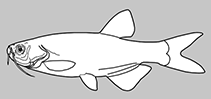 No image available for this species;
drawing shows typical species in Danionidae.
Google Bild
drawing shows typical species in Danionidae.
Klassifizierung / Names Namen | Synonyme | Catalog of Fishes(Gattung, Arten) | ITIS | CoL | WoRMS | Cloffa
> Cypriniformes (Carps) > Danionidae (Danios) > Danioninae
Etymology: Betadevario: Beta-, the second letter in Greek alphabet, also representing the numeral 2, and used in the meaning of second, and also the name of Beta Mahatvaraj who made great efforts to make the material available for this study; and -devario. With reference to its similarity to the genus Devario, in the meaning of second Devario; ramachandrani: Named after Professor Alappat Ramachandran, School of Industrial Fisheries, Cochin University of Science and Technology, Kochi, in recognition of his contributions to fisheries and sea food production management and studies on indigenous ornamental fishes.
Eponymy: Beta Mahatvara aided the authors, but the genus is only partly named after him as it closely resembles the genus Devario and Beta is Greek for second. [...] Professor Dr Alappat Ramachandran (d: 1957) is Professor of Fisheries Management (since 1999) and Director (since 2011), School of Industrial Fisheries, Cochin University of Science and Technology, Kochi, India. [...] (Ref. 128868), visit book page.
More on authors: Pramod, Fang, Rema, Devi, Liao, Indra & JameelaBeeviKullander.
Etymology: Betadevario: Beta-, the second letter in Greek alphabet, also representing the numeral 2, and used in the meaning of second, and also the name of Beta Mahatvaraj who made great efforts to make the material available for this study; and -devario. With reference to its similarity to the genus Devario, in the meaning of second Devario; ramachandrani: Named after Professor Alappat Ramachandran, School of Industrial Fisheries, Cochin University of Science and Technology, Kochi, in recognition of his contributions to fisheries and sea food production management and studies on indigenous ornamental fishes.
Eponymy: Beta Mahatvara aided the authors, but the genus is only partly named after him as it closely resembles the genus Devario and Beta is Greek for second. [...] Professor Dr Alappat Ramachandran (d: 1957) is Professor of Fisheries Management (since 1999) and Director (since 2011), School of Industrial Fisheries, Cochin University of Science and Technology, Kochi, India. [...] (Ref. 128868), visit book page.
More on authors: Pramod, Fang, Rema, Devi, Liao, Indra & JameelaBeeviKullander.
Umwelt: Milieu / Klimazone / Tiefenbereich / Verbreitungsgebiet Ökologie
; süßwasser benthopelagisch; tiefenbereich 0 - ? m (Ref. 84468). Tropical; 19°C - ?
Verbreitung Territorien | FAO Gebiete | Ökosysteme | Vorkommen | Punkt Karte | Einführungen | Faunafri
Asia: known only from the type locality area in the upper Sita River drainage in India.
Größe / Gewicht / Alter
Kurzbeschreibung Bestimmungsschlüssel | Morphologie | Morphometrie
Rückenflossenweichstrahlen (insgesamt) : 9 - 10; Afterflossenweichstrahlen: 14 - 15; Wirbelzahl: 35 - 36. For field identification purposes, it is easily distinguished from all species of Devario by its color pattern including a wide light horizontal band along the middle of the side bordering a wide dark lateral band along the abdominal side, and the long rostral and maxillary barbels (Ref. 84468).
Occurs in a small, high-altitude stream with a cascade and riffle-pool habitat and with width of 2.27 m and at depth at most about 30 cm (Ref. 84468).
Lebenszyklus und Paarungsverhalten Geschlechtsreife | Fortpflanzung | Ablaichen | Eier | Fruchtbarkeit | Larven
Hauptreferenz
Laden Sie Ihre Referenzen hoch | Referenzen | Koordinator | Partner
Pramod, P.K., F. Fang, K. Rema Devi, Liao-T.-Y., T.J. Indra, K.S. Jameela Beevi and S.O. Kullander, 2010. Betadevario ramachandrani, a new danionine genus and species from the Western Ghats of India (Teleostei: Cyprinidae: Danioninae). Zootaxa 2519:31-47. (Ref. 84468)
IUCN Rote Liste Status (Ref. 130435: Version 2025-2 (Global))
Daten mangelhaft (DD) ; Date assessed: 05 September 2010
CITES
Not Evaluated
Bedrohung für Menschen
Harmless
Nutzung durch Menschen
FAO - Publication: search | FishSource |
Mehr Information
Trophische Ökologie
Lebensmittel (Beutetiere)
Nahrungszusammensetzung
Nahrungsaufnahme
Lebensmittelrationen
Räuber
Lebensmittel (Beutetiere)
Nahrungszusammensetzung
Nahrungsaufnahme
Lebensmittelrationen
Räuber
Ökologie
Ökologie
Ökologie
Populationsdynamik
Wachstumsparameter
Max. Alter/Größen
Länge-Gewicht-Rel.
Länge-Länge-Verhältnis.
Längenhäufigkeiten
Massenkonvertierung
Rekrutierung
Dichte
Wachstumsparameter
Max. Alter/Größen
Länge-Gewicht-Rel.
Länge-Länge-Verhältnis.
Längenhäufigkeiten
Massenkonvertierung
Rekrutierung
Dichte
Lebenszyklus
Fortpflanzung
Geschlechtsreife
Reifung/Kiemen rel.
Fruchtbarkeit
Ablaichen
Laichaggregationen
Eier
Eientwicklung
Larven
Larven Pop.Dyn.
Fortpflanzung
Geschlechtsreife
Reifung/Kiemen rel.
Fruchtbarkeit
Ablaichen
Laichaggregationen
Eier
Eientwicklung
Larven
Larven Pop.Dyn.
Anatomie
Kiemenoberfläche
Gehirn
Otolith
Kiemenoberfläche
Gehirn
Otolith
Physiologie
Körperliche Zusammensetzung
Nährstoffe
Sauerstoffverbrauch
Schwimmart
Schwimmgeschwindigkeit
Visuelle Pigmente
Fischgeräusche
Krankheiten und Parasiten
Toxizität (LC50s)
Körperliche Zusammensetzung
Nährstoffe
Sauerstoffverbrauch
Schwimmart
Schwimmgeschwindigkeit
Visuelle Pigmente
Fischgeräusche
Krankheiten und Parasiten
Toxizität (LC50s)
Genetik
Genom
Genetik
Heterozygotie
Vererbbarkeit
Genetische Vielfalt
Genom
Genetik
Heterozygotie
Vererbbarkeit
Genetische Vielfalt
Menschenbezogen
Aquakultur-Systeme
Aquakultur Profile
Zuchtlinien
Ciguatera-Fälle
Briefmarken, Münzen, Verschiedenes.
Aquakultur-Systeme
Aquakultur Profile
Zuchtlinien
Ciguatera-Fälle
Briefmarken, Münzen, Verschiedenes.
Tools
Zusatzinformationen
Download XML
Zusammenfassung | Punktdaten | Namen | Photos
Internet Quellen
AFORO (otoliths) | Aquatic Commons | BHL | Cloffa | Websites from users | FishWatcher Einträge suchen | CISTI | Catalog of Fishes: Gattung, Arten | DiscoverLife | ECOTOX | FAO - Publication: search | Faunafri | Fishipedia | Fishtrace | GloBI | Google Books | Google Scholar | Google | IGFA World Record | OneZoom | Open Tree of Life | Otolith Atlas of Taiwan Fishes | PubMed | Reef Life Survey | Socotra Atlas | TreeBase | Tree of Life | Wikipedia: Gehe zu, Suchen | World Records Freshwater Fishing | Zoobank | Zoologischer Rekord
Schätzungen auf der Grundlage von Modellen
Phylogenetischer Diversitätsindex (Ref. 82804): PD50 = 1.0000 [Uniqueness, from 0.5 = low to 2.0 = high].
Bayesian length-weight: a=0.00589 (0.00244 - 0.01420), b=3.12 (2.91 - 3.33), in cm total length, based on LWR estimates for this (Sub)family-body shape (Ref. 93245).
Trophische Ebene (Ref. 69278): 3.1 ±0.3 se; based on size and trophs of closest relatives