



Envoyez vos Photos et vidéos
Images Google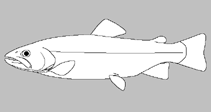 No image available for this species;
drawing shows typical species in Salmonidae.
Images Google
drawing shows typical species in Salmonidae.
Classification / Noms Noms communs | Synonymes | Catalog of Fishes(Genre, Espèce) | ITIS | CoL | WoRMS | Cloffa
> Salmoniformes (Salmons) > Salmonidae (Salmonids) > Salmoninae
Etymology: Salmo: Latin, salmo, Plinius = salmon (Ref. 45335).
More on author: Nardo.
Etymology: Salmo: Latin, salmo, Plinius = salmon (Ref. 45335).
More on author: Nardo.
Taxonomic Remarks
This species is synonym of Salmo marmoratus Cuvier, 1829 in Eschmeyer (CofF ver. Jan. 2012: Ref. 89336).
Environnement : milieu / zone climatique / profondeur / gamme de distribution Écologie
; eau douce benthopélagique. Subtropical
Distribution Territoires | Zones FAO | Écosystèmes | Occurrences | Carte par point | Introductions | Faunafri
Europe: Po to Soca drainages (where it is possibly introduced) and northern slope of Apennine range (Italy, Switzerland, Slovenia). The western and eastern distributional limits are not clear.
Taille / Poids / Âge
Maturité: Lm ? range ? - ? cm
Max length : 80.0 cm SL mâle / non sexé; (Ref. 59043); common length : 40.0 cm SL mâle / non sexé; (Ref. 59043); âge max. reporté: 8 années (Ref. 59043)
Max length : 80.0 cm SL mâle / non sexé; (Ref. 59043); common length : 40.0 cm SL mâle / non sexé; (Ref. 59043); âge max. reporté: 8 années (Ref. 59043)
Description synthétique Clés d'identification | Morphologie | Morphométrie
Distinguished from congeners in Apennine Peninsula by the combination of the following characters: parr marks absent in adults and subadults (over about 10 cm SL); parr marks vertically elongated; caudal fin slightly emarginate; body pattern not marbled; red spots not restricted to lateral line; black or dark brown spots present. This diagnosis is tentative as genetic data indicate that Salmo cenerinus represents a lineage very different from those of Atlantic and Black Sea basins, but there is no published morphological comparison. Salmo trutta has probably hybridized with most native populations (Ref. 59043).
Body shape (shape guide): fusiform / normal.
Body shape (shape guide): fusiform / normal.
Inhabits streams in hilly areas, with clear, flowing and well oxygenated water (as a result of continuous stocking, often present in unsuitable habitats). Also occurs in alpine and subalpine lakes. Feeds on aquatic insects and invertebrates. Large individuals also prey on fishes. Moves to smaller tributaries to spawn on gravel. Attains a maximum size of up to about 80 cm SL and lives up to at least 8 years. Introduced and has hybridized with Salmo marmoratus (Ref. 59043).
Cycle de vie et comportement reproducteur Maturité | Reproduction | Frai | Œufs | Fécondité | Larves
Référence principale
Téléchargez vos références | Références | Coordinateur | Collaborateurs
Kottelat, M. and J. Freyhof, 2007. Handbook of European freshwater fishes. Publications Kottelat, Cornol and Freyhof, Berlin. 646 pp. (Ref. 59043)
CITES
Not Evaluated
Menace pour l'homme
Harmless
Utilisations par l'homme
Pêcheries: d'intérêt potentiel
FAO - Publication: search | FishSource |
Plus d'informations
Écologie trophique
Aliments (proies)
Composition du régime alimentaire
Consommation alimentaire
Rations alimentaires
Prédateurs
Aliments (proies)
Composition du régime alimentaire
Consommation alimentaire
Rations alimentaires
Prédateurs
Écologie
Écologie
Écologie
Dynamique des populations
Paramètres de croissance
Âges / tailles maximales
Longueur-poids rel.
Rel. longueur-longueur.
Fréquences de longueurs
Conversion de masse
Recrutement
Abondance
Paramètres de croissance
Âges / tailles maximales
Longueur-poids rel.
Rel. longueur-longueur.
Fréquences de longueurs
Conversion de masse
Recrutement
Abondance
Anatomie
Surface branchiale
Cerveau
Otolithe
Surface branchiale
Cerveau
Otolithe
Physiologie
Composition corporelle
Nutriments
Consommation d'oxygène
Type de natation
Vitesse de nage
Pigments visuels
Son de poisson
Maladies et parasites
Toxicité (CL50)
Composition corporelle
Nutriments
Consommation d'oxygène
Type de natation
Vitesse de nage
Pigments visuels
Son de poisson
Maladies et parasites
Toxicité (CL50)
Génétique
génôme
Génétique
Hétérozygotie
Héritabilité
Diversité génétique
génôme
Génétique
Hétérozygotie
Héritabilité
Diversité génétique
Liées à l'homme
Systèmes d'aquaculture
Profils d'aquaculture
Souches
Cas de ciguatera
Timbres, pièces de monnaie, divers
Systèmes d'aquaculture
Profils d'aquaculture
Souches
Cas de ciguatera
Timbres, pièces de monnaie, divers
Outils
E-book | Guide de terrain | Générateur de fréquences de longueur | Outil de dynamique de population | Carte par point |
Capture-MSY |
Articles particuliers
Télécharger en XML
Sources Internet
AFORO (otoliths) | Aquatic Commons | BHL | Cloffa | Websites from users | FishWatcher | CISTI | Catalog of Fishes: Genre, Espèce | DiscoverLife | ECOTOX | FAO - Publication: search | Faunafri | Fishipedia | Fishtrace | GloBI | Google Books | Google Scholar | Google | IGFA World Record | Bases de données nationales | OneZoom | Open Tree of Life | Otolith Atlas of Taiwan Fishes | PubMed | Reef Life Survey | Socotra Atlas | TreeBase | Arbre de Vie | Wikipedia: aller à, chercher | World Records Freshwater Fishing | Zoobank | Zoological Record
Estimations basées sur des modèles
Indice de diversité phylogénétique (Réf. 82804): PD50 = 0.5000 [Uniqueness, from 0.5 = low to 2.0 = high].
Bayesian length-weight: a=0.01047 (0.00486 - 0.02255), b=3.03 (2.86 - 3.20), in cm total length, based on LWR estimates for this Genus-body shape (Ref. 93245).
Niveau trophique (Réf. 69278): 3.7 ±0.5 se; based on size and trophs of closest relatives
Résilience (Réf. 120179): Milieu, temps minimum de doublement de population : 1,4 à 4,4 années (tm=2-3).