



Rhynchobatus springeri Compagno & Last, 2010
Broadnose wedgefish
Añada su observación en Fish Watcher
| Native range | All suitable habitat | Point map | Year 2050 |

|
| This map was computer-generated and has not yet been reviewed. |
| Rhynchobatus springeri AquaMaps Data sources: GBIF OBIS |
Sube tu fotos y Vídeos
Imágenes | Google image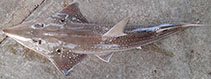 Rhynchobatus springeri
Foto de Krajangdara, T. & S. Boonsuk
Imágenes | Google image
Foto de Krajangdara, T. & S. Boonsuk
Clasificación / Nombres Nombres comunes | Sinónimos | Catalog of Fishes(Género, Especie) | ITIS | CoL | WoRMS | Cloffa
Elasmobranquios (tiburones y rayas) (sharks and rays) > Rhinopristiformes (Shovelnose rays) > Rhinidae (Wedgefishes)
Etymology: Rhynchobatus: Greek, rhingchos = snout + Greek, batis, -idos = a sting ray (Raja sp.) (Ref. 45335); springeri: Named for Stewart "Stew" Springer.
Eponymy: Stewart ‘Stew’ Springer (1906–1991) was a field naturalist who dropped out of Butler College (1929) but was awarded a baccalaureate by George Washington University (1964), by which time he was world-renowned as an expert on both the taxonomy and [...] (Ref. 128868), visit book page.
More on authors: Compagno & Last.
Etymology: Rhynchobatus: Greek, rhingchos = snout + Greek, batis, -idos = a sting ray (Raja sp.) (Ref. 45335); springeri: Named for Stewart "Stew" Springer.
Eponymy: Stewart ‘Stew’ Springer (1906–1991) was a field naturalist who dropped out of Butler College (1929) but was awarded a baccalaureate by George Washington University (1964), by which time he was world-renowned as an expert on both the taxonomy and [...] (Ref. 128868), visit book page.
More on authors: Compagno & Last.
Entorno: milieu / zona climática / rango de profundidad / gama de distribución Ecología
marino; salobre pelagic-neritic; rango de profundidad 16 - 37 m (Ref. 84284). Tropical; 20°N - 10°S, 95°E - 128°E (Ref. 114953)
Distribución Territorios | Áreas FAO | Ecosistemas | Ocurrencias, apariciones | Mapa de puntos | Introducciones | Faunafri
Indo-Malay: from Java (Indonesia) to Thailand, including Borneo, Singapore and the Philippines.
Tamaño / Peso / Edad
Madurez: Lm ? range ? - 125 cm
Max length : 215 cm TL macho / no sexado; (Ref. 84284); 213.0 cm TL (female)
Max length : 215 cm TL macho / no sexado; (Ref. 84284); 213.0 cm TL (female)
Descripción breve Claves de identificación | Morfología | Morfometría
This moderate-sized species is distinguished by the following set of characters: snout broadly wedge-shaped; preoral snout 16-22% of total length; eye small, length 3.1-4.0 in preorbital snout; interorbital space 2.2-2.7 in preorbital snout; mouth hardly bowed, with strong indentation on upper jaw near symphysis and strong protuberance on lower jaw; tooth rows in upper jaw about 52 (holotype); dorsal snout no spines; dorsal tip of snout with no rostral spines or spines; supraorbital spines small but well differentiated, extending from preorbit to end of spiracle; spines of mid-dorsal row relatively well developed; two obvious rows of small scapular spines on each side; origin of first dorsal fin over origin of pelvic fin bases; predorsal space 42-48% of total length; colour pale greyish green above with 3-4 rows of large, white spots extending along the tail; black pectoral marking distinct, usually closely surrounded with 4 white spots (occasionally 3); anterior pectoral disc with narrow whitish margin; orbital membrane with a pair of dark, widely spaced, recurved lines; interorbital space with no alternating light and dark markings; propterygial radials 1-8 + 20-23, mesopterygial radials 4-6, neopterygial radials 4-7, metapterygial radials 23-29, total radials 57-68 (inc. free radials); vertebrae with 12-14 synarcual centra, 18-28 monospondylous precaudal centra, 78-88 precaudal free centra, 33-40 diplospondylous caudal (free) centra, 113-126 total free centra, 127-139 total centra (including synarcual centra) (Ref. 84284).
Body shape (shape guide): elongated.
Body shape (shape guide): elongated.
Apparently confined mainly to brackish coastal and estuarine habitats in shallow water (Ref. 84284). Diet unknown, but presumably similar to other wedgefishes. Males mature at around
115 cm TL (Ref. 114953), two male paratypes from Sarawak (Malaysia) (IPPS 2009–338, adult male 112.6 cm TL) and Thailand (CAS-GVF 2361 unreg) were fully mature at 113 and 125 cm TL respectively, suggesting that this species is a moderate-sized wedgefish rather than a large species (Ref. 84284).
Ciclo vital y comportamiento de apareamiento Madurez | Reproducción | Puesta | Huevos | Fecundidad | Larva
Referencia principal
Suba sus referencias | Referencias | Coordinador | Colaboradores
Compagno, L.J.V. and P.R. Last, 2010. A new species of wedgefish, Rhynchobatus springeri (Rhynchobatoidei, Rhynchobatidae), from the Western Pacific. 77-88 pp. In Last, P.R., White, W.T. & Pogonoski, J.J. (eds.): Descriptions of new sharks and rays from Borneo. CSIRO Marine and Atmospheric Research Paper no. 32. (Ref. 84284)
Situación en la Lista Roja de la UICN (Ref. 130435: Version 2025-2 (Global))
Critically Endangered (CR) (A2bd); Date assessed: 03 December 2018
Amenaza para el ser humano
Harmless
Usos humanos
FAO - Publication: search | FishSource |
Más información
Ecología Trófica
Alimentos (presas)
Composición de la dieta
consumo de alimento
Raciones de comida
Despredadores
Alimentos (presas)
Composición de la dieta
consumo de alimento
Raciones de comida
Despredadores
Ecología
Ecología
Ecología
Dinámica de la población
Coeficiente del crecimiento para
Edades / tallas máximas
Longitud-peso rel.
Longitud-longitud rel.
Longitud-frecuencias
Conversión de masas
Reclutamiento
Abundancia
Coeficiente del crecimiento para
Edades / tallas máximas
Longitud-peso rel.
Longitud-longitud rel.
Longitud-frecuencias
Conversión de masas
Reclutamiento
Abundancia
Ciclo de vida
Reproducción
Madurez
Madurez/Gills rel.
Fecundidad
Puesta
Agregaciones de desove
Huevos
Desarrollo de los huevos
Larva
Dinámica larvaria
Reproducción
Madurez
Madurez/Gills rel.
Fecundidad
Puesta
Agregaciones de desove
Huevos
Desarrollo de los huevos
Larva
Dinámica larvaria
Distribución
Territorios
Áreas FAO
Ecosistemas
Ocurrencias, apariciones
Introducciones
BRUVS - Vídeos
Territorios
Áreas FAO
Ecosistemas
Ocurrencias, apariciones
Introducciones
BRUVS - Vídeos
Anatomía
Superficie branquial
Cerebro
Otolito
Superficie branquial
Cerebro
Otolito
Fisiología
Composición corporal
Nutrientes
Consumo del oxígeno
Tipo de natación
Velocidad de natación
Pigmentos visuales
Sonido de peces
Enfermedades y parásitos
Toxicidad (CL50)
Composición corporal
Nutrientes
Consumo del oxígeno
Tipo de natación
Velocidad de natación
Pigmentos visuales
Sonido de peces
Enfermedades y parásitos
Toxicidad (CL50)
Genética
Genoma
Genética
Heterocigosidad
heritabilidad
Diversidad genética
Genoma
Genética
Heterocigosidad
heritabilidad
Diversidad genética
Relacionados con el ser humano
Sistemas de acuicultura
Perfiles de acuicultura
Razas
Ciguatera cases
Sellos, monedas, varios
Sistemas de acuicultura
Perfiles de acuicultura
Razas
Ciguatera cases
Sellos, monedas, varios
Herramientas
Libro electrónico | Guía de campo | Asistente para frecuencias de tallas | Herramienta de ciclo de vida | Mapa de puntos |
Catch-MSY |
Informes especiales
Comprobar el mantenimiento del acuario | Buscar fichas sobre especies | Consulte las hojas informativas sobre acuicultura
Descargar XML
Fuentes de Internet
AFORO (otoliths) | Aquatic Commons | BHL | Cloffa | Websites from users | Check FishWatcher | CISTI | Catalog of Fishes: Género, Especie | DiscoverLife | ECOTOX | FAO - Publication: search | Faunafri | Fishipedia | Fishtrace | GloBI | Google Books | Google Scholar | Google | IGFA World Record | OneZoom | Open Tree of Life | Otolith Atlas of Taiwan Fishes | PubMed | Reef Life Survey | Socotra Atlas | TreeBase | Árbol de la vida | Wikipedia: Go, búsqueda | World Records Freshwater Fishing | Zoobank | Expediente Zoológico
Estimaciones basadas en modelos
Temperatura preferida (Referencia 123201): 28 - 29.1, mean 28.7 °C (based on 160 cells).
Índice de diversidad filogenética (Referencia 82804): PD50 = 0.5024 [Uniqueness, from 0.5 = low to 2.0 = high].
Bayesian length-weight: a=0.00372 (0.00166 - 0.00830), b=3.11 (2.91 - 3.31), in cm total length, based on LWR estimates for this (Sub)family-body shape (Ref. 93245).
Nivel trófico (Referencia 69278): 3.6 ±0.6 se; based on size and trophs of closest relatives