



Orectolobus leptolineatus Last, Pogonoski & White, 2010
Indonesian wobbegong
Hochladen Photos und videos
Bilder | Google Bild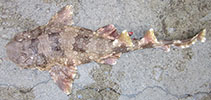 Orectolobus leptolineatus
Photo von Krajangdara, T.
Bilder | Google Bild
Photo von Krajangdara, T.
Klassifizierung / Names Namen | Synonyme | Catalog of Fishes(Gattung, Arten) | ITIS | CoL | WoRMS | Cloffa
Elasmobranchii (Haie und Rochen) (sharks and rays) > Orectolobiformes (Carpet sharks) > Orectolobidae (Carpet or nurse sharks)
Etymology: Orectolobus: orektos (Gr.), stretched out; lobus (L.), from lobos (Gr.), rounded projection or protuberance, referring to long nasal barbels of Squalus barbatus (=O. maculatus) (See ETYFish); leptolineatus: leptos (Gr.) fine or thin; lineatus (L.), lined, referring to thin, vermicular markings on dorsal surface (See ETYFish).
More on authors: Last, Pogonoski & White.
Etymology: Orectolobus: orektos (Gr.), stretched out; lobus (L.), from lobos (Gr.), rounded projection or protuberance, referring to long nasal barbels of Squalus barbatus (=O. maculatus) (See ETYFish); leptolineatus: leptos (Gr.) fine or thin; lineatus (L.), lined, referring to thin, vermicular markings on dorsal surface (See ETYFish).
More on authors: Last, Pogonoski & White.
Umwelt: Milieu / Klimazone / Tiefenbereich / Verbreitungsgebiet Ökologie
seewasser benthopelagisch; tiefenbereich 20 - 110 m (Ref. 126634). Tropical
Verbreitung Territorien | FAO Gebiete | Ökosysteme | Vorkommen | Punkt Karte | Einführungen | Faunafri
Western Pacific: Indonesia (Ref. 84278); also from off Sarawak Malaysian (Borneo), and with unconfirmed records from Taiwan (Penghu Islands), and the Philippines (Visayas and Cebu City), Ryukyu Islands (Ref. 90102).
Größe / Gewicht / Alter
Geschlechtsreife: Lm ? range ? - ? cm
Max length : 112 cm TL Männchen/unbestimmt; (Ref. 84278); 120.0 cm TL (female)
Max length : 112 cm TL Männchen/unbestimmt; (Ref. 84278); 120.0 cm TL (female)
Kurzbeschreibung Bestimmungsschlüssel | Morphologie | Morphometrie
This medium-sized (to at least 120 cm TL) Orectolobus species is distinguished by the following set of characters: coloration complex and variable, strongly vermiculate over dorsal and lateral surfaces with alternating dark brownish bars and saddles; dorsal and upper surface of paired fins with prominent vermicular patterns; ventral surface of trunk mainly uniformly pale; nasal barbel with a branch; preorbital dermal lobes complex, with 2-3 simple lobes in PO1 group and 3-4 simple to terminally branched lobes in PO2; simple postspiracular dermal lobes, well- developed, thallate, distance across preorbital group 1.3-1.6 times interspace between preorbital group and postspiracular lobe (PO/PO-PS1), 6.5-8.0 times base length of anterior postspiracular lobe (PO/PS1); base of anterior postspiracular lobe 4.3-5.3 in its distance from postorbital group (PO-PS1/PS1), 2.5-2.9 in its distance from posterior postspiracular lobe (PS1-PS2/PS1); enlarged supraocular knob or warty tubercles on back absent; dorsal fins tall, upright; first dorsal-fin origin near insertion of pelvic fin; tip of pelvic fin below insertion of first dorsal fin; interdorsal space 0.5-0.8 times anal-fin base length; anal-fin inner margin 0.7-0.8 of anal-fin posterior margin; 23 tooth rows in upper jaw, rudimentary row of teeth at symphysis of upper jaw usually present; monospondylous centra 44-51; total vertebral centra about 148-163 (Ref. 84278).
Body shape (shape guide): elongated.
Body shape (shape guide): elongated.
The depth range of this species is not well defined; specimens observed at fish markets
were presumably caught by longline fishers operating in deeper parts of the continental shelf. It probably prefers deeper colder water with a single shallow water observation from the east
coast of Bali where cold-water upwelling is common. All males (n = 43) mature by ca 90 cm TL; smallest mature female recorded at 94 cm TL, two pregnant females recorded at 104 and 108 cm TL, smaller of the two pregnant females contained 4 mid-term embryos between 13 and 14 cm TL (Ref. 84278).
Lebenszyklus und Paarungsverhalten Geschlechtsreife | Fortpflanzung | Ablaichen | Eier | Fruchtbarkeit | Larven
Hauptreferenz
Laden Sie Ihre Referenzen hoch | Referenzen | Koordinator | Partner
Last, P.R., J.J. Pogonoski and W.T. White, 2010. A new wobbegong shark, Orectolobus leptolineatus sp. nov. (Orectolobiformes: Orectolobidae), from the Western Central Pacific. pp. 1-16. In Last, P.R., White, W.T. & Pogonoski, J.J. (eds.): Descriptions of new sharks and rays from Borneo. CSIRO Marine and Atmospheric Research Paper no. 32. (Ref. 84278)
IUCN Rote Liste Status (Ref. 130435: Version 2025-2 (Global))
Gefährdung zunehmend (NT) (A2d); Date assessed: 19 May 2020
CITES
Not Evaluated
Bedrohung für Menschen
Harmless
Nutzung durch Menschen
FAO - Publication: search | FishSource |
Mehr Information
Trophische Ökologie
Lebensmittel (Beutetiere)
Nahrungszusammensetzung
Nahrungsaufnahme
Lebensmittelrationen
Räuber
Lebensmittel (Beutetiere)
Nahrungszusammensetzung
Nahrungsaufnahme
Lebensmittelrationen
Räuber
Ökologie
Ökologie
Ökologie
Populationsdynamik
Wachstumsparameter
Max. Alter/Größen
Länge-Gewicht-Rel.
Länge-Länge-Verhältnis.
Längenhäufigkeiten
Massenkonvertierung
Rekrutierung
Dichte
Wachstumsparameter
Max. Alter/Größen
Länge-Gewicht-Rel.
Länge-Länge-Verhältnis.
Längenhäufigkeiten
Massenkonvertierung
Rekrutierung
Dichte
Lebenszyklus
Fortpflanzung
Geschlechtsreife
Reifung/Kiemen rel.
Fruchtbarkeit
Ablaichen
Laichaggregationen
Eier
Eientwicklung
Larven
Larven Pop.Dyn.
Fortpflanzung
Geschlechtsreife
Reifung/Kiemen rel.
Fruchtbarkeit
Ablaichen
Laichaggregationen
Eier
Eientwicklung
Larven
Larven Pop.Dyn.
Anatomie
Kiemenoberfläche
Gehirn
Otolith
Kiemenoberfläche
Gehirn
Otolith
Physiologie
Körperliche Zusammensetzung
Nährstoffe
Sauerstoffverbrauch
Schwimmart
Schwimmgeschwindigkeit
Visuelle Pigmente
Fischgeräusche
Krankheiten und Parasiten
Toxizität (LC50s)
Körperliche Zusammensetzung
Nährstoffe
Sauerstoffverbrauch
Schwimmart
Schwimmgeschwindigkeit
Visuelle Pigmente
Fischgeräusche
Krankheiten und Parasiten
Toxizität (LC50s)
Genetik
Genom
Genetik
Heterozygotie
Vererbbarkeit
Genetische Vielfalt
Genom
Genetik
Heterozygotie
Vererbbarkeit
Genetische Vielfalt
Menschenbezogen
Aquakultur-Systeme
Aquakultur Profile
Zuchtlinien
Ciguatera-Fälle
Briefmarken, Münzen, Verschiedenes.
Aquakultur-Systeme
Aquakultur Profile
Zuchtlinien
Ciguatera-Fälle
Briefmarken, Münzen, Verschiedenes.
Tools
Zusatzinformationen
Download XML
Zusammenfassung | Punktdaten | Namen | Photos
Internet Quellen
AFORO (otoliths) | Aquatic Commons | BHL | Cloffa | Websites from users | FishWatcher Einträge suchen | CISTI | Catalog of Fishes: Gattung, Arten | DiscoverLife | ECOTOX | FAO - Publication: search | Faunafri | Fishipedia | Fishtrace | GloBI | Google Books | Google Scholar | Google | IGFA World Record | Nationale Datenbanken | OneZoom | Open Tree of Life | Otolith Atlas of Taiwan Fishes | PubMed | Reef Life Survey | Socotra Atlas | TreeBase | Tree of Life | Wikipedia: Gehe zu, Suchen | | Zoobank | Zoologischer Rekord
Schätzungen auf der Grundlage von Modellen
|
Phylogenetischer Diversitätsindex (Ref. 82804) |
PD50 = 0.5012 [Uniqueness, from 0.5 = low to 2.0 = high]. |
| Bayesian length-weight | a=0.00389 (0.00180 - 0.00842), b=3.12 (2.94 - 3.30), in cm total length, based on all LWR estimates for this body shape (Ref. 93245). |
|
Trophische Ebene (Ref. 69278) |
3.9 ±0.6 se; based on size and trophs of closest relatives |
|
Anfälligkeit der Fischerei (Ref. 59153) |
High vulnerability (61 of 100). 🛈 |