



Porotergus duende de Santana & Crampton, 2010
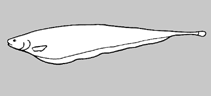
分類 / 名稱 俗名 | 同種異名 | Catalog of Fishes(屬, 種) | ITIS | CoL | WoRMS | Cloffa
Teleostei > Gymnotiformes (Knifefishes) 電鰻目 (Knifefishes) > Apteronotidae (Ghost knifefishes) 無背魚科 (Ghost knifefishes) > Apteronotinae
Etymology: Porotergus: Greek, poros = porous + Latin, tergum = back, the upper plate or segment in an animal (Ref. 45335); duende: The specific epithet, duende, is the Portuguese for elf or imp, referring to the diminutive size of P. duende. A noun in apposition. Gender masculine.
Etymology: Porotergus: Greek, poros = porous + Latin, tergum = back, the upper plate or segment in an animal (Ref. 45335); duende: The specific epithet, duende, is the Portuguese for elf or imp, referring to the diminutive size of P. duende. A noun in apposition. Gender masculine.
環境: 環境 / 氣候帶 / 深度上下限 / 配送範圍 生態學
; 淡水 居於水底的; pH range: 6.9 - 7.3. 27°C - 32°C (Ref. 83661)
分布 領土 | FAO區域 | 生態系 | 發現紀錄 | 分布圖 | 簡介 | Faunafri
Known from the main channel of the Amazon River in the western portions of the Amazon basin (Rio Negro and Rio Solimões in Brazil, Rio Ucayali in Peru.
大小 / 重量 / 年齡
簡短描述 檢索表 | 型態特徵 | 形態測量圖
臀鰭軟條: 124 - 142. This species is distinguished from its congeners by the following characted: presence of a light brown body pigmentation (vs. pale straw pigmentation in P. gimbeli, and dark brown in P. gymnotus); one row of conical teeth on the dentary (vs. two); edentulous premaxilla (vs. presence of teeth); ossified second basibranchial (vs. unossified in P. gimbeli, condition unknown in P. gymnotus). It further differs from P. gimbeli by the absence of a distinct swelling on the chin (vs. presence of this structure), the total anal-fin rays (124-142 vs. 171–198), and the prepectoral-fin distance (14.1-17.0% of LEA vs. 10.3-13.5); from P. gymnotus by the distance from the posterior naris to the eye (1.7-3.8% of HL vs. 8.2-11.9), mouth length (12.4-27.4% of HL vs. 28.1-38.7), pectoral-fin length (72.7-89.0% of HL vs. 60.4-70.7) (Ref. 83661).
Body shape (shape guide): elongated; Cross section: compressed.
Body shape (shape guide): elongated; Cross section: compressed.
This species is known mainly from the main channels of large whitewater rivers such as the Rio Solimões(Amazon) and Río Ucayali. In the Tefé region, it was encountered only during the rising water period in January and February, and captured in waters of 2–4 m depth on beaches of alluvial silt and fine sand. Based on examined stomachs of four specimens, this species feeds exclusively on small, autochthonous, benthic insect larvae (of micro-caddis fly, biting midge and beetle). Most specimens had loose sand grains in the stomach (larger than the grains of sand in the caddis fly jackets), suggesting foraging on sandy substrates; one stomach contained many endoparasitic nematodes. All four specimens captured in the Tefé region had maturing, but not fully mature, gonads, suggesting that spawning occur during the rising water period, typical of riverine apteronotids (Ref. 83661).
生命週期和交配行為 成熟度 | 繁殖 | 產卵場 | 卵 | 孕卵數 | 仔魚
主要參考資料
上傳您的推薦信 | 參考文獻 | 合作者 : Albert, James S. | 合作者
de Santana, C. D. and G. R. Crampton, 2010. A review of the South American electric fish genus Porotergus (Gymnotiformes: Apteronotidae) with the description of a new species. Copeia 2010(1):165-175. (Ref. 83661)
CITES
Not Evaluated
對人類具威脅
人類使用
FAO - Publication: search | FishSource |
更多資訊
解剖學
鰓區
腦部
耳石
鰓區
腦部
耳石
生理學
身體成分
營養素
耗氧量
游泳類型
游泳速度
視覺色素
魚聲
疾病與寄生蟲
毒性 (LC50s)
身體成分
營養素
耗氧量
游泳類型
游泳速度
視覺色素
魚聲
疾病與寄生蟲
毒性 (LC50s)
遺傳學
基因組
遺傳學
異種性
遺傳率
遺傳多樣性
基因組
遺傳學
異種性
遺傳率
遺傳多樣性
工具
特別的報告
下載 XML
網路資源
AFORO (otoliths) | Aquatic Commons | BHL | Cloffa | Websites from users | 檢查 FishWatcher | CISTI | Catalog of Fishes: 屬, 種 | DiscoverLife | ECOTOX | FAO - Publication: search | Faunafri | Fishipedia | Fishtrace | GloBI | Google Books | Google Scholar | Google | IGFA World Record | OneZoom | Open Tree of Life | Otolith Atlas of Taiwan Fishes | PubMed | Reef Life Survey | Socotra Atlas | TreeBase | 樹狀分類階層 | Wikipedia: 去, 搜尋 | World Records Freshwater Fishing | Zoobank | 動物學的記錄
基於模型的估計
系統發育多樣性指數 (參考文獻 82804): PD50 = 0.5625 [Uniqueness, from 0.5 = low to 2.0 = high].
Bayesian length-weight: a=0.00355 (0.00146 - 0.00863), b=3.06 (2.85 - 3.27), in cm total length, based on LWR estimates for this (Sub)family-body shape (Ref. 93245).
營養階層 (參考文獻 69278): 3.3 ±0.3 se; based on size and trophs of closest relatives