



Adicionar o seu Fotografias e vídeos
Fotografias | Selos, moedas, diversos. | Imagem do Google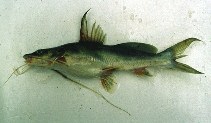 Bagrus docmak
Fotografia de de Vos, L.
Fotografias | Selos, moedas, diversos. | Imagem do Google
Fotografia de de Vos, L.
Classificação / Nomes Nomes comuns | Sinónimos | Catalog of Fishes(Género, Espécies) | ITIS | CoL | WoRMS | Cloffa
> Siluriformes (Catfishes) > Bagridae (Bagrid catfishes)
Etymology: Bagrus: Mozarabic, bagre, taken from Greek, pagros = a fish (Dentex sp.) (Ref. 45335).
Etymology: Bagrus: Mozarabic, bagre, taken from Greek, pagros = a fish (Dentex sp.) (Ref. 45335).
Ambiente: milieu / zona climática / intervalo de profundidade / gama de distribuição Ecologia
; Água doce bentopelágico; pH range: 6.5 - 8.2; dH range: ? - 30; intervalo de profundidade 0 - 80 m (Ref. 34291), usually 0 - 70 m (Ref. 34291). Tropical; 21°C - 25°C (Ref. 2060)
Distribuição Territórios | Áreas FAO | Ecossistemas | Ocorrências | Mapa dos pontos | Introduções | Faunafri
Africa: widely distributed throughout Tchad, Niger, Volta, Senegal (Ref. 57125), Mono, Oueme, Cross and Sanaga Rivers, as well as the Rift Valley Lakes Edward, George, Albert, Victoria and Tanganyika (Ref. 81641), but not Lake Kivu (Ref. 46152). Widely distributed in Nile system (Ref. 28714, 31439, 58460). In the Lukuga River (Lake Tanganyika outflow), known up to the Kisimba-Kilia rapids (Ref. 93587).
Comprimento na primeira maturidade / Tamanho / Peso / Idade
Maturidade: Lm 22.7, range 20 - 25.9 cm
Max length : 127 cm TL macho/indeterminado; (Ref. 42492); common length : 62.0 cm TL macho/indeterminado; (Ref. 11248); peso máx. Publicado: 35.0 kg (Ref. 4537); Idade máx. registada: 5 anos (Ref. 11248)
Max length : 127 cm TL macho/indeterminado; (Ref. 42492); common length : 62.0 cm TL macho/indeterminado; (Ref. 11248); peso máx. Publicado: 35.0 kg (Ref. 4537); Idade máx. registada: 5 anos (Ref. 11248)
Descrição breve Chaves de identificação | Morfologia | Morfometria
Espinhos dorsais (total) : 1; Raios dorsais moles (total) : 8 - 11; Espinhos anais: 0; Raios anais moles: 11 - 14; Vértebras: 46 - 49. Diagnosis: head depressed (Ref. 43434), broad, about 1.3-1.6 times as long as wide (Ref. 28714, 30488, 57125), squarish when viewed from above (Ref. 28714), without rough texture (Ref. 3034). Head width measured at base of preopercle 58.9-71.8% head length; 12-16 gill rakers on first gill arch (Ref. 81641). Body slightly elongated, 5-6 times longer than deep (Ref. 7324, 57125, 81641). Four pairs of barbels (Ref. 34290). Premaxillary tooth plate 5-7 times longer than wide, a little shorter than and about as broad as the band of vomerine teeth (Ref. 2988). Premaxillary toothplate width less than 2.5 times in head length (Ref. 57125). Occipital process 3-5 times longer than wide (Ref. 57125, 81641). Predorsal length 2.4-2.7 times in standard length; 9-10 branched dorsal fin rays, not or only slightly filamentous (Ref. 57125, 81641). Long adipose dorsal fin present (Ref. 34290). Standard length/caudal peduncle length 2.4-2.7 (Ref. 57125). Upper lobe of caudal fin often with a short filament (Ref. 7324, 57125, 81641).
Body shape (shape guide): fusiform / normal; Cross section: circular.
Body shape (shape guide): fusiform / normal; Cross section: circular.
Inhabit lakes, swamps and rivers (Ref. 31256). Widespread in both shallow and deep water (Ref. 34291). Probably associated with rocky bottoms/coarse substrates (Ref. 27490). Mostly active during the night and the twilight hours (Ref. 2060). Juveniles may frequent exposed rocky shores (Ref. 12526). Feed on insects, crustaceans, molluscs and fish; some debris and vegetable matter may also be ingested (Ref. 28714). Moderately important as a food species in Lake Victoria, but becoming rare with the appearance of Nile perch (Ref. 4967). Catches decreased strongly in Lake Victoria after the Lates upsurge (Ref. 34291). Predation by Lates and competition with Lates (for haplochromines) may have played a role in the decline (Ref. 34291). A notably recovery in waters between 3m and 6m depth in Lake Victoria has been reported (Ref. 51900). Second most important food species in Lake Edward, Congo (Ref. 13302).
Ciclo de vida e comportamento de acasalamento Maturidade | Reprodução | Desova | Ovos | Fecundidade | Larvas
Distinct pairing (Ref. 205).
Referência principal
Carregar as suas referências | Referências | Coordenador | Colaboradores
Risch, L.M., 1992. Bagridae. p. 395-431. In C. Lévêque, D. Paugy and G.G. Teugels (eds.) Faune des poissons d'eaux douces et saumâtres d'Afrique de l'Ouest. Tome 2. Coll. Faune Tropicale N° XXVIII. Musée Royal de l'Afrique Centrale, Tervuren, Belgique and O.R.S.T.O.M., Paris, France. (Ref. 7324)
Categoria na Lista Vermelha da IUCN (Ref. 130435: Version 2025-2 (Global))
Preocupação menor (LC) ; Date assessed: 20 April 2019
CITES
Not Evaluated
Ameaça para o homem
Harmless
Utilização humana
Pescarias: espécies comerciais; peixe desportivo: sim
FAO - Publication: search | FishSource |
Mais informação
Ecologia Trófica
Produtos alimentares (presas)
Composição da dieta
Consumo alimentar
Rações alimentares
Predadores
Produtos alimentares (presas)
Composição da dieta
Consumo alimentar
Rações alimentares
Predadores
Dinâmica das populações
Parâmetros de crescimento
Idades / tamanhos máximos
Comprimento-peso rel.
Comprimento-comprimento rel.
Frequência de comprimento
Conversão de massa
Recrutamento
Abundância
Parâmetros de crescimento
Idades / tamanhos máximos
Comprimento-peso rel.
Comprimento-comprimento rel.
Frequência de comprimento
Conversão de massa
Recrutamento
Abundância
Ciclo de vida
Reprodução
Maturidade
Maturidade/Rel. das guelras
Fecundidade
Desova
Agregações de desova
Ovos
Desenvolvimento dos ovos
Larvas
Dinâmica larvar
Reprodução
Maturidade
Maturidade/Rel. das guelras
Fecundidade
Desova
Agregações de desova
Ovos
Desenvolvimento dos ovos
Larvas
Dinâmica larvar
Anatomia
Área branquial
Cérebro
Otólitos
Área branquial
Cérebro
Otólitos
Fisiologia
Composição corporal
Nutrientes
Consumo de oxigénio
Tipo de natação
Velocidade de natação
Pigmentos visuais
Som de peixe
Doenças e Parasitas
Toxicidade (LC50s)
Composição corporal
Nutrientes
Consumo de oxigénio
Tipo de natação
Velocidade de natação
Pigmentos visuais
Som de peixe
Doenças e Parasitas
Toxicidade (LC50s)
Relacionado com o ser humano
Sistemas de aquacultura
Perfis para aquacultura
Estirpes
Casos de Ciguatera
Selos, moedas, diversos.
Sistemas de aquacultura
Perfis para aquacultura
Estirpes
Casos de Ciguatera
Selos, moedas, diversos.
Ferramentas
Questionário orgânico | E-book | Guia de campo | Chaves de identificação | Ferramenta auxiliar de frequências de comprimento | Ferramenta sobre a história de vida | Mapa dos pontos |
Captura-MSY |
Relatórios especiais
Descarregue XML
Fontes da internet
AFORO (otoliths) | Aquatic Commons | BHL | Cloffa | Websites from users | Consultar FishWatcher | CISTI | Catalog of Fishes: Género, Espécies | DiscoverLife | ECOTOX | FAO - Publication: search | Faunafri | Fishipedia | Fishtrace | GloBI | Google Books | Google Scholar | Google | IGFA World Record | OneZoom | Open Tree of Life | Otolith Atlas of Taiwan Fishes | Aquários públicos | PubMed | Reef Life Survey | Socotra Atlas | TreeBase | Árvore da vida | Wikipedia: ir para, procurar | World Records Freshwater Fishing | Registo zoológico
Estimativas baseadas em modelos
Índice de diversidade filogenética (Ref. 82804): PD50 = 0.5005 [Uniqueness, from 0.5 = low to 2.0 = high].
Bayesian length-weight: a=0.01023 (0.00792 - 0.01323), b=2.95 (2.88 - 3.02), in cm total length, based on LWR estimates for this species (Ref. 93245).
Nível Trófico (Ref. 69278): 4.1 ±0.95 se; based on food items.
Resiliência (Ref. 120179): Médio, tempo mínimo de duplicação da população 1,4 - 4,4 anos (tm-2-3; tmax=5; K=0.06-0.35; Fec=2,000-774,000).
Nutrientes (Ref. 124155): Calcium = 31.3 [14.9, 70.7] mg/100g; Iron = 0.908 [0.503, 1.791] mg/100g; Protein = 16.8 [15.5, 18.2] %; Omega3 = 0.389 [0.125, 1.148] g/100g; Selenium = 116 [42, 289] μg/100g; VitaminA = 45.1 [12.5, 160.7] μg/100g; Zinc = 1.18 [0.76, 1.82] mg/100g (wet weight);