



Adicionar sua observação em Fish Watcher
| Native range | All suitable habitat | Point map | Year 2050 |

|
| This map was computer-generated and has not yet been reviewed. |
| Mobula alfredi AquaMaps Data sources: GBIF OBIS |
Carregue seu(sua) Fotos e vídeos
Fotos | vídeos | Selos, moedas, diversos. | Imagem do Google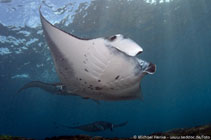 Mobula alfredi
Foto de Henke, M.
Fotos | vídeos | Selos, moedas, diversos. | Imagem do Google
Foto de Henke, M.
Classificação / Nomes Nomes comuns | Sinônimos | Catalog of Fishes(Gênero, Espécies) | ITIS | CoL | WoRMS | Cloffa
Elasmobranchii (tubarões e raias) (sharks and rays) > Myliobatiformes (Stingrays) > Mobulidae (Devilrays)
Eponymy: Prince Alfred, Duke of Edinburgh (1844–1900) was a son of Queen Victoria who ruled as Duke of Saxe-Coburg and Gotha (1893) in the Prussian Empire. [...] (Ref. 128868), visit book page.
Eponymy: Prince Alfred, Duke of Edinburgh (1844–1900) was a son of Queen Victoria who ruled as Duke of Saxe-Coburg and Gotha (1893) in the Prussian Empire. [...] (Ref. 128868), visit book page.
Meio ambiente: milieu / Zona climática / intervalo de profundidade / faixa de distribuição Ecologia
marinhas; Água doce bentopelágico; intervalo de profundidade 0 - 120 m (Ref. 86942). Tropical; 32°N - 34°S, 30°E - 134°W
Distribuição Territórios | Áreas da FAO | Ecossistemas | Ocorrências | Mapa de pontos | Introduções | Faunafri
Indo-Pacific: Red Sea, South Africa, Thailand to Western Australia.; north to Japan (Yaeyama Is.), to Solitary Is., Australia as far east as French Polynesia and the Hawaiian Is. Reported in the Atlantic (Canary and Cape Verde islands) but this species may be restricted more or less to the Indian and Western Pacific only (McEachran, pers.comm. 03/10).
Comprimento de primeira maturação / Tamanho / Peso / Idade
Maturidade: Lm 371.1, range 324 - 390 cm
Max length : 450 cm WD macho/indeterminado; (Ref. ); idade máx. registrada: 31 anos (Ref. 97313)
Max length : 450 cm WD macho/indeterminado; (Ref. ); idade máx. registrada: 31 anos (Ref. 97313)
Descrição suscinta Chaves de identificação | Morfologia | Morfometria
This species is characterized by the following: disc approximately 2.2-2.4 times as broad as it is long, the maximum disc width size approximately 550 cm; slender whip-like tail approximately 123% of disc length if intact; no distinct caudal spine or cartilaginous mass at base of tail; some specimens have small hump at the base of the tail on the dorsal surface, while others have a slight depression and groove on the dorsum of the tail immediately posterior to the posterior margin of the dorsal fin; small, knob-like dermal denticles evenly distributed on both the dorsal and ventral surfaces, with ventral surface having slightly larger denticles; dental ligament with small cusped teeth on the lower jaw measuring roughly 22% of total disc length, approximately 6-8 rows, 142-182 files across entire width of the tooth band; total tooth counts of 900-1500 for entire tooth band; top jaw lacks rows of enlarged denticles (Ref. 82755).
Body shape (shape guide): other.
Body shape (shape guide): other.
Adults are commonly sighted inshore, within a few kilometers of land; found around coral and rocky reefs as well as along productive coastlines with consistent upwelling, tropical island groups, atolls and bays (Ref. 82755). Maximum movement recorded is >500,000 m (Ref. 97317). Known aggregations include sites in Hawai'i, Mozambique, Maldives, Ryukyu Island, Yap Island, Indonesia, eastern and western Australia (Ref. 82755). Gestation period is 12-13 months. Major food consists of planktonic organisms and probably small bony fishes (Ref. 114953). Maximum correted to 450 cm WD by Giuseppe Notarbartolo di Sciara (pers. Comm. 01/2025).
Ciclo de vida ou comportamento de acasalamento Maturidade | Reprodução | Desova | Ovos | Fecundidade | Larvas
Young may tend to follow large objects such as their mother (Ref. 205).
Referência principal
Carregar suas referências | Referências | Coordenador | Colaboradores
Last, P.R., W.T. White, M.R. de Carvalho, B. Séret, M.F.W. Stehmann and G.J.P. Naylor, 2016. Rays of the world. CSIRO Publishing, Comstock Publishing Associates. i-ix + 1-790. (Ref. 114953)
Status na Lista Vermelha da UICN (Ref. 130435: Version 2025-2 (Global))
Vulnerável (VU) (A2bcd+3d); Date assessed: 09 November 2018
Ameaça para os humanos
Harmless
Uso pelos humanos
FAO - Publication: search | FishSource |
Mais informação
Ecologia Trófica
Itens alimentares (presas)
Composição da dieta
Consumo alimentar
Rações alimentares
Predadores
Itens alimentares (presas)
Composição da dieta
Consumo alimentar
Rações alimentares
Predadores
Dinâmica populacional
Parâmetros de crescimento
Idade máxima / tamanhos
Relação comprimento-peso.
Relação comprimento-comprimento.
Frequências de comprimento
Conversão de massa
Recrutamento
Abundância
Parâmetros de crescimento
Idade máxima / tamanhos
Relação comprimento-peso.
Relação comprimento-comprimento.
Frequências de comprimento
Conversão de massa
Recrutamento
Abundância
Ciclo de vida
Reprodução
Maturidade
Maturidade/Rel. das guelras
Fecundidade
Desova
Agregações de desova
Ovos
Desenvolvimento dos ovos
Larvas
Dinâmica larval
Reprodução
Maturidade
Maturidade/Rel. das guelras
Fecundidade
Desova
Agregações de desova
Ovos
Desenvolvimento dos ovos
Larvas
Dinâmica larval
Anatomia
Área branquial
Cérebro
Otólito
Área branquial
Cérebro
Otólito
Fisiologia
Composição corporal
Nutrientes
Consumo de oxigênio
Tipo de natação
Velocidade de natação
Pigmentos visuais
Som de peixe
Doenças e Parasitas
Toxicidade (LC50s)
Composição corporal
Nutrientes
Consumo de oxigênio
Tipo de natação
Velocidade de natação
Pigmentos visuais
Som de peixe
Doenças e Parasitas
Toxicidade (LC50s)
Relacionado a humanos
Sistemas de aquicultura
Perfis para aquacultura
Estirpes
Casos de Ciguatera
Selos, moedas, diversos.
Sistemas de aquicultura
Perfis para aquacultura
Estirpes
Casos de Ciguatera
Selos, moedas, diversos.
Ferramentas
Livro eletrônico | Guia de campo | Ferramenta auxiliar de frequências de comprimento | Ferramenta sobre a história de vida | Mapa de pontos |
Catch-MSY |
Relatórios especiais
Checar Manutenção em Aquário | Checar Planilhas de Fatos sobre as Espécies | Checar Planilhas de Fatos sobre Aquicultura
Baixar XML
Fontes da internet
AFORO (otoliths) | Aquatic Commons | BHL | Cloffa | Websites from users | Checar Observador de Peixes (FishWatcher) | CISTI | Catalog of Fishes: Gênero, Espécies | DiscoverLife | DORIS | ECOTOX | FAO - Publication: search | Faunafri | Fishipedia | Fishtrace | GloBI | Google Books | Google Scholar | Google | IGFA World Record | Bases de dados nacionais | OneZoom | Open Tree of Life | Otolith Atlas of Taiwan Fishes | PubMed | Reef Life Survey | Socotra Atlas | TreeBase | Árvore da vida | Wikipedia: Ir para, procura | World Records Freshwater Fishing | Registro zoológico
Estimativas baseadas em modelos
Temperatura preferida (Ref. 123201): 24.3 - 29, mean 27.8 °C (based on 1274 cells).
Índice de diversidade filogenética (Ref. 82804): PD50 = 0.5020 [Uniqueness, from 0.5 = low to 2.0 = high].
Bayesian length-weight: a=0.01000 (0.00244 - 0.04107), b=3.04 (2.81 - 3.27), in cm total length, based on all LWR estimates for this body shape (Ref. 93245).
Nível Trófico (Ref. 69278): 3.5 ±0.5 se; based on size and trophs of closest relatives
Resiliência (Ref. 120179): Muito baixo(a), tempo mínimo de duplicação da população maior que 14 anos (tmax>31; tm = 3-8; Fec =1).
Nutrientes (Ref. 124155): Calcium = 5.54 [0.80, 100.50] mg/100g; Iron = 0.474 [0.044, 5.786] mg/100g; Protein = 19.2 [13.9, 24.5] %; Omega3 = 0.0832 [, ] g/100g; Selenium = 90.7 [16.3, 541.7] μg/100g; VitaminA = 6.64 [0.42, 83.54] μg/100g; Zinc = 0.545 [0.030, 6.451] mg/100g (wet weight);