



Psalidodon xavante (Garutti & Venere, 2009)
Envoyez vos Photos et vidéos
Images | Images Google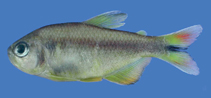 Psalidodon xavante
Photo de Garutti, G.F.
Images | Images Google
Photo de Garutti, G.F.
Classification / Noms Noms communs | Synonymes | Catalog of Fishes(Genre, Espèce) | ITIS | CoL | WoRMS | Cloffa
> Characiformes (Characins) > Acestrorhamphidae (American tetras) > Acestrorhamphinae
Etymology: Psalidodon: Greek, psalis, -idos = scissors + Greek, odous = teeth (Ref. 45335); xavante: Named after Xavante ethnic group, natives inhabiting the Serra do Roncador and middle rio Araguaia, Mato Grosso, Brazil. A noun in apposition.
Eponymy: The Xavante are an indigenous ethnic group who live in the region between Rio das Mortes and Rio Culuene, Mato Grosso, Brazil. They are the largest Amerindian tribe in the area where the rivuline species was discovered. (Ref. 128868), visit book page.
Etymology: Psalidodon: Greek, psalis, -idos = scissors + Greek, odous = teeth (Ref. 45335); xavante: Named after Xavante ethnic group, natives inhabiting the Serra do Roncador and middle rio Araguaia, Mato Grosso, Brazil. A noun in apposition.
Eponymy: The Xavante are an indigenous ethnic group who live in the region between Rio das Mortes and Rio Culuene, Mato Grosso, Brazil. They are the largest Amerindian tribe in the area where the rivuline species was discovered. (Ref. 128868), visit book page.
Environnement : milieu / zone climatique / profondeur / gamme de distribution Écologie
; eau douce benthopélagique. Tropical
Distribution Territoires | Zones FAO | Écosystèmes | Occurrences | Carte par point | Introductions | Faunafri
South America: middle rio Araguaia in Mato Grosso, Brazil.
Longueur à la première maturité / Taille / Poids / Âge
Occurs in crystalline water streams with flow from 0.05 to 0.70 m3/s. Prefers to occupy the water surface and the spaces among plants roots and tree branches. Usually aggregates with up to 2 dozens individuals, but schools with about 150 individuals have also been observed. An omnivorous fish which feeds on insects, plants, crustaceans, filamentous algae and fish (Ref. 82392).
Cycle de vie et comportement reproducteur Maturité | Reproduction | Frai | Œufs | Fécondité | Larves
Référence principale
Téléchargez vos références | Références | Coordinateur | Collaborateurs
Terán, G.E., M.F. Benitez and J.M. Mirande, 2020. Opening the Trojan house: phylogeny of Astyanax, two genera and resurrection of Psalidodon (Teleostei: Characidae). Zool. J. Lin. Soc. 190(4):1217-1234. (Ref. 123753)
CITES
Not Evaluated
Menace pour l'homme
Harmless
Utilisations par l'homme
FAO - Publication: search | FishSource |
Plus d'informations
Écologie trophique
Aliments (proies)
Composition du régime alimentaire
Consommation alimentaire
Rations alimentaires
Prédateurs
Aliments (proies)
Composition du régime alimentaire
Consommation alimentaire
Rations alimentaires
Prédateurs
Écologie
Écologie
Écologie
Dynamique des populations
Paramètres de croissance
Âges / tailles maximales
Longueur-poids rel.
Rel. longueur-longueur.
Fréquences de longueurs
Conversion de masse
Recrutement
Abondance
Paramètres de croissance
Âges / tailles maximales
Longueur-poids rel.
Rel. longueur-longueur.
Fréquences de longueurs
Conversion de masse
Recrutement
Abondance
Anatomie
Surface branchiale
Cerveau
Otolithe
Surface branchiale
Cerveau
Otolithe
Physiologie
Composition corporelle
Nutriments
Consommation d'oxygène
Type de natation
Vitesse de nage
Pigments visuels
Son de poisson
Maladies et parasites
Toxicité (CL50)
Composition corporelle
Nutriments
Consommation d'oxygène
Type de natation
Vitesse de nage
Pigments visuels
Son de poisson
Maladies et parasites
Toxicité (CL50)
Génétique
génôme
Génétique
Hétérozygotie
Héritabilité
Diversité génétique
génôme
Génétique
Hétérozygotie
Héritabilité
Diversité génétique
Liées à l'homme
Systèmes d'aquaculture
Profils d'aquaculture
Souches
Cas de ciguatera
Timbres, pièces de monnaie, divers
Systèmes d'aquaculture
Profils d'aquaculture
Souches
Cas de ciguatera
Timbres, pièces de monnaie, divers
Outils
E-book | Guide de terrain | Générateur de fréquences de longueur | Outil de dynamique de population | Carte par point |
Capture-MSY |
Articles particuliers
Télécharger en XML
Sources Internet
AFORO (otoliths) | Aquatic Commons | BHL | Cloffa | Websites from users | FishWatcher | CISTI | Catalog of Fishes: Genre, Espèce | DiscoverLife | ECOTOX | FAO - Publication: search | Faunafri | Fishipedia | Fishtrace | GloBI | Google Books | Google Scholar | Google | IGFA World Record | OneZoom | Open Tree of Life | Otolith Atlas of Taiwan Fishes | PubMed | Reef Life Survey | Socotra Atlas | TreeBase | Arbre de Vie | Wikipedia: aller à, chercher | World Records Freshwater Fishing | Zoological Record
Estimations basées sur des modèles
Indice de diversité phylogénétique (Réf. 82804): PD50 = 0.5000 [Uniqueness, from 0.5 = low to 2.0 = high].
Bayesian length-weight: a=0.01349 (0.00601 - 0.03026), b=3.09 (2.91 - 3.27), in cm total length, based on LWR estimates for this Genus-body shape (Ref. 93245).
Niveau trophique (Réf. 69278): 3.0 ±0.3 se; based on size and trophs of closest relatives
Résilience (Réf. 120179): Haut, temps minimum de doublement de population inférieur à 15 mois (Lm=2.5-2.6).