



Cetopsidium soniae Vari & Ferraris, 2009
Envoyez vos Photos et vidéos
Images Google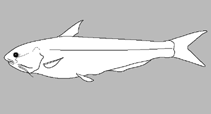 No image available for this species;
drawing shows typical species in Cetopsidae.
Images Google
drawing shows typical species in Cetopsidae.
Classification / Noms Noms communs | Synonymes | Catalog of Fishes(Genre, Espèce) | ITIS | CoL | WoRMS | Cloffa
> Siluriformes (Catfishes) > Cetopsidae (Whale catfishes) > Cetopsinae
Etymology: Cetopsidium: From Cetopsis, the first genus proposed in subfamily Cetopsinae, and 'idium' meaning diminutive, referring to the relatively small body sizes of the members of the genus; soniae: The species name, soniae, is in honor of Dr. Sonia Fisch-Muller of the Muséum d’histoire naturelle, Geneva, who brought the species to our attention, has been of invaluable assistance to both authors with a number of projects over the years, and ha.
Eponymy: Dr Sonia Fisch-Muller is a professor at the Department of Herpetology and Ichthyology, Muséum d’histoire naturelle, Geneva. She co-wrote: Three new species of Ancistrus (2005). She brought Cetopsidium soniae to the authors’ attention. (See also Muller, S) (Ref. 128868), visit book page.
More on authors: Vari & Ferraris.
Etymology: Cetopsidium: From Cetopsis, the first genus proposed in subfamily Cetopsinae, and 'idium' meaning diminutive, referring to the relatively small body sizes of the members of the genus; soniae: The species name, soniae, is in honor of Dr. Sonia Fisch-Muller of the Muséum d’histoire naturelle, Geneva, who brought the species to our attention, has been of invaluable assistance to both authors with a number of projects over the years, and ha.
Eponymy: Dr Sonia Fisch-Muller is a professor at the Department of Herpetology and Ichthyology, Muséum d’histoire naturelle, Geneva. She co-wrote: Three new species of Ancistrus (2005). She brought Cetopsidium soniae to the authors’ attention. (See also Muller, S) (Ref. 128868), visit book page.
More on authors: Vari & Ferraris.
Environnement : milieu / zone climatique / profondeur / gamme de distribution Écologie
; eau douce benthopélagique. Tropical
Distribution Territoires | Zones FAO | Écosystèmes | Occurrences | Carte par point | Introductions | Faunafri
South America: Guyana. Cetopsidium soniae is known from the type locality in the Manari River, a tributary of the Takutu River in the western portions of the rio Branco system of the Amazon basin (Ref. 82380).
Taille / Poids / Âge
Maturité: Lm ? range ? - ? cm
Max length : 3.1 cm SL mâle / non sexé; (Ref. 82380); 3.6 cm SL (female)
Max length : 3.1 cm SL mâle / non sexé; (Ref. 82380); 3.6 cm SL (female)
Description synthétique Clés d'identification | Morphologie | Morphométrie
Cetopsidium soniae differs from its congeners in the posterior extent of the pelvic fin (falling distinctly short of the vent versus extending beyond the vent and reaching to the origin of the anal fin in C. minutum (Eigenmann, 1912), and reaching to or slightly beyond the anterior limit of the vent in C. ferreirai Vari, Ferraris & de Pinna, 2005, C. morenoi (Fernández-Yépez, 1972), C. orientale (Vari, Ferraris & Keith, 2003), and C. pemon Vari, Ferraris & de Pinna, 2005, the position of the vent (proximate to the base of the anterior most anal-fin ray versus distinctly anterior to that location in C. roae Vari, Ferraris & de Pinna, 2005), the form of the first rays of the dorsal and pectoral fins (with distal filaments present in males versus without such sexually-dimorphic filaments in C. ferreirai), the orientation of the dorsal and ventral profiles of the postdorsal portion of the body (converging posteriorly versus running in parallel in C. orientale), the distribution of dark pigmentation on the body (with pigmentation distributed across dorsal and lateral surfaces of body versus limited to middorsal region in C. ferreirai), the degree of dark pigmentation on the ventral surface of the lower jaw (with
limited or no pigmentation versus with broad band of pigmentation in C. orientale), the form of the pigmentation on the head and body (chromatophores large and stellate versus small and round in C. minutum and C. pemon), the extent of the pigmentation on the dorsal fin (without any pigmentation or at most several small dark basal spots versus with distinct semicircular dark spot basally in C. morenoi, C. orientale, and
C. pemon), the body depth (0.17-0.18 versus 0.14-0.15 of SL in C. roae), and the form of the head in lateral view (triangular overall but relatively deep posteriorly versus more acutely triangular in C. minutum [see Vari et al., 2005).
Body shape (shape guide): elongated.
Body shape (shape guide): elongated.
Cycle de vie et comportement reproducteur Maturité | Reproduction | Frai | Œufs | Fécondité | Larves
Référence principale
Téléchargez vos références | Références | Coordinateur : Ferraris, Jr., Carl J. | Collaborateurs
Vari, R.P. and C.J. Ferraris Jr., 2009. New species of Cetopsidium (Siluriformes: Cetopsidae: Cetopsinae)from the upper rio Branco system in Guyana. Neotrop. Ichthyol. 7(3):289-293. (Ref. 82380)
Statut dans la liste rouge de l'IUCN (Ref. 130435: Version 2025-2 (Global))
Données manquantes (DD) ; Date assessed: 16 November 2020
CITES
Not Evaluated
Menace pour l'homme
Harmless
Utilisations par l'homme
FAO - Publication: search | FishSource |
Plus d'informations
Écologie trophique
Aliments (proies)
Composition du régime alimentaire
Consommation alimentaire
Rations alimentaires
Prédateurs
Aliments (proies)
Composition du régime alimentaire
Consommation alimentaire
Rations alimentaires
Prédateurs
Écologie
Écologie
Écologie
Dynamique des populations
Paramètres de croissance
Âges / tailles maximales
Longueur-poids rel.
Rel. longueur-longueur.
Fréquences de longueurs
Conversion de masse
Recrutement
Abondance
Paramètres de croissance
Âges / tailles maximales
Longueur-poids rel.
Rel. longueur-longueur.
Fréquences de longueurs
Conversion de masse
Recrutement
Abondance
Cycle de vie
Reproduction
Maturité
Maturité/épines rel.
Fécondité
Frai
Agrégats de frai
Œufs
Développement de l'œuf
Larves
Dynamique des populations larvaires
Reproduction
Maturité
Maturité/épines rel.
Fécondité
Frai
Agrégats de frai
Œufs
Développement de l'œuf
Larves
Dynamique des populations larvaires
Anatomie
Surface branchiale
Cerveau
Otolithe
Surface branchiale
Cerveau
Otolithe
Physiologie
Composition corporelle
Nutriments
Consommation d'oxygène
Type de natation
Vitesse de nage
Pigments visuels
Son de poisson
Maladies et parasites
Toxicité (CL50)
Composition corporelle
Nutriments
Consommation d'oxygène
Type de natation
Vitesse de nage
Pigments visuels
Son de poisson
Maladies et parasites
Toxicité (CL50)
Génétique
génôme
Génétique
Hétérozygotie
Héritabilité
Diversité génétique
génôme
Génétique
Hétérozygotie
Héritabilité
Diversité génétique
Liées à l'homme
Systèmes d'aquaculture
Profils d'aquaculture
Souches
Cas de ciguatera
Timbres, pièces de monnaie, divers
Systèmes d'aquaculture
Profils d'aquaculture
Souches
Cas de ciguatera
Timbres, pièces de monnaie, divers
Outils
E-book | Guide de terrain | Générateur de fréquences de longueur | Outil de dynamique de population | Carte par point |
Capture-MSY |
Articles particuliers
Télécharger en XML
Sources Internet
AFORO (otoliths) | Aquatic Commons | BHL | Cloffa | Websites from users | FishWatcher | CISTI | Catalog of Fishes: Genre, Espèce | DiscoverLife | ECOTOX | FAO - Publication: search | Faunafri | Fishipedia | Fishtrace | GloBI | Google Books | Google Scholar | Google | IGFA World Record | OneZoom | Open Tree of Life | Otolith Atlas of Taiwan Fishes | PubMed | Reef Life Survey | Socotra Atlas | TreeBase | Arbre de Vie | Wikipedia: aller à, chercher | World Records Freshwater Fishing | Zoobank | Zoological Record
Estimations basées sur des modèles
Indice de diversité phylogénétique (Réf. 82804): PD50 = 0.5078 [Uniqueness, from 0.5 = low to 2.0 = high].
Bayesian length-weight: a=0.00550 (0.00224 - 0.01349), b=3.13 (2.92 - 3.34), in cm total length, based on LWR estimates for this (Sub)family-body shape (Ref. 93245).
Niveau trophique (Réf. 69278): 3.3 ±0.4 se; based on size and trophs of closest relatives