



Enigmatochromis lucanusi Lamboj, 2009
Carregue seu(sua) Fotos e vídeos
Fotos | Imagem do Google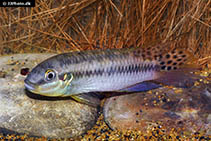 Enigmatochromis lucanusi
Foto de JJPhoto
Fotos | Imagem do Google
Foto de JJPhoto
Classificação / Nomes Nomes comuns | Sinônimos | Catalog of Fishes(Gênero, Espécies) | ITIS | CoL | WoRMS | Cloffa
> Cichliformes (Cichlids, convict blennies) > Cichlidae (Cichlids) > Pseudocrenilabrinae
Etymology: lucanusi: Enigma from enigmatic, refers to the somewhat intermediate characters between Pelvicachromis and Parananochromis in possessing pigmentation similarities to the first, but anatomical similarities to the second genus; and chromis.
Eponymy: Oliver Lucanus (d: 1970) is a German born Canadian collector, aquarist, videographer, explorer and tropical fish importer. [...] (Ref. 128868), visit book page.
Etymology: lucanusi: Enigma from enigmatic, refers to the somewhat intermediate characters between Pelvicachromis and Parananochromis in possessing pigmentation similarities to the first, but anatomical similarities to the second genus; and chromis.
Eponymy: Oliver Lucanus (d: 1970) is a German born Canadian collector, aquarist, videographer, explorer and tropical fish importer. [...] (Ref. 128868), visit book page.
Meio ambiente: milieu / Zona climática / intervalo de profundidade / faixa de distribuição Ecologia
; Água doce bentopelágico; pH range: 5.8 - ? ; dH range: 0 - ?. Tropical; 24°C - ? (Ref. 81928); 11°N - 10°N, 13°W - 14°W
Distribuição Territórios | Áreas da FAO | Ecossistemas | Ocorrências | Mapa de pontos | Introduções | Faunafri
Africa: Guinea. Only known from type locality, the Foto River, what is a small savannah river near the bauxite mining town of Fria in coastal Guinea, north of Conakry (Ref. 81928).
Tamanho / Peso / Idade
Descrição suscinta Chaves de identificação | Morfologia | Morfometria
The new genus is distinguished from all other chromidotilapiine genera by a unique combination of characters. It possesses twelve scales around the caudal peduncle vs. (13 or 14 scales) in Limbochromis Greenwood 1987, (14-16 scales) in Chromidotilapia, Boulenger 1898, and (16 scales) in Benitochromis Lamboj 2001, Pelvicachromis Thys van den Audenaerde 1968 and Thysochromis Daget 1988. Among the remaining chromidotilapiine genera with twelve circumpeduncular scales this new genus is further distinguished from Congochromis Stiassny & Schliewen 2007 and Nanochromis Pellegrin 1904 by: an infraorbital series containing a lachrymal and three additional tubular bones, and a gap between the 2nd and 3rd tubular infraorbitals (vs. lachrymal and one tubular bone), plus the lateral line is clearly separated from the dorsal-fin base (vs. posterior part contiguous with the dorsal-fin base). It is distinguished from Divandu Lamboj & Snoeks 2000 by: an infraorbital series with a lachrymal and three additional tubular bones and a gap between the 2nd and 3rd tubular infraorbitals (vs. four tubular bones), only four openings of the
laterosensory system in the lachrymal bone (vs. five), the first ray of pelvic fin in adult females is of equal length or longer than second ray of this fin (vs. first ray always longer), being a pair-bonding cave breeder (vs. a mouthbrooder), and by well developed sexual dichromatism (vs. weakly developed). Finally it is distinguished from Parananochromis Greenwood 1987 by: an infraorbital series with a lachrymal and three additional tubular bones with a gap between the 2nd and 3rd tubular infraorbitals (vs. four tubular bones in some species of Parananochromis), juveniles with 3 or 4 rows of irregular dark brown to black dots on body (vs. maximum of 2 rows), and the first ray of pelvic fin in adult females of equal length or longer than the second ray of this fin (vs. second ray slightly longer or of equal length) (Ref. 81928).
Where it was collected, Enigmatochromis lucanusi occured syntopically with Pelvicachromis humilis (Ref. 81928).
Ciclo de vida ou comportamento de acasalamento Maturidade | Reprodução | Desova | Ovos | Fecundidade | Larvas
In aquaria, the species is a monogamous, pair bonding, cave spawner. Eggs are guarded by both sexes, but more intensively by the female. Hatching occurs after three days post-spawn.
Larvae are normally deposited on the bottom of the cave, rarely in other caves nearby the original cave. Juveniles are free swimming 8 or 9 days post-hatching, and are guarded by both parents for about 5 to 6 weeks. Breeding and guarding individuals of both sexes regularly exhibit more aggressive and intensive coloration. The dark, longitudinal stripe that is typical for breeding and guarding specimens of both sexes in
many other cave breeders of the chromidotilapiine lineage (e.g., Pelvicachromis, Congochromis, and Parananochromis) is prominently visible in males, but is more rarely and weakly visible in females. In this
character, females of Enigmatochromis differ from females of Pelvicachromis, Congochromis and Parananochromis, where a prominent dark, longitudinal stripe is typical for females (and only rarely for males) during the first 2 to 4 weeks when guarding fry (Ref. 81928).
Referência principal
Carregar suas referências | Referências | Coordenador : Kullander, Sven O. | Colaboradores
Lamboj, A., 2009. A new dwarf cichlid genus and species (Teleostei, Cichlidae) from Guinea, West Africa. Zootaxa 2173:41-48. (Ref. 81928)
CITES
Not Evaluated
Ameaça para os humanos
Harmless
Uso pelos humanos
FAO - Publication: search | FishSource |
Mais informação
Ecologia Trófica
Itens alimentares (presas)
Composição da dieta
Consumo alimentar
Rações alimentares
Predadores
Itens alimentares (presas)
Composição da dieta
Consumo alimentar
Rações alimentares
Predadores
Dinâmica populacional
Parâmetros de crescimento
Idade máxima / tamanhos
Relação comprimento-peso.
Relação comprimento-comprimento.
Frequências de comprimento
Conversão de massa
Recrutamento
Abundância
Parâmetros de crescimento
Idade máxima / tamanhos
Relação comprimento-peso.
Relação comprimento-comprimento.
Frequências de comprimento
Conversão de massa
Recrutamento
Abundância
Ciclo de vida
Reprodução
Maturidade
Maturidade/Rel. das guelras
Fecundidade
Desova
Agregações de desova
Ovos
Desenvolvimento dos ovos
Larvas
Dinâmica larval
Reprodução
Maturidade
Maturidade/Rel. das guelras
Fecundidade
Desova
Agregações de desova
Ovos
Desenvolvimento dos ovos
Larvas
Dinâmica larval
Anatomia
Área branquial
Cérebro
Otólito
Área branquial
Cérebro
Otólito
Fisiologia
Composição corporal
Nutrientes
Consumo de oxigênio
Tipo de natação
Velocidade de natação
Pigmentos visuais
Som de peixe
Doenças e Parasitas
Toxicidade (LC50s)
Composição corporal
Nutrientes
Consumo de oxigênio
Tipo de natação
Velocidade de natação
Pigmentos visuais
Som de peixe
Doenças e Parasitas
Toxicidade (LC50s)
Genética
genoma
Genética
Heterozigosidade
Hereditariedade
Diversidade genética
genoma
Genética
Heterozigosidade
Hereditariedade
Diversidade genética
Relacionado a humanos
Sistemas de aquicultura
Perfis para aquacultura
Estirpes
Casos de Ciguatera
Selos, moedas, diversos.
Sistemas de aquicultura
Perfis para aquacultura
Estirpes
Casos de Ciguatera
Selos, moedas, diversos.
Ferramentas
Livro eletrônico | Guia de campo | Ferramenta auxiliar de frequências de comprimento | Ferramenta sobre a história de vida | Mapa de pontos |
Catch-MSY |
Relatórios especiais
Checar Manutenção em Aquário | Checar Planilhas de Fatos sobre as Espécies | Checar Planilhas de Fatos sobre Aquicultura
Baixar XML
Fontes da internet
AFORO (otoliths) | Aquatic Commons | BHL | Cloffa | Websites from users | Checar Observador de Peixes (FishWatcher) | CISTI | Catalog of Fishes: Gênero, Espécies | DiscoverLife | ECOTOX | FAO - Publication: search | Faunafri | Fishipedia | Fishtrace | GloBI | Google Books | Google Scholar | Google | IGFA World Record | OneZoom | Open Tree of Life | Otolith Atlas of Taiwan Fishes | Aquários públicos | PubMed | Reef Life Survey | Socotra Atlas | TreeBase | Árvore da vida | Wikipedia: Ir para, procura | World Records Freshwater Fishing | Zoobank | Registro zoológico
Estimativas baseadas em modelos
Índice de diversidade filogenética (Ref. 82804): PD50 = 1.0000 [Uniqueness, from 0.5 = low to 2.0 = high].
Bayesian length-weight: a=0.01445 (0.00671 - 0.03113), b=2.99 (2.82 - 3.16), in cm total length, based on LWR estimates for this (Sub)family-body shape (Ref. 93245).
Nível Trófico (Ref. 69278): 3.2 ±0.4 se; based on size and trophs of closest relatives