



Hochladen Photos und videos
Google Bild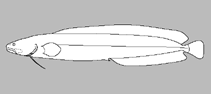 No image available for this species;
drawing shows typical species in Bythitidae.
Google Bild
drawing shows typical species in Bythitidae.
Klassifizierung / Names Namen | Synonyme | Catalog of Fishes(Gattung, Arten) | ITIS | CoL | WoRMS | Cloffa
> Ophidiiformes (Cusk eels) > Bythitidae (Livebearing brotulas)
Etymology: robusta: The specific name, robusta, refers to the short, deep body (Ref. 80456).
Eponymy: Cristoforo Bellotti (1823–1919) was an Italian ichthyologist and palaeontologist, who was also very interested in the breeding of silkworms. [...] (Ref. 128868), visit book page.
More on authors: Nielsen, Ross & Cohen.
Etymology: robusta: The specific name, robusta, refers to the short, deep body (Ref. 80456).
Eponymy: Cristoforo Bellotti (1823–1919) was an Italian ichthyologist and palaeontologist, who was also very interested in the breeding of silkworms. [...] (Ref. 128868), visit book page.
More on authors: Nielsen, Ross & Cohen.
Umwelt: Milieu / Klimazone / Tiefenbereich / Verbreitungsgebiet Ökologie
seewasser benthopelagisch; tiefenbereich 506 - 580 m (Ref. 80456). Subtropical; 28°N - 27°N, 91°W - 92°W
Verbreitung Territorien | FAO Gebiete | Ökosysteme | Vorkommen | Punkt Karte | Einführungen | Faunafri
Atlantic Ocean: Gulf of Mexico (Ref. 80456).
Größe / Gewicht / Alter
Kurzbeschreibung Bestimmungsschlüssel | Morphologie | Morphometrie
Rückenflossenweichstrahlen (insgesamt) : 85 - 93; Afterflossenweichstrahlen: 75 - 88; Wirbelzahl: 48 - 51. Body robust, highest near base of pectoral fin, completely covered with oval, ca.1.5 mm, cycloid scales. Anterior segment of lateral line extending close to dorsal margin of body and from above anus along midline of body. Head profile convex, cheek and gill-cover scaled, while rest of head naked. Mouth slightly oblique with posterior margin of maxillary vertically expanded ending well behind eye. Anterior nostril closer to upper lip than to posterior nostril, both with low rim. Small opercular spine strong and pointed, almostcompletely covered by skin, and not reaching posterior margin of opercle (a few specimens with spine reaching just beyond hind margin of opercle). Ventral margin of preopercle with four distinct spines and one spine on preopercular crest (spine often covered by skin; one specimen with two spines on crest).
Origin of dorsal fin above tip of pectoral fin, anal fin origin just behind midpoint of fish (some specimens with preanal up to 59 % SL). Pectoral fin placed on mid-body level with peduncle higher than long. A distinct spine on cleithrum just above base of pectoral fin (one specimen with spine ending in a blunt tip). Anterior gill arch with 2–3 (2–4) plate-like rakers on upper branch, one long raker in the angle between the two branches and lower branch with 4–5 long rakers, followed by seven (6–9) plate-like rakers. Longest gill filament
slightly shorter than longest raker. Two minute pseudobranchial filaments (Ref. 80456).
Bellottia robusta differs from its congeners by the following combination of characters: depth at origin of anal fin 17.5–23.0 % SL, small teeth blunt or pointed, four spines on hind margin and one on crest of preopercle, distinct spine on cleithrum above base of pectoral fin, anterior gill arch with 5–6 long rakers, predorsal 44.0–49.5 % SL and precaudal vertebrae 12 (Ref. 80456).
Lebenszyklus und Paarungsverhalten Geschlechtsreife | Fortpflanzung | Ablaichen | Eier | Fruchtbarkeit | Larven
Hauptreferenz
Laden Sie Ihre Referenzen hoch | Referenzen | Koordinator | Partner
Nielsen, J.G., S.W. Ross and D.M. Cohen, 2009. Atlantic occurrence of the genus Bellottia (Teleostei, Bythitidae) with two new species from the Western North Atlantic. Zootaxa 2018:45-57. (Ref. 80456)
IUCN Rote Liste Status (Ref. 130435: Version 2025-2 (Global))
Daten mangelhaft (DD) ; Date assessed: 09 October 2018
CITES
Not Evaluated
Bedrohung für Menschen
Harmless
Nutzung durch Menschen
FAO - Publication: search | FishSource |
Mehr Information
Trophische Ökologie
Lebensmittel (Beutetiere)
Nahrungszusammensetzung
Nahrungsaufnahme
Lebensmittelrationen
Räuber
Lebensmittel (Beutetiere)
Nahrungszusammensetzung
Nahrungsaufnahme
Lebensmittelrationen
Räuber
Ökologie
Ökologie
Ökologie
Populationsdynamik
Wachstumsparameter
Max. Alter/Größen
Länge-Gewicht-Rel.
Länge-Länge-Verhältnis.
Längenhäufigkeiten
Massenkonvertierung
Rekrutierung
Dichte
Wachstumsparameter
Max. Alter/Größen
Länge-Gewicht-Rel.
Länge-Länge-Verhältnis.
Längenhäufigkeiten
Massenkonvertierung
Rekrutierung
Dichte
Lebenszyklus
Fortpflanzung
Geschlechtsreife
Reifung/Kiemen rel.
Fruchtbarkeit
Ablaichen
Laichaggregationen
Eier
Eientwicklung
Larven
Larven Pop.Dyn.
Fortpflanzung
Geschlechtsreife
Reifung/Kiemen rel.
Fruchtbarkeit
Ablaichen
Laichaggregationen
Eier
Eientwicklung
Larven
Larven Pop.Dyn.
Anatomie
Kiemenoberfläche
Gehirn
Otolith
Kiemenoberfläche
Gehirn
Otolith
Physiologie
Körperliche Zusammensetzung
Nährstoffe
Sauerstoffverbrauch
Schwimmart
Schwimmgeschwindigkeit
Visuelle Pigmente
Fischgeräusche
Krankheiten und Parasiten
Toxizität (LC50s)
Körperliche Zusammensetzung
Nährstoffe
Sauerstoffverbrauch
Schwimmart
Schwimmgeschwindigkeit
Visuelle Pigmente
Fischgeräusche
Krankheiten und Parasiten
Toxizität (LC50s)
Genetik
Genom
Genetik
Heterozygotie
Vererbbarkeit
Genetische Vielfalt
Genom
Genetik
Heterozygotie
Vererbbarkeit
Genetische Vielfalt
Menschenbezogen
Aquakultur-Systeme
Aquakultur Profile
Zuchtlinien
Ciguatera-Fälle
Briefmarken, Münzen, Verschiedenes.
Aquakultur-Systeme
Aquakultur Profile
Zuchtlinien
Ciguatera-Fälle
Briefmarken, Münzen, Verschiedenes.
Tools
Zusatzinformationen
Download XML
Zusammenfassung | Punktdaten | Namen | Photos
Internet Quellen
AFORO (otoliths) | Aquatic Commons | BHL | Cloffa | Websites from users | FishWatcher Einträge suchen | CISTI | Catalog of Fishes: Gattung, Arten | DiscoverLife | ECOTOX | FAO - Publication: search | Faunafri | Fishipedia | Fishtrace | GloBI | Google Books | Google Scholar | Google | IGFA World Record | OneZoom | Open Tree of Life | Otolith Atlas of Taiwan Fishes | PubMed | Reef Life Survey | Socotra Atlas | TreeBase | Tree of Life | Wikipedia: Gehe zu, Suchen | World Records Freshwater Fishing | Zoobank | Zoologischer Rekord
Schätzungen auf der Grundlage von Modellen
Phylogenetischer Diversitätsindex (Ref. 82804): PD50 = 0.5312 [Uniqueness, from 0.5 = low to 2.0 = high].
Bayesian length-weight: a=0.00479 (0.00192 - 0.01191), b=3.03 (2.81 - 3.25), in cm total length, based on LWR estimates for this (Sub)family-body shape (Ref. 93245).
Trophische Ebene (Ref. 69278): 3.3 ±0.5 se; based on size and trophs of closest relatives
Widerstandsfähigkeit (Ref. 120179): hoch, Verdopplung der Population dauert weniger als 15 Monate. (Preliminary K or Fecundity.).