



Glossogobius bellendenensis Hoese & Allen, 2009
Hochladen Photos und videos
Google Bild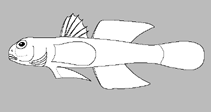 No image available for this species;
drawing shows typical species in Gobiidae.
Google Bild
drawing shows typical species in Gobiidae.
Klassifizierung / Names Namen | Synonyme | Catalog of Fishes(Gattung, Arten) | ITIS | CoL | WoRMS | Cloffa
> Gobiiformes (Gobies) > Gobiidae (Gobies) > Gobiinae
Etymology: Glossogobius: Greek, glossa = tongue + Latin, gobius = gudgeon (Ref. 45335); bellendenensis: Named for the Bellenden Ker Range, where the species was first discovered.
More on authors: Hoese & Allen.
Etymology: Glossogobius: Greek, glossa = tongue + Latin, gobius = gudgeon (Ref. 45335); bellendenensis: Named for the Bellenden Ker Range, where the species was first discovered.
More on authors: Hoese & Allen.
Umwelt: Milieu / Klimazone / Tiefenbereich / Verbreitungsgebiet Ökologie
; süßwasser benthopelagisch. Tropical; 17°S - 18°S, 145°E - 146°E
Verbreitung Territorien | FAO Gebiete | Ökosysteme | Vorkommen | Punkt Karte | Einführungen | Faunafri
Oceania: Australia, Queensland.
Größe / Gewicht / Alter
Kurzbeschreibung Bestimmungsschlüssel | Morphologie | Morphometrie
Afterflossenstacheln: 1; Afterflossenweichstrahlen: 8. Mental fraenum bilobed, with lateral lobes broad and attached to chin, with a posteromedian
attachment sometimes giving the appearance of a third lobe; predorsal area partly scaled, midline scales extending no farther forward than posterior preopercular margin; cheek, operculum, pectoral base, prepelvic area and anterior midline of belly naked; first dorsal fin with one or two large black spots posteriorly; second dorsal-fin rays usually I,10; anal-fin rays I,8; pectoral-fin rays usually 16–17; predorsal scale count 2–14; cheek papilla lines composed of single row of papillae; papilla line 6 absent and vertebrae usually 12+16.Glossogobius bellendenensis is readily distinguished from other species of Glossogobius in dorsal and anal-ray counts, reduced predorsal scale coverage, absence of scales of prepelvic area and pectoral base and distinctive shape of the mental frenum. It shares most of those characteristics with Glossogobius muscorum from the Fly River in New Guinea. Glossogobius bellendensis differs from that species in coloration, in usually having 12+16 vertebrae (versus 11+17), and a trilobed mental frenum (versus bilobed). The coloration differences include lacking a horizontal brown stripe on the cheek below the eye, an oval brown spot on the anteromedian margin of the operculum and white on the posterior end of lips, characteristic of G. muscorum. It addition there are two large spots on the midside on the belly (versus one large blotch on the side of the belly).
The species can be confused with Glossogobius concavifrons, which has scales on the pectoral base and prepelvic area, predorsal scales reaching to near eye, more numerous precaudal vertebrae (13–15) and more compressed head. Currently the two species are not known to be sympatric. Glossogobius concavifrons is known from rivers of western Cape York to Arnhem Land in Australia and southern New Guinea. Separation of juveniles below 20 mm SL is difficult because the scales are not well developed in Glossogobius concavifrons at that size.
Body shape (shape guide): fusiform / normal.
Body shape (shape guide): fusiform / normal.
Kroon and Johnson (2006) document Queensland records of this species. Although the species currently is restricted in its distribution, it may have been mistaken for juveniles of other species because of the small size of the species. Consequently it is likely to be more widely distributed in Australia (Ref. 80299).
Lebenszyklus und Paarungsverhalten Geschlechtsreife | Fortpflanzung | Ablaichen | Eier | Fruchtbarkeit | Larven
Hauptreferenz
Laden Sie Ihre Referenzen hoch | Referenzen | Koordinator | Partner
Hoese, D.F. and G.R. Allen, 2009. Description of three new species of Glossogobius from Australia and New Guinea. Zootaxa 1981:1-14. (Ref. 80299)
IUCN Rote Liste Status (Ref. 130435: Version 2025-2 (Global))
stark gefährdet (EN) (B1ab(ii,iii)); Date assessed: 14 February 2019
CITES
Not Evaluated
Bedrohung für Menschen
Harmless
Nutzung durch Menschen
FAO - Publication: search | FishSource |
Mehr Information
Trophische Ökologie
Lebensmittel (Beutetiere)
Nahrungszusammensetzung
Nahrungsaufnahme
Lebensmittelrationen
Räuber
Lebensmittel (Beutetiere)
Nahrungszusammensetzung
Nahrungsaufnahme
Lebensmittelrationen
Räuber
Populationsdynamik
Wachstumsparameter
Max. Alter/Größen
Länge-Gewicht-Rel.
Länge-Länge-Verhältnis.
Längenhäufigkeiten
Massenkonvertierung
Rekrutierung
Dichte
Wachstumsparameter
Max. Alter/Größen
Länge-Gewicht-Rel.
Länge-Länge-Verhältnis.
Längenhäufigkeiten
Massenkonvertierung
Rekrutierung
Dichte
Lebenszyklus
Fortpflanzung
Geschlechtsreife
Reifung/Kiemen rel.
Fruchtbarkeit
Ablaichen
Laichaggregationen
Eier
Eientwicklung
Larven
Larven Pop.Dyn.
Fortpflanzung
Geschlechtsreife
Reifung/Kiemen rel.
Fruchtbarkeit
Ablaichen
Laichaggregationen
Eier
Eientwicklung
Larven
Larven Pop.Dyn.
Anatomie
Kiemenoberfläche
Gehirn
Otolith
Kiemenoberfläche
Gehirn
Otolith
Physiologie
Körperliche Zusammensetzung
Nährstoffe
Sauerstoffverbrauch
Schwimmart
Schwimmgeschwindigkeit
Visuelle Pigmente
Fischgeräusche
Krankheiten und Parasiten
Toxizität (LC50s)
Körperliche Zusammensetzung
Nährstoffe
Sauerstoffverbrauch
Schwimmart
Schwimmgeschwindigkeit
Visuelle Pigmente
Fischgeräusche
Krankheiten und Parasiten
Toxizität (LC50s)
Genetik
Genom
Genetik
Heterozygotie
Vererbbarkeit
Genetische Vielfalt
Genom
Genetik
Heterozygotie
Vererbbarkeit
Genetische Vielfalt
Menschenbezogen
Aquakultur-Systeme
Aquakultur Profile
Zuchtlinien
Ciguatera-Fälle
Briefmarken, Münzen, Verschiedenes.
Aquakultur-Systeme
Aquakultur Profile
Zuchtlinien
Ciguatera-Fälle
Briefmarken, Münzen, Verschiedenes.
Tools
Zusatzinformationen
Download XML
Zusammenfassung | Punktdaten | Namen | Photos
Internet Quellen
AFORO (otoliths) | Aquatic Commons | BHL | Cloffa | Websites from users | FishWatcher Einträge suchen | CISTI | Catalog of Fishes: Gattung, Arten | DiscoverLife | ECOTOX | FAO - Publication: search | Faunafri | Fishipedia | Fishtrace | GloBI | Google Books | Google Scholar | Google | IGFA World Record | OneZoom | Open Tree of Life | Otolith Atlas of Taiwan Fishes | PubMed | Reef Life Survey | Socotra Atlas | TreeBase | Tree of Life | Wikipedia: Gehe zu, Suchen | World Records Freshwater Fishing | Zoobank | Zoologischer Rekord
Schätzungen auf der Grundlage von Modellen
Phylogenetischer Diversitätsindex (Ref. 82804): PD50 = 0.5000 [Uniqueness, from 0.5 = low to 2.0 = high].
Bayesian length-weight: a=0.01023 (0.00477 - 0.02194), b=3.01 (2.83 - 3.19), in cm total length, based on LWR estimates for this (Sub)family-body shape (Ref. 93245).
Trophische Ebene (Ref. 69278): 3.3 ±0.4 se; based on size and trophs of closest relatives
Widerstandsfähigkeit (Ref. 120179): hoch, Verdopplung der Population dauert weniger als 15 Monate. (Preliminary K or Fecundity.).