This website uses cookies to enhance your browsing experience and ensure the functionality of our site. For more detailed information about the types of cookies we use and how we protect your privacy, please visit our Privacy Information page.
×
Cookie Settings
This website uses different types of cookies to enhance your experience. Please select your preferences below:
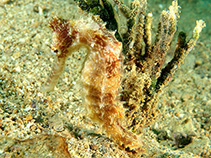
Hippocampus curvicuspis, New Caledonian thorny seahorse
> Syngnathiformes (Pipefishes and seahorses) > Syngnathidae (Pipefishes and seahorses) > Syngnathinae
Etymology: Hippocampus:Greek, ippos = horse + Greek,kampe = curvature (Ref. 45335); curvicuspis:Name from the Latin 'curvus' for curved and 'cuspis' for spine; referring to the curved spines, including the nape spine and several spines on the superior and lateral trunk ridges. More on author: Fricke.
Taxonomic Remarks This species is a synonym of Hippocampus hystrix Weber, 1913 according to Lourie et al., 2016 (Ref. 115213). This species record will be removed.
Umwelt: Milieu / Klimazone / Tiefenbereich / Verbreitungsgebiet Ökologie
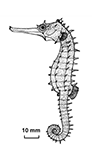
Rückenflossenweichstrahlen (insgesamt) : 17. This large spiny seahorse is distinguished by the having 17 dorsal fin rays; 17-18 pectoral fin rays; 11 trunk rings; 35-37 tail rings; subdorsal spines 3/0,1,0; moderately large nose spine, height about equal to pupil diameter; double spine above eyes which are moderately long, shorter than eye diameter; single lateral head spine; raised coronet with 4 large spines; restricted gill openings, not close together near the neck ridge; shoulder rings not confluent over neck ridge, not forming continuous collar; the upper shoulder ring spine opposite 11th pectoral fin ray; trunk and tail ridges with many large, curved spines; snout length approximately 57% of head length (Ref. 75989). Body shape (shape guide): other.
Found in seagrass beds at depths of more than 6 meters (Ref. 75989).
Fricke, R., 2004. Review of the pipefishes and seahorses (Teleostei: Syngnathidae) of New Caledonia, with descriptions of five new species. Stuttgarter Beitr. Naturkd., Ser. A Nr. 668:1-67. (Ref. 75989)
IUCN Rote Liste Status (Ref. 130435: Version 2025-2 (Global))
Phylogenetischer Diversitätsindex (Ref. 82804): PD50 = 0.5000 [Uniqueness, from 0.5 = low to 2.0 = high].
Bayesian length-weight: a=0.00447 (0.00176 - 0.01132), b=3.00 (2.78 - 3.22), in cm total length, based on LWR estimates for this (Sub)family-body shape (Ref. 93245).
Trophische Ebene (Ref. 69278): 3.4 ±0.4 se; based on size and trophs of closest relatives
Widerstandsfähigkeit (Ref. 120179): hoch, Verdopplung der Population dauert weniger als 15 Monate. (Preliminary K or Fecundity.).
Anfälligkeit der Fischerei (Ref. 59153): Low vulnerability (10 of 100). 🛈