



Uploaden van uw Foto's en video's
Google afbeelding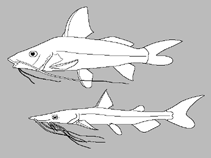 No image available for this species;
drawing shows typical species in Pimelodidae.
Google afbeelding
drawing shows typical species in Pimelodidae.
Classificatie / Namen Lokale namen | Synoniemen | Catalog of Fishes(Genus, Soort(en)) | ITIS | CoL | WoRMS | Cloffa
> Siluriformes (Catfishes) > Pimelodidae (Long-whiskered catfishes)
Etymology: Pimelodus: Greek, pimele = fat + Greek, odous = teeth (Ref. 45335); joannis: Named for John Lundberg, in recognition of his many contributions to catfishes systematics.
Eponymy: Dr John Graham Lundberg (d: 1942). Joannis is a Latinized version of John, here referring to “…John Lundberg, in recognition of his many contributions to catfish systematics”. (See Lundberg, JG) (Ref. 128868), visit book page.
Etymology: Pimelodus: Greek, pimele = fat + Greek, odous = teeth (Ref. 45335); joannis: Named for John Lundberg, in recognition of his many contributions to catfishes systematics.
Eponymy: Dr John Graham Lundberg (d: 1942). Joannis is a Latinized version of John, here referring to “…John Lundberg, in recognition of his many contributions to catfish systematics”. (See Lundberg, JG) (Ref. 128868), visit book page.
Milieu: milieu / Klimaatzone / Diepte / verspreidingsgebied Ecologie
; zoet water demersaal. Tropical
Verspreiding Gebieden | FAO regio's | Ecosystemen | Voorkomen | Verspreidingskaart | Introducties | Faunafri
South America: Rio Tocantins drainage, Brazil.
Grootte / Gewicht / Leeftijd
Korte beschrijving Determinatiesleutels | Morfologie | Morfometrie
Dorsale stekels (totaal) : 2; Dorsale zachte stralen (totaal) : 6; Wervels: 40. Diagnosed from all other species of the genus Pimelodus, except Pimelodus halisodous, Pimelodus jivaro, Pimelodus ornatus, Pimelodus pictus, and Pimelodus stewarti, by its supraoccipital process with a dorsal median crest; posterior nostril closer to anterior orbital border (vs. posterior nostril closer to anterior nostril than to anterior orbital border); distal portion of dorsal-fin rays 2-4 with a dark spot; caudal- fin base with two dark blotches. Distinguished from Pimelodus jivaro by having a shorter maxillary barbel, extending only slightly past caudal-fin base (vs. maxillary barbel extending beyond caudal-fin base); distal portion of dorsal-fin rays 2-4 with a dark spot, and caudal-fin base with two dark blotches. Differs from Pimelodus ornatus and Pimelodus pictus by the uniform grayish to yellowish coloration (vs. presence of bands or dark dots along flanks, respectively); from Pimelodus stewarti by its shorter posterior cleithral process (10.2-12.4 vs. 12.7-15.6 % of SL); caudal-fin base two dark blotches; and supraoccipital process with dorsal median crest; from Pimelodus halisodous by its shorter pectoral-spine (15.5-18.5 vs. 20.0-23.5% of SL); shorter snout (35.8-41.8 vs. 43.1-47.9% of HL); and fewer premaxillary tooth rows (5-9 vs. 13-16) (Ref. 79502).
Body shape (shape guide): elongated.
Body shape (shape guide): elongated.
Levenscyclus en paargedrag Maturiteit | Voortplanting | Paaien | Eieren | Fecunditeit | Larven
Hoofdreferentie
Upload uw referenties | Referenties | Coördinator | Medewerkers
Ribeiro, F.R.V., C.A.S. Lucena and P.H.F. Lucinda, 2008. Three new Pimelodus species (Siluriformes: Pimelodidae) from the rio Tocantins drainage, Brazil. Neotrop. Ichthyol. 6(3):455-464. (Ref. 79502)
Status op de Rode Lijst van het IUCN (Ref. 130435: Version 2025-2 (Global))
Onvoldoende gegevens (DD) ; Date assessed: 18 May 2022
CITES
Not Evaluated
Gevaar voor de mens
Harmless
Gebruik door de mens
FAO - Publication: search | FishSource |
Meer informatie
Trofische ecologie
Voedsel (prooien)
Dieetsamenstelling
Voedselconsumptie
Voedselrantsoenen
Predatoren
Voedsel (prooien)
Dieetsamenstelling
Voedselconsumptie
Voedselrantsoenen
Predatoren
Ecologie
Ecologie
Ecologie
Populatiedynamica
Groeiparameters
Max. leeftijden / maten
Lengte-gewicht rel.
Lengte-lengte rel.
Lengtefrequenties
Massaconversie
Rekrutering
Abundantie
Groeiparameters
Max. leeftijden / maten
Lengte-gewicht rel.
Lengte-lengte rel.
Lengtefrequenties
Massaconversie
Rekrutering
Abundantie
Levenscyclus
Voortplanting
Maturiteit
Rijpheid/kieuwen rel.
Fecunditeit
Paaien
Paaibestanden
Eieren
Ontwikkeling van de eieren
Larven
Larvale populatiedynamiek
Voortplanting
Maturiteit
Rijpheid/kieuwen rel.
Fecunditeit
Paaien
Paaibestanden
Eieren
Ontwikkeling van de eieren
Larven
Larvale populatiedynamiek
Anatomie
Kieuwoppervlak
Hersenen
Otoliet
Kieuwoppervlak
Hersenen
Otoliet
Fysiologie
Lichaamssamenstelling
Voedingsstoffen
Zuurstofverbruik
Type zwemmen
Zwemsnelheid
Visuele pigmenten
Vis geluid
Ziekten en parasieten
Toxiciteit (LC50)
Lichaamssamenstelling
Voedingsstoffen
Zuurstofverbruik
Type zwemmen
Zwemsnelheid
Visuele pigmenten
Vis geluid
Ziekten en parasieten
Toxiciteit (LC50)
Genetica
genoom
Genetica
Heterozygositeit
Erfelijkheid
Genetische diversiteit
genoom
Genetica
Heterozygositeit
Erfelijkheid
Genetische diversiteit
Menselijk gerelateerd
Aquacultuursystemen
Aquacultuurprofielen
Kweeklijnen
Ciguatera gevallen
Postzegels, munten, diversen.
Aquacultuursystemen
Aquacultuurprofielen
Kweeklijnen
Ciguatera gevallen
Postzegels, munten, diversen.
Tools
Speciale rapporten
Bekijk gegevens voor het houden in een aquarium | Bekijk Fact Sheets voor de soort | Bekijk Aquacultuur Fact Sheets
Download XML
Internetbronnen
AFORO (otoliths) | Aquatic Commons | BHL | Cloffa | Websites from users | Bekijk FishWatcher | CISTI | Catalog of Fishes: Genus, Soort(en) | DiscoverLife | ECOTOX | FAO - Publication: search | Faunafri | Fishipedia | Fishtrace | GloBI | Google Books | Google Scholar | Google | IGFA World Record | OneZoom | Open Tree of Life | Otolith Atlas of Taiwan Fishes | PubMed | Reef Life Survey | Socotra Atlas | TreeBase | Tree of Life | Wikipedia: ga naar, zoek | World Records Freshwater Fishing | Zoobank | Zoological Record
Schattingen op basis van modellen
Fylogenetische diversiteitsindex (Ref. 82804): PD50 = 0.5000 [Uniqueness, from 0.5 = low to 2.0 = high].
Bayesian length-weight: a=0.00692 (0.00304 - 0.01573), b=3.10 (2.92 - 3.28), in cm total length, based on LWR estimates for this Genus-body shape (Ref. 93245).
Trofisch niveau (Ref. 69278): 3.2 ±0.5 se; based on size and trophs of closest relatives
Weerstandsvermogen (Ref. 120179): Hoog, minimale populatieverdubbelingstijd minder dan 15 maanden (Preliminary K or Fecundity.).