This website uses cookies to enhance your browsing experience and ensure the functionality of our site. For more detailed information about the types of cookies we use and how we protect your privacy, please visit our Privacy Information page.
×
Cookie Settings
This website uses different types of cookies to enhance your experience. Please select your preferences below:
> Callionymiformes (Dragonets) > Callionymidae (Dragonets)
Etymology: Callionymus:Greek, kallion, comparative of kallos = beautiful + Greek, onyma = name; with a better name; kanakorum:Name after the local name of the inhabitants of the islands of New Caledonia, 'kanak' or 'canaque' a word of Polynesian origin. Eponymy: The Kanaky are an indigenous people in New Caledonia, where the shark and dragonet were first taken. As Séret puts it, the shark is “…dedicated to the Melanesian people of New Caledonia”. (Ref. 128868), visit book page. More on author: Fricke.
Environnement : milieu / zone climatique / profondeur / gamme de distribution Écologie
marin démersal; profondeur 110 - 800 m (Ref. 78107). Tropical
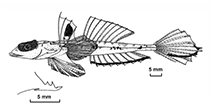
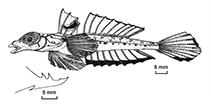
This species belonging to the Callionymus kaianus species-group, has the following characters: 9 unbranched second dorsal and anal fin rays (last one divided at its base); pectoral fin rays 20-22; preopercular spine dorsally with a small antrorse point and two large points which are equal in length; first spine of the first dorsal fin subequal in length with the first ray of the second dorsal fin, mostly with a short filament; margin of the second dorsal fin distally straight in both sexes; caudal fin with no median filaments; third membrane of first dorsal fin with an ocellate black blotch, a basal branch of which may extend to the second membrane; anal fin with a distal dark margin; caudal fin with a large lower and a small upper black area (Ref. 78107). Body shape (shape guide): elongated; Cross section: flattened.
Inhabits sandy bottoms with few rubble or coralline gravel and sand (Ref. 78107).
Cycle de vie et comportement reproducteur Maturité | Reproduction | Frai | Œufs | Fécondité | Larves
Fricke, R., 2006. Two new species and a new record of dragonets from New Caledonia (Teleostei: Callionymidae). Stuttg. Beitr. Naturk. Ser. A (Biol.) 696:1-14. (Ref. 78107)
Statut dans la liste rouge de l'IUCN (Ref. 130435: Version 2025-2 (Global))
Dynamique des populations Paramètres de croissance Âges / tailles maximales Longueur-poids rel. Rel. longueur-longueur. Fréquences de longueurs Conversion de masse Recrutement Abondance
Cycle de vie Reproduction Maturité Maturité/épines rel. Fécondité Frai Agrégats de frai Œufs Développement de l'œuf Larves Dynamique des populations larvaires
Physiologie Composition corporelle Nutriments Consommation d'oxygène Type de natation Vitesse de nage Pigments visuels Son de poisson Maladies et parasites Toxicité (CL50)
Température préférée (Réf. 123201): 12.9 - 20.3, mean 17.2 °C (based on 27 cells).
Indice de diversité phylogénétique (Réf. 82804): PD50 = 0.5000 [Uniqueness, from 0.5 = low to 2.0 = high].
Bayesian length-weight: a=0.00871 (0.00397 - 0.01910), b=2.78 (2.61 - 2.95), in cm total length, based on LWR estimates for this Genus-body shape (Ref. 93245).
Niveau trophique (Réf. 69278): 3.2 ±0.4 se; based on size and trophs of closest relatives
Résilience (Réf. 120179): Haut, temps minimum de doublement de population inférieur à 15 mois (Preliminary K or Fecundity.).
Vulnérabilité de la pêche (Ref. 59153): Low vulnerability (10 of 100). 🛈