



Apteronotus galvisi de Santana, Maldonado-Ocampo & Crampton, 2007
Uploaden van uw Foto's en video's
Google afbeelding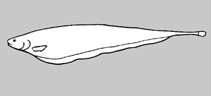 No image available for this species;
drawing shows typical species in Apteronotidae.
Google afbeelding
drawing shows typical species in Apteronotidae.
Classificatie / Namen Lokale namen | Synoniemen | Catalog of Fishes(Genus, Soort(en)) | ITIS | CoL | WoRMS | Cloffa
> Gymnotiformes (Knifefishes) > Apteronotidae (Ghost knifefishes) > Apteronotinae
Etymology: Apteronotus: Greek, apteros = without wings / (in this cases, fins) + Greek, noton = back (Ref. 45335).
Eponymy: Germán Galvis Vergara is a Colombian biologist whose bachelor’s degree was awarded by the University of Strasbourg (1967). [...] (Ref. 128868), visit book page.
Etymology: Apteronotus: Greek, apteros = without wings / (in this cases, fins) + Greek, noton = back (Ref. 45335).
Eponymy: Germán Galvis Vergara is a Colombian biologist whose bachelor’s degree was awarded by the University of Strasbourg (1967). [...] (Ref. 128868), visit book page.
Milieu: milieu / Klimaatzone / Diepte / verspreidingsgebied Ecologie
; zoet water benthopelagisch; pH range: 7.3 - ?. Tropical; 27°C - ? (Ref. 75033)
Verspreiding Gebieden | FAO regio's | Ecosystemen | Voorkomen | Verspreidingskaart | Introducties | Faunafri
South America: Río Meta basin in Colombia.
Grootte / Gewicht / Leeftijd
Maturiteit: Lm ? range ? - ? cm
Max length : 18.4 cm TL mannelijk / geslacht onbekend; (Ref. 75033); 19.0 cm TL (female)
Max length : 18.4 cm TL mannelijk / geslacht onbekend; (Ref. 75033); 19.0 cm TL (female)
Korte beschrijving Determinatiesleutels | Morfologie | Morfometrie
Anale zachte stralen: 145 - 165. Distinguished from all congeners by the following combination of characters: hypermorphosis of sphenoid region of the neurocranium in both males and females; ossified lateral ethmoid; uniformly brown body coloration other than for white or yellow band on the chin, dorsal surface of head, and mid-dorsal part of body; presence of a white or yellow band on chin, dorsal surface of head, and mid-dorsal part of body; unpigmented band encircling base of caudal fin. Males differ from the holotype of Apteronotus macrostomus, which is presumably a male, by the following characters: head length 18.6-20.3% of length to end to anal fin [LEA] vs. (21.4); head width 25.3-36.5% of HL (vs. 39.3); head depth at eye 37.9-39.4% of HL (vs. 50.1); snout length 40.0-43.8 % HL (vs. 44.7); and distance from posterior naris to eye 17.8-20.3% of HL (vs. 23.6); width of mouth 40.6-50.1% (vs. 56.2); interocular width 14.1-18.6% HL (vs. 19.9); and postocular distance 49.2-58% HL (vs. 62.1). In addition, males can be separated from the holotype of Apteronotus leptorhynchus, presumably also a male, by the following features: length of anal-fin base 70-79% of LEA (vs. 83.7); head length 18.6-20.3% of LEA (vs. 21); head width 25.3-36.5% of HL (vs. 37.3); and head depth at eye 37.9-39.4 % of HL (43.6) (Ref. 75033).
Inhabits piedmont rivers with clear water, rocky bottom and strong current (Ref. 75033). Has the ability to generate a continuous wave (tone) -type electric organ discharges (EOD) with a stable fundamental frequency of 700-957 (Ref. 75033). Sexually mature males have more fundamental frequencies of the EOD than females, with no overlap between sexes (Ref. 75033).
Levenscyclus en paargedrag Maturiteit | Voortplanting | Paaien | Eieren | Fecunditeit | Larven
Hoofdreferentie
Upload uw referenties | Referenties | Coördinator : Albert, James S. | Medewerkers
de Santana, C.D., J.A. Maldonado-Ocampo and W.G.R. Crampton, 2007. Apteronotus galvisi, a new species of electric ghost knifefish fro the Río Meta basin, Colombia (Gymnotiformes: Apteronotidae). Ichthyol. Explor. Freshwat. 18(2):117-124. (Ref. 75033)
Status op de Rode Lijst van het IUCN (Ref. 130435: Version 2025-2 (Global))
Onvoldoende gegevens (DD) ; Date assessed: 04 October 2020
CITES
Not Evaluated
Gevaar voor de mens
Harmless
Gebruik door de mens
FAO - Publication: search | FishSource |
Meer informatie
Trofische ecologie
Voedsel (prooien)
Dieetsamenstelling
Voedselconsumptie
Voedselrantsoenen
Predatoren
Voedsel (prooien)
Dieetsamenstelling
Voedselconsumptie
Voedselrantsoenen
Predatoren
Ecologie
Ecologie
Ecologie
Populatiedynamica
Groeiparameters
Max. leeftijden / maten
Lengte-gewicht rel.
Lengte-lengte rel.
Lengtefrequenties
Massaconversie
Rekrutering
Abundantie
Groeiparameters
Max. leeftijden / maten
Lengte-gewicht rel.
Lengte-lengte rel.
Lengtefrequenties
Massaconversie
Rekrutering
Abundantie
Levenscyclus
Voortplanting
Maturiteit
Rijpheid/kieuwen rel.
Fecunditeit
Paaien
Paaibestanden
Eieren
Ontwikkeling van de eieren
Larven
Larvale populatiedynamiek
Voortplanting
Maturiteit
Rijpheid/kieuwen rel.
Fecunditeit
Paaien
Paaibestanden
Eieren
Ontwikkeling van de eieren
Larven
Larvale populatiedynamiek
Anatomie
Kieuwoppervlak
Hersenen
Otoliet
Kieuwoppervlak
Hersenen
Otoliet
Fysiologie
Lichaamssamenstelling
Voedingsstoffen
Zuurstofverbruik
Type zwemmen
Zwemsnelheid
Visuele pigmenten
Vis geluid
Ziekten en parasieten
Toxiciteit (LC50)
Lichaamssamenstelling
Voedingsstoffen
Zuurstofverbruik
Type zwemmen
Zwemsnelheid
Visuele pigmenten
Vis geluid
Ziekten en parasieten
Toxiciteit (LC50)
Genetica
genoom
Genetica
Heterozygositeit
Erfelijkheid
Genetische diversiteit
genoom
Genetica
Heterozygositeit
Erfelijkheid
Genetische diversiteit
Menselijk gerelateerd
Aquacultuursystemen
Aquacultuurprofielen
Kweeklijnen
Ciguatera gevallen
Postzegels, munten, diversen.
Aquacultuursystemen
Aquacultuurprofielen
Kweeklijnen
Ciguatera gevallen
Postzegels, munten, diversen.
Tools
Speciale rapporten
Bekijk gegevens voor het houden in een aquarium | Bekijk Fact Sheets voor de soort | Bekijk Aquacultuur Fact Sheets
Download XML
Internetbronnen
AFORO (otoliths) | Aquatic Commons | BHL | Cloffa | Websites from users | Bekijk FishWatcher | CISTI | Catalog of Fishes: Genus, Soort(en) | DiscoverLife | ECOTOX | FAO - Publication: search | Faunafri | Fishipedia | Fishtrace | GloBI | Google Books | Google Scholar | Google | IGFA World Record | OneZoom | Open Tree of Life | Otolith Atlas of Taiwan Fishes | PubMed | Reef Life Survey | Socotra Atlas | TreeBase | Tree of Life | Wikipedia: ga naar, zoek | World Records Freshwater Fishing | Zoobank | Zoological Record
Schattingen op basis van modellen
Fylogenetische diversiteitsindex (Ref. 82804): PD50 = 0.5000 [Uniqueness, from 0.5 = low to 2.0 = high].
Bayesian length-weight: a=0.00355 (0.00146 - 0.00863), b=3.06 (2.85 - 3.27), in cm total length, based on LWR estimates for this (Sub)family-body shape (Ref. 93245).
Trofisch niveau (Ref. 69278): 3.3 ±0.3 se; based on size and trophs of closest relatives