



Uploaden van uw Foto's en video's
Afbeeldingen | Google afbeelding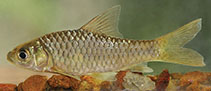 Puntius kamalika
Afbeelding van Gunasekara, S.
Afbeeldingen | Google afbeelding
Afbeelding van Gunasekara, S.
Classificatie / Namen Lokale namen | Synoniemen | Catalog of Fishes(Genus, Soort(en)) | ITIS | CoL | WoRMS | Cloffa
> Cypriniformes (Carps) > Cyprinidae (Minnows or carps) > Smiliogastrinae
Etymology: Puntius: Lantin, punctum = point, the point of the sword (Ref. 45335); kamalika: Named for Kamalika Abeyaratne (22 June 1934-11 December 2004), formed as a noun in apposition. Puntius kamalika has previously been known in Sri Lanka by the vernacular names Ipilli kadeya and Mada ipilla (Deraniyagala 1930).
Eponymy: Dr Kamalika ‘Kami’ Abeyaratne (1934–2004) was a Sri Lankan pediatrician who became an AIDS activist (1997) after she contracted HIV through a contaminated blood transfusion, administered following a near-fatal traffic accident (1995). (Ref. 128868), visit book page.
Etymology: Puntius: Lantin, punctum = point, the point of the sword (Ref. 45335); kamalika: Named for Kamalika Abeyaratne (22 June 1934-11 December 2004), formed as a noun in apposition. Puntius kamalika has previously been known in Sri Lanka by the vernacular names Ipilli kadeya and Mada ipilla (Deraniyagala 1930).
Eponymy: Dr Kamalika ‘Kami’ Abeyaratne (1934–2004) was a Sri Lankan pediatrician who became an AIDS activist (1997) after she contracted HIV through a contaminated blood transfusion, administered following a near-fatal traffic accident (1995). (Ref. 128868), visit book page.
Milieu: milieu / Klimaatzone / Diepte / verspreidingsgebied Ecologie
; zoet water benthopelagisch. Tropical; 7°N - 6°N
Verspreiding Gebieden | FAO regio's | Ecosystemen | Voorkomen | Verspreidingskaart | Introducties | Faunafri
Asia: Sri Lanka: widely distributed in the wet-zone lowlands of Sri Lanka (rainfall >2,500 mm yr-1), where it occurs in streams, rivers and marshes between the Kelani-River basin draining to the island’s west, and the Gin River basin to the south.
Grootte / Gewicht / Leeftijd
Korte beschrijving Determinatiesleutels | Morfologie | Morfometrie
Can be distinguished from all Sri Lankan and peninsular-Indian congeners by having ½4/1/2½ scales in transverse line between mid-dorsal scale row and pelvic-fin origin and lacking any prominent markings on fins and body in both living and preserved examples. Additionally, it is distinguished from the Sri Lankan and peninsular Indian species of Puntius that most closely resemble it as follows: from P. amphibius sensu stricto by having the head length 28.8-31.2% (vs. 26.4-28.3%) SL; eye diameter 7.7-10.2% (vs. 6.6-7.3%) SL; maxillary barbel 3.7-5.3% (vs. 3.1%) SL; and 16+14 vertebrae (vs. 17+14); from P. dorsalis by its smaller size (maximum standard length 72 mm, vs. 133 mm); and lacking any prominent markings on fins and body (vs. black blotches on base of dorsal and caudal fins); and from P. mahecola by its smaller maximum size (up to 73 mm SL, vs. 89 mm SL in P. mahecola), and by lacking a black blotch, larger than eye, across about 3½ scales of the caudal peduncle (Ref. 77057).
Body shape (shape guide): fusiform / normal.
Body shape (shape guide): fusiform / normal.
Levenscyclus en paargedrag Maturiteit | Voortplanting | Paaien | Eieren | Fecunditeit | Larven
Hoofdreferentie
Upload uw referenties | Referenties | Coördinator | Medewerkers
Silva, A., K. Maduwage and R. Pethiyagoda, 2008. Puntius kamalika, a new species of barb from Sri Lanka (Teleostei: Cyprinidae). Zootaxa 1824:55-64. (Ref. 77057)
Status op de Rode Lijst van het IUCN (Ref. 130435: Version 2025-2 (Global))
Bedreigd (EN) (B1ab(iii)+2ab(iii)); Date assessed: 29 July 2019
CITES
Not Evaluated
Gevaar voor de mens
Harmless
Gebruik door de mens
Visserij: van geen belang
FAO - Publication: search | FishSource |
Meer informatie
Trofische ecologie
Voedsel (prooien)
Dieetsamenstelling
Voedselconsumptie
Voedselrantsoenen
Predatoren
Voedsel (prooien)
Dieetsamenstelling
Voedselconsumptie
Voedselrantsoenen
Predatoren
Ecologie
Ecologie
Ecologie
Populatiedynamica
Groeiparameters
Max. leeftijden / maten
Lengte-gewicht rel.
Lengte-lengte rel.
Lengtefrequenties
Massaconversie
Rekrutering
Abundantie
Groeiparameters
Max. leeftijden / maten
Lengte-gewicht rel.
Lengte-lengte rel.
Lengtefrequenties
Massaconversie
Rekrutering
Abundantie
Levenscyclus
Voortplanting
Maturiteit
Rijpheid/kieuwen rel.
Fecunditeit
Paaien
Paaibestanden
Eieren
Ontwikkeling van de eieren
Larven
Larvale populatiedynamiek
Voortplanting
Maturiteit
Rijpheid/kieuwen rel.
Fecunditeit
Paaien
Paaibestanden
Eieren
Ontwikkeling van de eieren
Larven
Larvale populatiedynamiek
Anatomie
Kieuwoppervlak
Hersenen
Otoliet
Kieuwoppervlak
Hersenen
Otoliet
Fysiologie
Lichaamssamenstelling
Voedingsstoffen
Zuurstofverbruik
Type zwemmen
Zwemsnelheid
Visuele pigmenten
Vis geluid
Ziekten en parasieten
Toxiciteit (LC50)
Lichaamssamenstelling
Voedingsstoffen
Zuurstofverbruik
Type zwemmen
Zwemsnelheid
Visuele pigmenten
Vis geluid
Ziekten en parasieten
Toxiciteit (LC50)
Genetica
genoom
Genetica
Heterozygositeit
Erfelijkheid
Genetische diversiteit
genoom
Genetica
Heterozygositeit
Erfelijkheid
Genetische diversiteit
Menselijk gerelateerd
Aquacultuursystemen
Aquacultuurprofielen
Kweeklijnen
Ciguatera gevallen
Postzegels, munten, diversen.
Aquacultuursystemen
Aquacultuurprofielen
Kweeklijnen
Ciguatera gevallen
Postzegels, munten, diversen.
Tools
Speciale rapporten
Bekijk gegevens voor het houden in een aquarium | Bekijk Fact Sheets voor de soort | Bekijk Aquacultuur Fact Sheets
Download XML
Internetbronnen
AFORO (otoliths) | Aquatic Commons | BHL | Cloffa | Websites from users | Bekijk FishWatcher | CISTI | Catalog of Fishes: Genus, Soort(en) | DiscoverLife | ECOTOX | FAO - Publication: search | Faunafri | Fishipedia | Fishtrace | GloBI | Google Books | Google Scholar | Google | IGFA World Record | OneZoom | Open Tree of Life | Otolith Atlas of Taiwan Fishes | PubMed | Reef Life Survey | Socotra Atlas | TreeBase | Tree of Life | Wikipedia: ga naar, zoek | World Records Freshwater Fishing | Zoobank | Zoological Record
Schattingen op basis van modellen
Fylogenetische diversiteitsindex (Ref. 82804): PD50 = 0.5000 [Uniqueness, from 0.5 = low to 2.0 = high].
Bayesian length-weight: a=0.01259 (0.00566 - 0.02798), b=3.02 (2.85 - 3.19), in cm total length, based on LWR estimates for this Genus-body shape (Ref. 93245).
Trofisch niveau (Ref. 69278): 2.7 ±0.1 se; based on size and trophs of closest relatives
Weerstandsvermogen (Ref. 120179): Hoog, minimale populatieverdubbelingstijd minder dan 15 maanden (Preliminary K or Fecundity.).