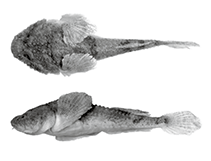
Benthophilus durrelli, Don tadpole-goby

Benthophilus durrelli Boldyrev & Bogutskaya, 2004

Don tadpole-goby
Hochladen Photos und videos
Bilder | Google Bild

Klassifizierung / Names Namen | Synonyme | Catalog of Fishes(Gattung, Arten) | ITIS | CoL | WoRMS | Cloffa

> Gobiiformes (Gobies) > Gobiidae (Gobies) > Gobiinae
Etymology: Benthophilus: Greek, benthos = depth of the sea + Greek, phyle, that loves (Ref. 45335).
Eponymy: Gerald ‘Gerry’ Malcolm Durrell (1925–1995) is best known for the Durrell Wildlife Preservation Trust, Jersey, Channel Islands. [...] (Ref. 128868), visit book page.

Umwelt: Milieu / Klimazone / Tiefenbereich / Verbreitungsgebiet Ökologie

; süßwasser; brackwasser demersal. Temperate

Verbreitung Territorien | FAO Gebiete | Ökosysteme | Vorkommen | Punkt Karte | Einführungen | Faunafri

Europe: Taganrog Bay of the Sea of Azov and Don River.

Größe / Gewicht / Alter

Geschlechtsreife: Lm ?  range ? - ? cm
Max length : 6.6 cm SL Männchen/unbestimmt; (Ref. 58669); max. veröff. Alter: 1.00 Jahre (Ref. 59043)

Kurzbeschreibung Bestimmungsschlüssel | Morphologie | Morphometrie

Wirbelzahl: 28 - 29. This species is distinguished from all congeners in the Black Sea basin by having the anal-fin origin in front of the vertical through the second dorsal-fin origin and by the combination of the following non-unique characters: body with three dark blotches; often dark spot on back just in front of second dorsal fin; tubercles relatively small so that tubercles and granules on head not clearly different in size; first semicircle blotch narrow, not extending origin of second dorsal fin; absence of granules on caudal peduncle; lm rows of neuromasts 15-21, commonly 17-18; second dorsal-fin segmented rays commonly 7½ -8½ (Ref. 58669).

Biologie     Fachlexikon (Englisch) (z.B. epibenthic)

Prefers fresh and brackish waters, mostly on river mouths (abundant), lower reaches of rivers and reservoirs and does not enter the sea (Ref. 58669, 59043). Lives on silty sand with mollusc shells; feeding mostly on molluscs and crustaceans. Life span about a year; spawns in May to August; females probably lay eggs in 2-3 portions inside or under a mollusc shell; and adults die soon after spawning (Ref. 59043). Invasive in the large tributaries of the Caspian and Black Sea (Ref. 92840).

Lebenszyklus und Paarungsverhalten Geschlechtsreife | Fortpflanzung | Ablaichen | Eier | Fruchtbarkeit | Larven

Hauptreferenz Laden Sie Ihre Referenzen hoch | Referenzen | Koordinator | Partner

Boldyrev, V.S. and N.G. Bogutskaya, 2007. Revision of the tadpole-gobies of the genus Benthophilus (Teleostei: Gobiidae). Ichthyol. Explor. Freshwat. 18(1):31-96. (Ref. 58669)

IUCN Rote Liste Status (Ref. 130435: Version 2025-2 (Global))

  nicht bedroht (LC) ; Date assessed: 13 January 2023

CITES

Not Evaluated

CMS (Ref. 116361)

Not Evaluated

Bedrohung für Menschen

  Harmless


Nutzung durch Menschen

FAO - Publication: search | FishSource |

Mehr Information

Trophische Ökologie
Lebensmittel (Beutetiere)
Nahrungszusammensetzung
Nahrungsaufnahme
Lebensmittelrationen
Räuber
Ökologie
Ökologie
Populationsdynamik
Wachstumsparameter
Max. Alter/Größen
Länge-Gewicht-Rel.
Länge-Länge-Verhältnis.
Längenhäufigkeiten
Massenkonvertierung
Rekrutierung
Dichte
Lebenszyklus
Fortpflanzung
Geschlechtsreife
Reifung/Kiemen rel.
Fruchtbarkeit
Ablaichen
Laichaggregationen
Eier
Eientwicklung
Larven
Larven Pop.Dyn.
Verbreitung
Territorien
FAO Gebiete
Ökosysteme
Vorkommen
Einführungen
BRUVS - Videos
Anatomie
Kiemenoberfläche
Gehirn
Otolith
Physiologie
Körperliche Zusammensetzung
Nährstoffe
Sauerstoffverbrauch
Schwimmart
Schwimmgeschwindigkeit
Visuelle Pigmente
Fischgeräusche
Krankheiten und Parasiten
Toxizität (LC50s)
Genetik
Genom
Genetik
Heterozygotie
Vererbbarkeit
Genetische Vielfalt
Menschenbezogen
Aquakultur-Systeme
Aquakultur Profile
Zuchtlinien
Ciguatera-Fälle
Briefmarken, Münzen, Verschiedenes.
Aufsuchen
Partner
Taxonomie
Namen
Synonyme
Morphologie
Morphometrie
Bilder
Referenzen
Referenzen

Tools

Zusatzinformationen

Download XML

Internet Quellen

AFORO (otoliths) | Aquatic Commons | BHL | Cloffa | Websites from users | FishWatcher Einträge suchen | CISTI | Catalog of Fishes: Gattung, Arten | DiscoverLife | ECOTOX | FAO - Publication: search | Faunafri | Fishipedia | Fishtrace | GloBI | Google Books | Google Scholar | Google | IGFA World Record | OneZoom | Open Tree of Life | Otolith Atlas of Taiwan Fishes | PubMed | Reef Life Survey | Socotra Atlas | TreeBase | Tree of Life | Wikipedia: Gehe zu, Suchen | World Records Freshwater Fishing | Zoobank | Zoologischer Rekord

Schätzungen auf der Grundlage von Modellen

Phylogenetischer Diversitätsindex (Ref. 82804):  PD50 = 0.5000   [Uniqueness, from 0.5 = low to 2.0 = high].
Bayesian length-weight: a=0.00741 (0.00347 - 0.01582), b=3.09 (2.91 - 3.27), in cm total length, based on LWR estimates for this (Sub)family-body shape (Ref. 93245).
Trophische Ebene (Ref. 69278):  3.3   ±0.3 se; based on size and trophs of closest relatives
Widerstandsfähigkeit (Ref. 120179):  hoch, Verdopplung der Population dauert weniger als 15 Monate. (Preliminary K or Fecundity.).
Anfälligkeit der Fischerei (Ref. 59153):  Low vulnerability (10 of 100). 🛈