



Phalloceros elachistos Lucinda, 2008
Córrego toothcarp
muatnaik fotos/gambar dan video
Gambar | imej Google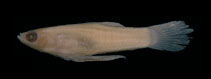 Phalloceros elachistos
Male foto/gambar oleh Lucinda, P.H.F.
Gambar | imej Google
Male foto/gambar oleh Lucinda, P.H.F.
klasifikasi / Nama Nama-nama umum | Sinonim (persamaan) | Catalog of Fishes(Marga, Jenis) | ITIS | CoL | WoRMS | Cloffa
> Cyprinodontiformes (Rivulines, killifishes and live bearers) > Poeciliidae (Poeciliids) > Poeciliinae
Etymology: Phalloceros: Greek, phallos = penis + Greek, keras = horn (Ref. 45335); elachistos: Specific name from the Greek elachis, small, short, little, plus the superlative ending -istos. Elachistos meaning the least, which alludes to the small size of the specimens. An adjective, gender masculine.
Etymology: Phalloceros: Greek, phallos = penis + Greek, keras = horn (Ref. 45335); elachistos: Specific name from the Greek elachis, small, short, little, plus the superlative ending -istos. Elachistos meaning the least, which alludes to the small size of the specimens. An adjective, gender masculine.
Lingkungan: lingkungan / zona iklim / kisaran kedalaman / jangkauan distribusi Ekologi
; air tawar pelagis, permukaan. Tropical
Penyebaran Wilayah | Daerah-daerah FAO | Ekosistem | Kemunculan | peta titik | Introduksi | Faunafri
South America: Brazil: Drainages of rio Doce, Santa Maria da Vitória, Jucu, and Timbuí, coastal drainages of Espírito Santo State of Brazil.
Ukuran / Berat / umur
deskripsi pendek Kunci identifiaksi (pengenalan) | Morfologi | Morfometrik
duri punggung lunak (Keseluruhan (total)) : 7 - 9; Sirip dubur lunak: 8 - 11; vertebrata, bertulang belakang: 31 - 33. Can be separated from Phalloceros anisophallos, Phalloceros megapolos, Phalloceros spiloura, Phalloceros reisi, Phalloceros buckupi, Phalloceros alessandrae, Phalloceros lucenorum, Phalloceros uai, Phalloceros pellos, and Phalloceros malabarbai by the female urogenital papilla straight along midline and located between the anus and the base of first anal-fin ray (vs. curved to the right, located laterally; border of the anal aperture in contact with the first anal-fin ray). Differs from Phalloceros tupinamba, Phalloceros leptokeras, and Phalloceros aspilos by the female urogenital papilla straight along midline (vs. slightly left turned); absence of a lateral ramus of the female urogenital papilla (vs. lateral ramus present); and small and simple hook in gonopodial appendix (vs. large sickle like hook). Can be distinguished from Phalloceros caudimaculatus, Phalloceros heptaktinos, Phalloceros ocellatus, Phalloceros mikrommatos, and Phalloceros leticiae by the possession of a hook in the gonopodial appendix (vs. hook absent). Readily distinguished from Phalloceros titthos by the absence of symphyseal papillae on mandible of largefemales (vs. symphyseal papillae present); and from Phalloceros enneaktinos by the possession of seven or eight dorsal-fin rays (vs. nine). Distinguished from P. harpagos by the hook of gonopodial appendix, which is very small in adults, forming a minute lateral protuberance (vs. not forming a lateral protuberance). In juveniles hook (usually) is absent or (rarely) minuscule. When present in juveniles hook never situated on the appendix corner (vs. present and located on the appendix corner). Juveniles never present skin covering the tip of appendix (vs. skin present). Distal half of appendix approximately as wide as (or slightly narrower than) proximal half (vs. narrower than proximal half) (Ref. 76852).
Siklus hidup dan perilaku kawin Kematangan | Reproduksi, perkembang biakan | Pemijahan | telur-telur | Fekunditas | Larva
rujukan utama
Unggah referensi Anda | Acuan | Koordinator | mitra
Lucinda, P.H.F., 2008. Systematics and biogeography of the genus Phalloceros Eigenmann, 1907 (Cyprinodontiformes: Poeciliidae: Poeciliinae), with the description of twenty-one new species. Neotrop. Ichthyol. 6(2):113-158. (Ref. 76852)
Status IUCN Red List (Ref. 130435: Version 2025-2 (Global))
kurang bimbang (LC) ; Date assessed: 07 November 2018
CITES
Not Evaluated
ancaman kepada manusia
Harmless
penggunaan manusia
FAO - Publication: search | FishSource |
informasi lanjut
Ekologi trofik
Item makanan (mangsa)
Komposisi makanan
Konsumsi makanan
Ransum makanan
Pemangsa
Item makanan (mangsa)
Komposisi makanan
Konsumsi makanan
Ransum makanan
Pemangsa
Ekologi
Ekologi
Ekologi
Dinamika populasi
Parameter pertumbuhan
Maks. usia / ukuran
Panjang-berat rel.
Panjang-panjang rel.
ukuran frekuensi
Konversi massa
pemulihan
Kelimpahan
Parameter pertumbuhan
Maks. usia / ukuran
Panjang-berat rel.
Panjang-panjang rel.
ukuran frekuensi
Konversi massa
pemulihan
Kelimpahan
Siklus hidup
Reproduksi, perkembang biakan
Kematangan
Kedewasaan / insang rel.
Fekunditas
Pemijahan
Agregasi pemijahan
telur-telur
pekembangan telor
Larva
Dinamika larva
Reproduksi, perkembang biakan
Kematangan
Kedewasaan / insang rel.
Fekunditas
Pemijahan
Agregasi pemijahan
telur-telur
pekembangan telor
Larva
Dinamika larva
Anatomi
Area insang
Otak
Otolith
Area insang
Otak
Otolith
Fisiologi
Komposisi tubuh
Nutrisi
Konsumsi oksigen
Jenis renang
Kecepatan berenang
Pigmen visual
Suara ikan
Penyakit & Parasit
Toksisitas (LC50)
Komposisi tubuh
Nutrisi
Konsumsi oksigen
Jenis renang
Kecepatan berenang
Pigmen visual
Suara ikan
Penyakit & Parasit
Toksisitas (LC50)
Genetika
genom
Genetika
Heterozigositas
Diturunkan
Keanekaragaman Genetik
genom
Genetika
Heterozigositas
Diturunkan
Keanekaragaman Genetik
Yang berhubungan dengan manusia
Sistem akuakultur
profil budidaya air
Strain
Kasus Ciguatera
Perangko, koin, dll.
Sistem akuakultur
profil budidaya air
Strain
Kasus Ciguatera
Perangko, koin, dll.
Alat, peralatan
E-book | Penuntun lapangan | tanda freqkuenci panjang | peringkat sejarah hidup | peta titik |
Tangkap-MSY |
laporan khas
muat turun XML
Sumber internet
AFORO (otoliths) | Aquatic Commons | BHL | Cloffa | Websites from users | semak peneliti ikan | CISTI | Catalog of Fishes: Marga, Jenis | DiscoverLife | ECOTOX | FAO - Publication: search | Faunafri | Fishipedia | Fishtrace | GloBI | Google Books | Google Scholar | Google | IGFA World Record | OneZoom | Open Tree of Life | Otolith Atlas of Taiwan Fishes | PubMed | Reef Life Survey | Socotra Atlas | TreeBase | Tree of Life | Wikipedia: pergi, Cari | World Records Freshwater Fishing | Zoobank | Catatan Zoologi
Estimasi berdasarkan model
Indeks keanekaragaman filogenetik (Acuan 82804): PD50 = 0.5000 [Uniqueness, from 0.5 = low to 2.0 = high].
Bayesian length-weight: a=0.00851 (0.00369 - 0.01962), b=3.15 (2.96 - 3.34), in cm total length, based on LWR estimates for this (Sub)family-body shape (Ref. 93245).
Tingkat Trofik (Acuan 69278): 3.0 ±0.4 se; based on size and trophs of closest relatives
Daya lenting (Acuan 120179): Tinggi, Waktu penggandaan populasi minimum kurang dari 15 bulan (Preliminary K or Fecundity.).