



Hochladen Photos und videos
Google Bild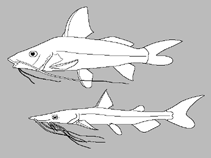 No image available for this species;
drawing shows typical species in Pimelodidae.
Google Bild
drawing shows typical species in Pimelodidae.
Klassifizierung / Names Namen | Synonyme | Catalog of Fishes(Gattung, Arten) | ITIS | CoL | WoRMS | Cloffa
> Siluriformes (Catfishes) > Pimelodidae (Long-whiskered catfishes)
Etymology: Pimelodus: Greek, pimele = fat + Greek, odous = teeth (Ref. 45335); pohli: Named for Mr. Johan B. Emanuel Pohl, a participant of the Austrian Mission to Brazil (1817-1836) with Johann Natterer, for collecting samples in several localities of the rio São Francisco drainage.
Eponymy: Johann Baptist Emanuel Pohl (1782–1834) was a physician, entomologist, botanist and geologist, born in what is now the Czech Republic. [...] (Ref. 128868), visit book page.
Etymology: Pimelodus: Greek, pimele = fat + Greek, odous = teeth (Ref. 45335); pohli: Named for Mr. Johan B. Emanuel Pohl, a participant of the Austrian Mission to Brazil (1817-1836) with Johann Natterer, for collecting samples in several localities of the rio São Francisco drainage.
Eponymy: Johann Baptist Emanuel Pohl (1782–1834) was a physician, entomologist, botanist and geologist, born in what is now the Czech Republic. [...] (Ref. 128868), visit book page.
Umwelt: Milieu / Klimazone / Tiefenbereich / Verbreitungsgebiet Ökologie
; süßwasser demersal. Tropical
Verbreitung Territorien | FAO Gebiete | Ökosysteme | Vorkommen | Punkt Karte | Einführungen | Faunafri
South America: Rio São Francisco drainage in Brazil.
Größe / Gewicht / Alter
Kurzbeschreibung Bestimmungsschlüssel | Morphologie | Morphometrie
Rückenflossenstacheln (insgesamt) : 1; Rückenflossenweichstrahlen (insgesamt) : 6; Wirbelzahl: 40 - 41. Distinguished from other species of Pimelodus by the following combination of characters: body deep, 21.2- 31.0% of SL; comparatively long adipose fin, occupying more than one third of the distance between posterior of the dorsal- fin base and vertical through the end of anal-fin base, 21.8- 26.2% of SL; upper jaw anteriorly projecting, exposing about half of the premaxillary tooth plate; the maxillary barbel slightly surpassing the caudal-fin base; supraoccipital process base broad, 21.6-29.1% of HL; bones of cranial roof ornamented with small granulations; narrow internarial anterior width 10.1-12.8% of HL; uniform gray color pattern, with few dark dots on anterolateral region of body in individuals greater than 10 cm SL (sometimes weak or absent) and three or four rows of small dark dots on sides of body in smaller specimens; and a dark longitudinal bar on ventral lobe of the caudal fin, sometimes
very faint. Can be differentiated from two species (Pimelodus fur and Pimelodus maculatus) occurring in the Rio São Francisco drainage. Differs from Pimelodus fur by having shorter adipose-fin (21.8- 26.2% vs. 26.0-30.0% SL), deeper head (61.5-79.0% vs. 42.3-50.2% HL); wider interorbital distance (21.9-30.4% vs. 12.1-14.9% HL); wider anterior internarial distance (10.1-12.8% vs. 6.9-8.4% HL); wider supraoccipital width (21.6-29.1% vs. 11.7-15.5% HL); longer snout (40.5-47.8% vs. 28.9-33.1% HL); and dorsal supraoccipital process surface conspicuously ornamented with small granulations (vs. supraoccipital with smooth surface). Can be separated from Pimelodus maculatus by possessing greater horizontal eye diameter (26.5-32.2% vs. 19.5-25.1% HL) and by the peculiar color pattern of this species in all ontogenetic stages, consisting of three rows of dark spots (vs. uniform gray color pattern, with a few darks dots on anterolateral region of the body, sometimes very weak or absent in individuals greater than 10 cm SL). Can be distinguished from other species of
Pimelodus described from the adjacent Paraná-Paraguay-Uruguay River drainages: Pimelodus mysteriosus has a very long maxillary barbel, reaching the tips of caudal-fin lobes (vs. maxillary barbel short slightly surpassing the caudal-fin base in Pimelodus pohli); Pimelodus ortmanni has dark spots on dorsal and caudal fins (vs. absent in Pimelodus pohli) ; Pimelodus platicirris and Pimelodus heraldoi have, respectively, three rows of spots and small dots irregularly placed forming eight to nine rows on the lateral of body (vs. dark spots when present restricted to the anterodorsal region of the body in specimens larger than 10 cm SL, in Pimelodus pohli); Pimelodus platicirris has a relatively longer snout and Pimelodus heraldoi has striated lips (vs. lips smooth in Pimelodus pohli) and smaller orbital diameter (19.4-26.0% HL vs. 26.5-32.2% HL in Pimelodus pohli); Pimelodus paranaensis and Pimelodus absconditus 1995 also have small spots on the body sides, but Pimelodus pohli differs from the former in having the premaxillary tooth plate with rounded posterolateral corners (vs. pointed in Pimelodus paranaensis) and from the latter by the poorly developed lips (vs. well developed in Pimelodus absconditus) (Ref. 75972).
Lebenszyklus und Paarungsverhalten Geschlechtsreife | Fortpflanzung | Ablaichen | Eier | Fruchtbarkeit | Larven
Hauptreferenz
Laden Sie Ihre Referenzen hoch | Referenzen | Koordinator | Partner
Ribeiro, F.R.V. and C.A.S. de Lucena, 2006. A new species of Pimelodus LaCépède, 1803 (Siluriformes: Pimelodidae) from the Rio São Francisco drainage, Brazil. Neotrop. Ichthyol. 4(4):411-418. (Ref. 75972)
IUCN Rote Liste Status (Ref. 130435: Version 2025-2 (Global))
nicht bedroht (LC) ; Date assessed: 07 November 2018
CITES
Not Evaluated
Bedrohung für Menschen
Harmless
Nutzung durch Menschen
FAO - Publication: search | FishSource |
Mehr Information
Trophische Ökologie
Lebensmittel (Beutetiere)
Nahrungszusammensetzung
Nahrungsaufnahme
Lebensmittelrationen
Räuber
Lebensmittel (Beutetiere)
Nahrungszusammensetzung
Nahrungsaufnahme
Lebensmittelrationen
Räuber
Ökologie
Ökologie
Ökologie
Populationsdynamik
Wachstumsparameter
Max. Alter/Größen
Länge-Gewicht-Rel.
Länge-Länge-Verhältnis.
Längenhäufigkeiten
Massenkonvertierung
Rekrutierung
Dichte
Wachstumsparameter
Max. Alter/Größen
Länge-Gewicht-Rel.
Länge-Länge-Verhältnis.
Längenhäufigkeiten
Massenkonvertierung
Rekrutierung
Dichte
Lebenszyklus
Fortpflanzung
Geschlechtsreife
Reifung/Kiemen rel.
Fruchtbarkeit
Ablaichen
Laichaggregationen
Eier
Eientwicklung
Larven
Larven Pop.Dyn.
Fortpflanzung
Geschlechtsreife
Reifung/Kiemen rel.
Fruchtbarkeit
Ablaichen
Laichaggregationen
Eier
Eientwicklung
Larven
Larven Pop.Dyn.
Anatomie
Kiemenoberfläche
Gehirn
Otolith
Kiemenoberfläche
Gehirn
Otolith
Physiologie
Körperliche Zusammensetzung
Nährstoffe
Sauerstoffverbrauch
Schwimmart
Schwimmgeschwindigkeit
Visuelle Pigmente
Fischgeräusche
Krankheiten und Parasiten
Toxizität (LC50s)
Körperliche Zusammensetzung
Nährstoffe
Sauerstoffverbrauch
Schwimmart
Schwimmgeschwindigkeit
Visuelle Pigmente
Fischgeräusche
Krankheiten und Parasiten
Toxizität (LC50s)
Genetik
Genom
Genetik
Heterozygotie
Vererbbarkeit
Genetische Vielfalt
Genom
Genetik
Heterozygotie
Vererbbarkeit
Genetische Vielfalt
Menschenbezogen
Aquakultur-Systeme
Aquakultur Profile
Zuchtlinien
Ciguatera-Fälle
Briefmarken, Münzen, Verschiedenes.
Aquakultur-Systeme
Aquakultur Profile
Zuchtlinien
Ciguatera-Fälle
Briefmarken, Münzen, Verschiedenes.
Tools
Zusatzinformationen
Download XML
Zusammenfassung | Punktdaten | Namen | Photos
Internet Quellen
AFORO (otoliths) | Aquatic Commons | BHL | Cloffa | Websites from users | FishWatcher Einträge suchen | CISTI | Catalog of Fishes: Gattung, Arten | DiscoverLife | ECOTOX | FAO - Publication: search | Faunafri | Fishipedia | Fishtrace | GloBI | Google Books | Google Scholar | Google | IGFA World Record | OneZoom | Open Tree of Life | Otolith Atlas of Taiwan Fishes | PubMed | Reef Life Survey | Socotra Atlas | TreeBase | Tree of Life | Wikipedia: Gehe zu, Suchen | World Records Freshwater Fishing | Zoobank | Zoologischer Rekord
Schätzungen auf der Grundlage von Modellen
Phylogenetischer Diversitätsindex (Ref. 82804): PD50 = 0.5000 [Uniqueness, from 0.5 = low to 2.0 = high].
Bayesian length-weight: a=0.00692 (0.00304 - 0.01573), b=3.10 (2.92 - 3.28), in cm total length, based on LWR estimates for this Genus-body shape (Ref. 93245).
Trophische Ebene (Ref. 69278): 3.2 ±0.5 se; based on size and trophs of closest relatives
Widerstandsfähigkeit (Ref. 120179): hoch, Verdopplung der Population dauert weniger als 15 Monate. (Preliminary K or Fecundity.).