



Abyssoberyx levisquamosus Merrett & Moore, 2005
Carregue seu(sua) Fotos e vídeos
Fotos | Imagem do Google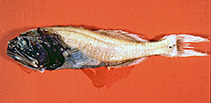 Abyssoberyx levisquamosus
Foto de Moore, J.
Fotos | Imagem do Google
Foto de Moore, J.
Classificação / Nomes Nomes comuns | Sinônimos | Catalog of Fishes(Gênero, Espécies) | ITIS | CoL | WoRMS | Cloffa
> Beryciformes (Sawbellies) > Stephanoberycidae (Pricklefishes)
Etymology: Abyssoberyx: Named for the great depth from which this fish was trawled; levisquamosus: Named for the smoothness of its scales.
Etymology: Abyssoberyx: Named for the great depth from which this fish was trawled; levisquamosus: Named for the smoothness of its scales.
Meio ambiente: milieu / Zona climática / intervalo de profundidade / faixa de distribuição Ecologia
marinhas batipelágico; intervalo de profundidade ? - 4565 m (Ref. 75592). Deep-water; 22°N - 20°N, 21°W - 31°W (Ref. 75592)
Distribuição Territórios | Áreas da FAO | Ecossistemas | Ocorrências | Mapa de pontos | Introduções | Faunafri
Eastern Central Atlantic. High Seas only.
Tamanho / Peso / Idade
Descrição suscinta Chaves de identificação | Morfologia | Morfometria
Vértebras: 32 - 34. This species have the following characters: cycloid scales; dorsal fin spines 1-2; gill rakers 5-7 + 14-15 (Ref. 75592).
Body shape (shape guide): fusiform / normal.
Body shape (shape guide): fusiform / normal.
This species is caught by bottom trawls (epibenthic sledge and semi-balloon otter trawl). The type series were collected at a single station where the terrain at these abyssal depths (4490-4640 m) is characterized by a complex topography of undulations, some hundreds of meters in height and where substratum is firm with very low megafaunal biomass. Lack of a rich benthic invertebrate fauna contrasts with the abundance and diversity of the fish fauna sampled. Also, this species occurred among 22 other species of Synaphobranchidae (1 species), Alepocephalidae (2), Ipnopidae (4), Bathysauridae (1), Ophidiidae (8), Aphyonidae (3) and Macrouridae (3). In overall abundance, it ranked fourth, equal to the ophidioid, Porogadus sp. (10 specimens), but less abundant than the ipnopids, Bathypterois longipes Günther, 1878 (24) and Bathymicrops regis Hjort & Koefoed, 1912 (28) and the ophidioid, Bathyonus laticeps (Günther, 1878) (51). Specimens (3) were examined internally, all females (15.2, 15.5, 16.8 cm SL), with ovaries in varying stages of yolk formation. Some 3-4 generations of oocytes were present in the ovaries. The ovaries of the 15.5 cm SL specimen were the most mature, with the most advanced generation (estimated at some thousands of ova) being c. 1 mm in diameter and containing a large oil globule. Also, intestinal contents of this specimen were chitinous remains, while that of the holotype bore a heavy infestation of cestode worms only (Ref. 75592).
Ciclo de vida ou comportamento de acasalamento Maturidade | Reprodução | Desova | Ovos | Fecundidade | Larvas
Referência principal
Carregar suas referências | Referências | Coordenador : Moore, Jon A. | Colaboradores
Merrett, N.R. and J.A. Moore, 2005. A new genus and species of deep demersal fish (Teleostei: Stephanobercidae) from the tropical eastern North Atlantic. J. Fish Biol. 67(6):1699-1710. (Ref. 75592)
Status na Lista Vermelha da UICN (Ref. 130435: Version 2025-2 (Global))
Dados insuficientes (DD) ; Date assessed: 15 July 2014
CITES
Not Evaluated
Ameaça para os humanos
Harmless
Uso pelos humanos
Pescarias: bycatch
FAO - Publication: search | FishSource |
Mais informação
Ecologia Trófica
Itens alimentares (presas)
Composição da dieta
Consumo alimentar
Rações alimentares
Predadores
Itens alimentares (presas)
Composição da dieta
Consumo alimentar
Rações alimentares
Predadores
Ecologia
Ecologia
Ecologia
Dinâmica populacional
Parâmetros de crescimento
Idade máxima / tamanhos
Relação comprimento-peso.
Relação comprimento-comprimento.
Frequências de comprimento
Conversão de massa
Recrutamento
Abundância
Parâmetros de crescimento
Idade máxima / tamanhos
Relação comprimento-peso.
Relação comprimento-comprimento.
Frequências de comprimento
Conversão de massa
Recrutamento
Abundância
Ciclo de vida
Reprodução
Maturidade
Maturidade/Rel. das guelras
Fecundidade
Desova
Agregações de desova
Ovos
Desenvolvimento dos ovos
Larvas
Dinâmica larval
Reprodução
Maturidade
Maturidade/Rel. das guelras
Fecundidade
Desova
Agregações de desova
Ovos
Desenvolvimento dos ovos
Larvas
Dinâmica larval
Anatomia
Área branquial
Cérebro
Otólito
Área branquial
Cérebro
Otólito
Fisiologia
Composição corporal
Nutrientes
Consumo de oxigênio
Tipo de natação
Velocidade de natação
Pigmentos visuais
Som de peixe
Doenças e Parasitas
Toxicidade (LC50s)
Composição corporal
Nutrientes
Consumo de oxigênio
Tipo de natação
Velocidade de natação
Pigmentos visuais
Som de peixe
Doenças e Parasitas
Toxicidade (LC50s)
Genética
genoma
Genética
Heterozigosidade
Hereditariedade
Diversidade genética
genoma
Genética
Heterozigosidade
Hereditariedade
Diversidade genética
Relacionado a humanos
Sistemas de aquicultura
Perfis para aquacultura
Estirpes
Casos de Ciguatera
Selos, moedas, diversos.
Sistemas de aquicultura
Perfis para aquacultura
Estirpes
Casos de Ciguatera
Selos, moedas, diversos.
Ferramentas
Livro eletrônico | Guia de campo | Ferramenta auxiliar de frequências de comprimento | Ferramenta sobre a história de vida | Mapa de pontos |
Catch-MSY |
Relatórios especiais
Checar Manutenção em Aquário | Checar Planilhas de Fatos sobre as Espécies | Checar Planilhas de Fatos sobre Aquicultura
Baixar XML
Fontes da internet
AFORO (otoliths) | Aquatic Commons | BHL | Cloffa | Websites from users | Checar Observador de Peixes (FishWatcher) | CISTI | Catalog of Fishes: Gênero, Espécies | DiscoverLife | ECOTOX | FAO - Publication: search | Faunafri | Fishipedia | Fishtrace | GloBI | Google Books | Google Scholar | Google | IGFA World Record | OneZoom | Open Tree of Life | Otolith Atlas of Taiwan Fishes | PubMed | Reef Life Survey | Socotra Atlas | TreeBase | Árvore da vida | Wikipedia: Ir para, procura | World Records Freshwater Fishing | Zoobank | Registro zoológico
Estimativas baseadas em modelos
Índice de diversidade filogenética (Ref. 82804): PD50 = 1.0625 [Uniqueness, from 0.5 = low to 2.0 = high].
Bayesian length-weight: a=0.01122 (0.00514 - 0.02450), b=3.04 (2.87 - 3.21), in cm total length, based on all LWR estimates for this body shape (Ref. 93245).
Nível Trófico (Ref. 69278): 3.4 ±0.5 se; based on size and trophs of closest relatives
Resiliência (Ref. 120179): médio(a), tempo mínimo de duplicação da população 1,4 - 4,4 anos (Preliminary K or Fecundity.).