



Mustelus albipinnis Castro-Aguirre, Antuna-Mendiola, González-Acosta & de la Cruz-Agüero, 2005
Whitemargin smoothhound
Lägg till din observation i Fish Watcher
| Native range | All suitable habitat | Point map | Year 2050 |

|
| This map was computer-generated and has not yet been reviewed. |
| Mustelus albipinnis AquaMaps Data sources: GBIF OBIS |
Ladda upp din foton och Videor
Google image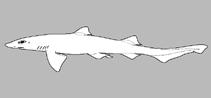 No image available for this species;
drawing shows typical species in Triakidae.
Google image
drawing shows typical species in Triakidae.
Klassificering / Namn Populärnamn | synonymer | Catalog of Fishes(Släkte, Arter) | ITIS | CoL | WoRMS | Cloffa
Elasmobranchii (hajar och rockor) (sharks and rays) > Carcharhiniformes (Ground sharks) > Triakidae (Houndsharks) > Triakinae
Etymology: Mustelus: Latin for weasel, an ancient name for sharks, possibly referring to the pointed snouts, swift movements and/or rapacious feeding behavior of smaller predatory sharks [strictly not tautonymous with Squalus mustelus Linnaeus 1758 since type was designated by the ICZN] (See ETYFish); albipinnis: albus (L.), white; pinnis (L.), fins, referring to white margin around dorsal, pectoral, pelvic and anal fins (See ETYFish).
Etymology: Mustelus: Latin for weasel, an ancient name for sharks, possibly referring to the pointed snouts, swift movements and/or rapacious feeding behavior of smaller predatory sharks [strictly not tautonymous with Squalus mustelus Linnaeus 1758 since type was designated by the ICZN] (See ETYFish); albipinnis: albus (L.), white; pinnis (L.), fins, referring to white margin around dorsal, pectoral, pelvic and anal fins (See ETYFish).
Miljö: miljö / Klimatzon / djupintervall / distributionsområde Ekologi
marina bentopelagisk; djupintervall 30 - 281 m (Ref. 30948). Tropical
Utbredning Territorier | FAO områden | Ekosystem | Förekomster | Prickkarta | Utplanteringar | Faunafri
Eastern Pacific: Gulf of California.
Storlek / Vikt / Ålder
Könsmognad: Lm ? range ? - ? cm
Max length : 109 cm TL hane/ej könsbestämd; (Ref. 30948); 118.0 cm TL (female)
Max length : 109 cm TL hane/ej könsbestämd; (Ref. 30948); 118.0 cm TL (female)
Kort beskrivning Bestämningsnycklar | Morfologi | Morfometri
Description of Mustelus hacat: this species differs from its congeners in having a uniformly dark gray brown color above and conspicuously having white tips and trailing edges of the dorsal, pectoral, anal, and caudal fins. Although some specimens of M. lunulatus and newborn pups and juveniles of M. canis from the western Atlantic, have tips and trailing edges of first dorsal, pectoral, anal, and caudal fins transparent or pale white, they clearly differ from this species in having less contrasted dorsal color compared with tips and trailing edges of the fins. Mustelus hacat is distinguished from the other eastern North Pacific species of Mustelus in having: 1) upper jaw teeth cuspidate and distinctly asymmetric, with low rounded cusp (teeth of californicus and lunulatus are from molariform to cuspidate and slightly asymmetric, with blunt to low rounded cusp, whereas henlei
and dorsalis have cuspidate and slightly asymmetric, with high sharp cusp teeth); 2) upper jaw labial folds notably longer than the lower folds, only similar to henlei (californicus has upper and lower jaw labial folds about equal in length, lunulatus has upper jaw labial folds notably shorter than lower jaw labial folds, and dorsalis has upper jaw labial folds slightly longer than lower jaw labial folds); 3) posterior margin of first dorsal fin vertical from apex, only similar to lunulatus, californicus, henlei, and dorsalis have the first dorsal fin with sloping posterior margin); 4) inter-nostril space wide (49-58 vs. 33-49% pre-oral length for all other four species); and 5) inter-orbital space wide (5.6-6.8 vs. 4.3-5.6% TL for californicus, henlei, lunulatus, but similar to dorsalis 5.7-7.5% TL) (Ref. 30948).
Body shape (shape guide): elongated.
Body shape (shape guide): elongated.
Information for Mustelus hacat include mode of reproduction is placental viviparity, having a brood size of 3 to 23 (mean 16); embryo measures 25-34 cm TL (mean 29 cm); young born probably between 30-35 cm TL; females mature between 94-98 cm and males between 90-99 cm TL. Caught by trawlers (Ref. 30948).
Livscykel och parningsbeteende Könsmognad | Reproduktion | Lek | Ägg | Fekunditet | Larver
Huvudreferens
Ladda upp dina referenser | referenser | Koordinator : Compagno, Leonard J.V. | Medarbetare
Castro-Aguirre, J.L., A. Antuna-Mendiola, A.F. González-Acosta and J. De la Cruz-Agüero, 2005. Mustelus albipinnis sp. Nov. (Chondrichthyes: Carcharhiniformes: Triakidae) from the southwestern coast of Baja California Sur, México. Hidrobiológica 15(2):123-130. (Ref. 91262)
Status på IUCN:s rödlista (Ref. 130435: Version 2025-2 (Global))
Least Concern (LC) ; Date assessed: 06 February 2019
CITES
Not Evaluated
Hot mot människor
Harmless
Mänskliga användningsområden
Fiskeri: bycatch
FAO - Publication: search | FishSource |
Ytterligare information
Trofisk ekologi
Livsmedelsartiklar (preys)
Födosammansättning
Födointag
Matransoner
Predatorer
Livsmedelsartiklar (preys)
Födosammansättning
Födointag
Matransoner
Predatorer
Ekologi
Ekologi
Ekologi
Populationsdynamik
Tillväxtparametrar
Max. åldrar / storlekar
Längd-vikt rel.
Längd-längd rel.
Längd-frekvenser
Massakonvertering
Rekrytering
Abundans
Tillväxtparametrar
Max. åldrar / storlekar
Längd-vikt rel.
Längd-längd rel.
Längd-frekvenser
Massakonvertering
Rekrytering
Abundans
Livscykel
Reproduktion
Könsmognad
Mognad/Gills rel.
Fekunditet
Lek
Lekande aggregat
Ägg
Utveckling av ägg
Larver
Larvdynamik
Reproduktion
Könsmognad
Mognad/Gills rel.
Fekunditet
Lek
Lekande aggregat
Ägg
Utveckling av ägg
Larver
Larvdynamik
Anatomi
Gälyta
Hjärna
Otolit
Gälyta
Hjärna
Otolit
Fysiologi
Kroppssammansättning
Näringsämnen
Syreförbrukning
Typ av simning
Simhastighet
Visuella pigment
Ljud från fisk
Sjukdomar & Parasiter
Toxicitet (LC50)
Kroppssammansättning
Näringsämnen
Syreförbrukning
Typ av simning
Simhastighet
Visuella pigment
Ljud från fisk
Sjukdomar & Parasiter
Toxicitet (LC50)
Genetik
Genom
Genetik
Heterozygositet
Ärftlighet
Genetisk mångfald
Genom
Genetik
Heterozygositet
Ärftlighet
Genetisk mångfald
Människorelaterad
Vattenbrukssystem
Vattenbruksprofiler
Avelslinjer
Ciguatera-fall
Frimärken, mynt, diverse.
Vattenbrukssystem
Vattenbruksprofiler
Avelslinjer
Ciguatera-fall
Frimärken, mynt, diverse.
Verktyg
Särskilda rapporter
Kontrollera för underhåll av akvarium | Kontrollera om det finns faktablad om arter | Kontrollera om det finns faktablad om vattenbruk
Ladda ner XML
Internet-källor
AFORO (otoliths) | Aquatic Commons | BHL | Cloffa | Websites from users | Check FishWatcher | CISTI | Catalog of Fishes: Släkte, Arter | DiscoverLife | ECOTOX | FAO - Publication: search | Faunafri | Fishipedia | Fishtrace | GloBI | Google Books | Google Scholar | Google | IGFA World Record | OneZoom | Open Tree of Life | Otolith Atlas of Taiwan Fishes | PubMed | Reef Life Survey | Socotra Atlas | TreeBase | Tree of Life | Wikipedia: Go, sök | World Records Freshwater Fishing | Zoobank | Zoologiskt register
Uppskattningar baserade på modeller
Önskad temperatur (Ref. 123201): 12.6 - 20.1, mean 15.3 °C (based on 41 cells).
Index för fylogenetisk mångfald (Ref. 82804): PD50 = 0.5000 [Uniqueness, from 0.5 = low to 2.0 = high].
Bayesian length-weight: a=0.00229 (0.00107 - 0.00491), b=3.14 (2.97 - 3.31), in cm total length, based on LWR estimates for this Genus-body shape (Ref. 93245).
Trofisk nivå (Ref. 69278): 3.6 ±0.4 se; based on size and trophs of closest relatives
Resiliens (Ref. 120179): Mellan, lägsta populationsfördubblingstid 1,4-4,4 år (Preliminary K or Fecundity.).
Näringsämnen (Ref. 124155): Calcium = 19.9 [5.8, 106.3] mg/100g; Iron = 0.373 [0.105, 1.367] mg/100g; Protein = 20.3 [18.0, 22.7] %; Omega3 = 0.0904 [, ] g/100g; Selenium = 96.1 [27.3, 382.5] μg/100g; VitaminA = 18.1 [5.9, 54.2] μg/100g; Zinc = 0.985 [0.423, 2.081] mg/100g (wet weight);