



Hexanchus griseus (Bonnaterre, 1788)
Bluntnose sixgill shark
Добавить Ваши наблюдения в Fish Watcher
| Native range | All suitable habitat | Point map | Year 2050 |

|
| This map was computer-generated and has not yet been reviewed. |
| Hexanchus griseus AquaMaps Data sources: GBIF OBIS |
Загрузить свой Фото и Видео
изображения | Видео | Марки, монеты и прочее. | Изображение на Google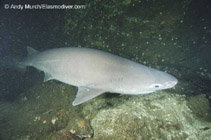 Hexanchus griseus
Изображение сделано Murch, A.
изображения | Видео | Марки, монеты и прочее. | Изображение на Google
Изображение сделано Murch, A.
Классификация / Имена народные названия | синонимы | Catalog of Fishes(род, виды) | ITIS | CoL | WoRMS | Cloffa
Пластиножаберные (акулы и скаты) (sharks and rays) > Hexanchiformes (Frill and cow sharks) > Hexanchidae (Cow sharks)
Etymology: Hexanchus: hex (Gr.), six; anchus, etymology unclear, perhaps anchos (Gr.), choke or throttle, referring to how six gill openings of H. griseus extend down onto the throat (See ETYFish); griseus: Medieval Latin for gray, reflecting the French vernacular “Le Griset,” referring to its dark-gray coloration (See ETYFish).
More on author: Bonnaterre.
Etymology: Hexanchus: hex (Gr.), six; anchus, etymology unclear, perhaps anchos (Gr.), choke or throttle, referring to how six gill openings of H. griseus extend down onto the throat (See ETYFish); griseus: Medieval Latin for gray, reflecting the French vernacular “Le Griset,” referring to its dark-gray coloration (See ETYFish).
More on author: Bonnaterre.
Окружающая среда: среда / климатическая зона / пределы глубины / диапазон распространения экология
морской батидемерсальный; мигрирует в океане (Ref. 87829); пределы глубины 0 - 2500 m (Ref. 132203), usually 180 - 1100 m (Ref. 45445). Subtropical; 6°C - 10°C (Ref. 125614); 65°N - 48°S, 180°W - 180°E
распространение Территории | регионы FAO | Экосистемы | места находок | карта точек | интродукции | Faunafri
Circumglobal with patchy distribution and possibly absent from Arctic and Antarctic. Highly migratory species.
Длина при первой зрелости / Размер / Вес / Возраст
половая зрелость: Lm 441.0, range 400 - 482 cm
Max length : 600 cm TL самец/пол неопределен; (Ref. 124786); common length : 300 cm TL самец/пол неопределен; (Ref. 5217); наибольший вес (опубликованные данные): 590.0 kg (Ref. 27436)
Max length : 600 cm TL самец/пол неопределен; (Ref. 124786); common length : 300 cm TL самец/пол неопределен; (Ref. 5217); наибольший вес (опубликованные данные): 590.0 kg (Ref. 27436)
Краткое описание определительные ключи | морфология | морфометрия
колючие лучи спинного плавника (общее число) : 0; колючие лучи анального плавника: 0. A heavily-bodied, broad-headed sixgill shark, mouth ventral with 6 rows of lower, bladelike, comb-shaped teeth on each side (Ref. 247). Snout broadly rounded, body fusiform (Ref. 6871). Anal fin smaller than dorsal fin (Ref. 6871). Brown or grey above, paler below, with a light stripe along side (Ref. 26346). Fins with white edges (Ref. 6574). Live specimens with fluorescent green eyes (Ref. 6871). Six gill slits are very long (Ref. 35388).
Body shape (shape guide): elongated.
Body shape (shape guide): elongated.
Depth range reported at 0m-2500m (Ref. 125614). A deepwater species of the outer continental and insular shelves and upper slopes (Ref. 6871, 75154), islands, seamounts and mid-ocean ridges (Ref. 125614). Near bottom, occasionally pelagic, adults usually below 91 m (Ref. 58302). Juveniles may be found close inshore (Ref. 6871), while nursery areas are in very shallow waters (Ref. 125614). Found on the bottom by day, moving to the surface at night to feed, and where it may take longlines set for other species (Ref. 45445). Depth distribution related to growth and temperature, with juveniles having most shallow records and from colder, poleward regions (Ref. 58302). Generally occurs at a bottom temperature of 6 to 10°C (Ref. 125614). Feeds on a wide range of marine organisms, including other sharks, rays, chimaeras, bony fish, squids, crabs, shrimps, carrion, and even seals (Ref. 26969). Large sharks (at least 2m) take cetaceans and seals. Viviparous, very large litters of 47-108 pups (Ref. 125614). Give birth to almost 100 young (Ref. 35388). Young and adults may be segregated, with the young using inshore nursery grounds. Possibly long-lived (Ref. 125614). Is a eurytrophic predator that is capable of exploiting a wide range of prey species and habitats (Ref. 26969). A vertical migrant, it may sit on the bottom by day, and rise to the surface at night to feed (Ref. 247). It occurs alone or in groups. Adults are more sensitive to light than the juveniles and less seen in clear shallow waters, but more prevalent at night or areas with dense plankton blooms (Ref. 125614). It is locally common in bycatch and target fisheries for food, fishmeal and oil, and in sports fisheries, but vulnerable to overfishing and requires careful management (Ref. 125614). Marketed fresh, frozen, or dried salted (Ref. 247). Not known to have attacked people without provocation (Ref. 247).
Жизненный цикл и брачное поведение половая зрелость | размножение | нерест | икра | Плодовитость | личинки
Viviparous, very large litters of 47-108 pups (Ref. 125614). Size at birth 60-75 cm (Ref. 26346). Distinct pairing with embrace (Ref. 205).
Основная ссылка
Загрузите свои рекомендации | ссылки | координатор : Compagno, Leonard J.V. | соавторы
Ebert, D.A., S. Fowler and M. Dando, 2021. Sharks of the World: A complete guide. Princeton University Press, 607 p. (Ref. 125614)
Статус Красного Списка МСОП (Ref. 130435: Version 2025-2 (Global))
Близок к исчезновению (NT) (A2bd); Date assessed: 21 November 2019
CITES
Not Evaluated
Угроза для людей
Other (Ref. 4690)
Использование человеком
рыболовство: коммерческий; объект спортивного рыболовства: да
FAO - рыболовство: посадки, Видовой профиль; Publication: search | FIRMS - Stock assessments | FishSource | Море вокруг нас
дополнительная информация
Трофическая экология
Пищевые предметы (добыча)
состав пищи
потребление пищи
Продовольственные пайки
хищники
Пищевые предметы (добыча)
состав пищи
потребление пищи
Продовольственные пайки
хищники
Динамика численности населения
Параметры роста
Макс. возраст / размер
Отношение длины к весу.
Отношение длины к длине.
Размерный состав
Преобразование массы
пополнение
численность
Параметры роста
Макс. возраст / размер
Отношение длины к весу.
Отношение длины к длине.
Размерный состав
Преобразование массы
пополнение
численность
Жизненный цикл
размножение
половая зрелость
Зрелость/Жиры относительно.
Плодовитость
нерест
Нерестовые скопления
икра
Развитие икры
личинки
динамика численности личинок
размножение
половая зрелость
Зрелость/Жиры относительно.
Плодовитость
нерест
Нерестовые скопления
икра
Развитие икры
личинки
динамика численности личинок
Физиология
Состав тела
Питательные вещества
Потребление кислорода
Тип плавания
Скорость плавания
Зрительные пигменты
Звук рыбы
Болезни и паразиты
Токсичность (LC50s)
Состав тела
Питательные вещества
Потребление кислорода
Тип плавания
Скорость плавания
Зрительные пигменты
Звук рыбы
Болезни и паразиты
Токсичность (LC50s)
Связанные с человеком
Системы аквакультуры
особенности рыбоводства
степень растяжения
Случаи заболевания сигуатерой
Марки, монеты и прочее.
Системы аквакультуры
особенности рыбоводства
степень растяжения
Случаи заболевания сигуатерой
Марки, монеты и прочее.
инструменты
Электронная книга | полевой определитель | определительные ключи | Длина-Частота | онтогенез | карта точек |
Catch-MSY |
Специальные отчеты
Проверить содержание в аквариумах | Проверить опубликованные видовые данные | Проверить опубликованные данные по аквакультуре
Скачать в формате XML
ресурсы в Интернет
AFORO (otoliths) | Aquatic Commons | BHL | Cloffa | Websites from users | Проверить FishWatcher | CISTI | Catalog of Fishes: род, виды | DiscoverLife | DORIS | ECOTOX | FAO - рыболовство: посадки, Видовой профиль; Publication: search | Faunafri | Fishipedia | Fishtrace | GloBI | Google Books | Google Scholar | Google | IGFA World Record | национальные базы данных | OceanAdapt | OneZoom | Open Tree of Life | Otolith Atlas of Taiwan Fishes | PubMed | Reef Life Survey | Socotra Atlas | TreeBase | Tree of Life | Wikipedia: Вперёд, поиск | World Records Freshwater Fishing | Зоологическая летопись
Оценки, основанные на моделях
Предпочтительная температура (ссылка 123201): 3.6 - 15.7, mean 8.1 °C (based on 3800 cells).
Индекс филогенетического разнообразия (ссылка 82804): PD50 = 0.6641 [Uniqueness, from 0.5 = low to 2.0 = high].
Bayesian length-weight: a=0.00081 (0.00049 - 0.00135), b=3.23 (3.08 - 3.38), in cm total length, based on LWR estimates for this species & (Sub)family-body (Ref. 93245).
Трофический уровень (ссылка 69278): 4.5 ±0.2 se; based on diet studies.
устойчивость к внешним воздействиям (ссылка 120179): низкий, минимальное время удвоения популяции 4.5-14 лет (Fec= 22-108).
Питательные вещества (Ref. 124155): Calcium = 8.75 [2.27, 47.99] mg/100g; Iron = 0.664 [0.163, 2.072] mg/100g; Protein = 19.5 [17.5, 21.5] %; Omega3 = 0.24 [0.10, 0.59] g/100g; Selenium = 79.6 [24.5, 261.1] μg/100g; VitaminA = 3.68 [0.99, 13.90] μg/100g; Zinc = 0.324 [0.155, 0.615] mg/100g (wet weight);