



Acanthopagrus latus (Houttuyn, 1782)
Yellowfin seabream
Waarneming toevoegen in Fish Watcher
| Native range | All suitable habitat | Point map | Year 2050 |

|
| This map was computer-generated and has not yet been reviewed. |
| Acanthopagrus latus AquaMaps Data sources: GBIF OBIS |
Uploaden van uw Foto's en video's
Afbeeldingen | Google afbeelding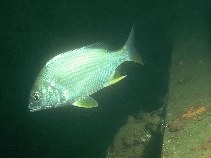 Acanthopagrus latus
Afbeelding van Cook, D.C.
Afbeeldingen | Google afbeelding
Afbeelding van Cook, D.C.
Classificatie / Namen Lokale namen | Synoniemen | Catalog of Fishes(Genus, Soort(en)) | ITIS | CoL | WoRMS | Cloffa
> Eupercaria/misc (Various families in series Eupercaria) > Sparidae (Porgies)
Etymology: Acanthopagrus: Greek, akantha = thorn + Greek, pagros, a kind of fish (Ref. 45335).
Etymology: Acanthopagrus: Greek, akantha = thorn + Greek, pagros, a kind of fish (Ref. 45335).
Milieu: milieu / Klimaatzone / Diepte / verspreidingsgebied Ecologie
marien; zoet water; brak water demersaal. Subtropical; 34°N - 15°N, 105°E - 137°E
Verspreiding Gebieden | FAO regio's | Ecosystemen | Voorkomen | Verspreidingskaart | Introducties | Faunafri
Northwest Pacific: limited to the east Asia Shelf, recorded only from the coasts of Honshu (including Seto Inland Sea), Shikoku and Kyushu Is., Japan (not Ryukyu and Ogasawara Is. or Sea of Japan), southern Korea, Taiwan, China (from around Shanghai to southern China) and northern Vietnam (south to Hué). Previous reports from other areas of the Indo-Pacific are misidentifications of species within the A. latus species complex.
Lengte bij maturiteit / Grootte / Gewicht / Leeftijd
Maturiteit: Lm 24.4 range ? - ? cm
Max length : 40.0 cm FL mannelijk / geslacht onbekend; (Ref. 108874); max. gepubliceerd gewicht: 1.5 kg (Ref. 40637)
Max length : 40.0 cm FL mannelijk / geslacht onbekend; (Ref. 108874); max. gepubliceerd gewicht: 1.5 kg (Ref. 40637)
Korte beschrijving Determinatiesleutels | Morfologie | Morfometrie
Dorsale stekels (totaal) : 11; Dorsale zachte stralen (totaal) : 10 - 11; Anale stekels: 8 - 9; Wervels: 24. This species is distinguished from its congeners by the following set of characteristics: generally deep body in young specimens, becoming slender in larger adults, 2.14-2.70 (mean 2.42) times in SL: D usually XI,11 (very rarely XI,10); scale rows between fifth dorsal-fin spine and lateral line 3.5-4.5 (3.5 often observed in northwestern Kyushu Island and Seto Inland Sea, Japan, southern Korea and Vietnam, and in pre c. 1980 specimens in China, Taiwan and Japan; pers. obs.); scale rows above lateral line 4.5-5.5, scale rows below 10.5-12.5; second anal-fin spine longer than third anal-fin spine [14.6-24.8% (mean 20.6%) of SL], 1.19-1.58 (mean 1.40) in 2AS and 3AS; pored
lateral-line scales 44-47 (mean 45.2); the first soft dorsal-fin ray slightly longer than last dorsal-fin
spine; color of pelvic, anal and caudal fins mostly whitish yellow to strong vivid yellow, except contrasting lower yellow margin on caudal fin; black streaks near anal-fin base on inter-radial membranes between yellow anal-fin rays, even in preserved specimens; no black blotches on inter-radial membranes between dorsal-fin rays; a weak diffuse dark blotch at origin of lateral line (usually covering region of first pored lateral-line scale) continuing as relatively dense blackish shading on upper part of posterior opercle (Ref. 93743).
Body shape (shape guide): short and / or deep; Cross section: compressed.
Body shape (shape guide): short and / or deep; Cross section: compressed.
This species inhabits warm shallow and coastal waters, often entering river mouths and estuaries (Ref. 93743). Used in Chinese medicine (Ref. 12166). It is parasitised by the monogenean Anoplodiscus australis on the fins and body surface (Ref. 124057).
Levenscyclus en paargedrag Maturiteit | Voortplanting | Paaien | Eieren | Fecunditeit | Larven
Hoofdreferentie
Upload uw referenties | Referenties | Coördinator | Medewerkers
Iwatsuki, Y., 2013. Review of the Acanthopagrus latus complex (Perciformes: Sparidae) with descriptions of three new species from the Indo-West Pacific Ocean. J. Fish Biol. 83(1):64-95. (Ref. 93743)
Status op de Rode Lijst van het IUCN (Ref. 130435: Version 2025-2 (Global))
Onvoldoende gegevens (DD) ; Date assessed: 03 December 2009
CITES
Not Evaluated
Gevaar voor de mens
Harmless
Gebruik door de mens
Visserij: commercieel; Aquacultuur: commercieel; sportvis: ja
FAO - Aquacultuursystemen: productie; visserij: aanvoer; Publication: search | FishSource | Sea Around Us
Meer informatie
Trofische ecologie
Voedsel (prooien)
Dieetsamenstelling
Voedselconsumptie
Voedselrantsoenen
Predatoren
Voedsel (prooien)
Dieetsamenstelling
Voedselconsumptie
Voedselrantsoenen
Predatoren
Populatiedynamica
Groeiparameters
Max. leeftijden / maten
Lengte-gewicht rel.
Lengte-lengte rel.
Lengtefrequenties
Massaconversie
Rekrutering
Abundantie
Groeiparameters
Max. leeftijden / maten
Lengte-gewicht rel.
Lengte-lengte rel.
Lengtefrequenties
Massaconversie
Rekrutering
Abundantie
Levenscyclus
Voortplanting
Maturiteit
Rijpheid/kieuwen rel.
Fecunditeit
Paaien
Paaibestanden
Eieren
Ontwikkeling van de eieren
Larven
Larvale populatiedynamiek
Voortplanting
Maturiteit
Rijpheid/kieuwen rel.
Fecunditeit
Paaien
Paaibestanden
Eieren
Ontwikkeling van de eieren
Larven
Larvale populatiedynamiek
Anatomie
Kieuwoppervlak
Hersenen
Otoliet
Kieuwoppervlak
Hersenen
Otoliet
Fysiologie
Lichaamssamenstelling
Voedingsstoffen
Zuurstofverbruik
Type zwemmen
Zwemsnelheid
Visuele pigmenten
Vis geluid
Ziekten en parasieten
Toxiciteit (LC50)
Lichaamssamenstelling
Voedingsstoffen
Zuurstofverbruik
Type zwemmen
Zwemsnelheid
Visuele pigmenten
Vis geluid
Ziekten en parasieten
Toxiciteit (LC50)
Menselijk gerelateerd
Aquacultuursystemen
Aquacultuurprofielen
Kweeklijnen
Ciguatera gevallen
Postzegels, munten, diversen.
Aquacultuursystemen
Aquacultuurprofielen
Kweeklijnen
Ciguatera gevallen
Postzegels, munten, diversen.
Tools
Biologische quiz | E-boek | Veldgids | Determinatiesleutels | Lengtefrequentie Tool | Levenscyclus tool | Verspreidingskaart |
Vangst-MSY |
Speciale rapporten
Bekijk gegevens voor het houden in een aquarium | Bekijk Fact Sheets voor de soort | Bekijk Aquacultuur Fact Sheets
Download XML
Internetbronnen
AFORO (otoliths) | Aquatic Commons | BHL | Cloffa | Websites from users | Bekijk FishWatcher | CISTI | Catalog of Fishes: Genus, Soort(en) | DiscoverLife | ECOTOX | FAO - Aquacultuursystemen: productie; visserij: aanvoer; Publication: search | Faunafri | Fishipedia | Fishtrace | GloBI | Google Books | Google Scholar | Google | IGFA World Record | Nationale databanken | OneZoom | Open Tree of Life | Otolith Atlas of Taiwan Fishes | PubMed | Reef Life Survey | Socotra Atlas | TreeBase | Tree of Life | Wikipedia: ga naar, zoek | World Records Freshwater Fishing | Zoological Record
Schattingen op basis van modellen
Gewenste temperatuur (Ref. 123201): 21.7 - 28.5, mean 27.4 °C (based on 644 cells).
Fylogenetische diversiteitsindex (Ref. 82804): PD50 = 0.5000 [Uniqueness, from 0.5 = low to 2.0 = high].
Bayesian length-weight: a=0.01622 (0.01306 - 0.02014), b=2.96 (2.92 - 3.00), in cm total length, based on LWR estimates for this species (Ref. 93245).
Trofisch niveau (Ref. 69278): 3.8 ±0.43 se; based on food items.
Weerstandsvermogen (Ref. 120179): Gemiddeld, minimale populatieverdubbelingstijd 1,4-4,4 jaar (K=0.21; Fec=1,811,434).
Prior r = 0.53, 95% CL = 0.35 - 0.79, Based on 1 data-limited stock assessment.
Voedingsstoffen (Ref. 124155): Calcium = 87.2 [43.9, 161.3] mg/100g; Iron = 1.02 [0.56, 2.12] mg/100g; Protein = 19.6 [18.5, 20.8] %; Omega3 = 0.31 [0.18, 0.53] g/100g; Selenium = 19.5 [9.0, 40.3] μg/100g; VitaminA = 8.92 [2.50, 30.68] μg/100g; Zinc = 0.745 [0.490, 1.109] mg/100g (wet weight);