



Загрузить свой Фото и Видео
Изображение на Google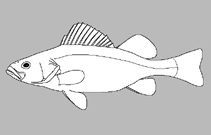 No image available for this species;
drawing shows typical species in Percidae.
Изображение на Google
drawing shows typical species in Percidae.
Классификация / Имена народные названия | синонимы | Catalog of Fishes(род, виды) | ITIS | CoL | WoRMS | Cloffa
> Perciformes/Percoidei (Perchs) > Percidae (Perches) > Etheostomatinae
Etymology: Percina: Latin, diminutive of perch = perch (Ref. 45335); sipsi: The specific name, sipsi, is the Chickasaw-Choctaw Indian name for poplar or cottonwood tree, and is the origin of “Sipsey” in the stream name, Sipsey Fork of the Black Warrior River (Foscue 1989), to which this species is endemic. The common name,.
Etymology: Percina: Latin, diminutive of perch = perch (Ref. 45335); sipsi: The specific name, sipsi, is the Chickasaw-Choctaw Indian name for poplar or cottonwood tree, and is the origin of “Sipsey” in the stream name, Sipsey Fork of the Black Warrior River (Foscue 1989), to which this species is endemic. The common name,.
Окружающая среда: среда / климатическая зона / пределы глубины / диапазон распространения экология
; пресноводный донно-пелагический; пределы глубины 0 - 2 m (Ref. 58738). Temperate; 35°N - 33°N, 88°W - 86°W
распространение Территории | регионы FAO | Экосистемы | места находок | карта точек | интродукции | Faunafri
North America: United States of America. Percina sipsi is known only from the Sipsey Fork of the Black Warrior River in the Bankhead National Forest in northwestern Alabama. It occurs in Borden Creek in Lawrence County, and Brushy Creek, Caney Creek, and Sipsey Fork (recorded as West Fork Sipsey River on some maps) in Winston County. While the current known range of P. sipsi is very limited and confined downstream by Lewis Smith Reservoir, historically it is possible that the species ranged farther downstream in the Sipsey Fork and conceivably in the Locust and Mulberry forks of the Black Warrior River, which are all located in the Cumberland Plateau physiographic province. Riverine habitat in the lower reaches of the Sipsey Fork was destroyed in 1960 by the Alabama Power Company impoundment behind Lewis Smith Dam. The current distribution of P. sipsi represents the most restricted range of any known species of Percina (Ref. 58738).
Размер / Вес / Возраст
Краткое описание определительные ключи | морфология | морфометрия
Percina sipsi is one of the two smallest species in the genus Percina, rarely exceeding 50 mm SL (P. brevicauda, maximum SL is 50 mm, see Suttkus et al. 1994). Percina sipsi is distinguished from all other described species of Percina by a combination of the following characteristics: absence of bright colors on body and fins of adults; no orange band in spinous dorsal fin; no broad vertical bands on body extending dorsally across the back joining those of the other side;
7–11 lateral blotches fused into continuous dark brown to black lateral stripe with undulating margins; lateral stripe continuous with large, somewhat quadrate basicaudal blotch that extends onto base of caudal fin rays; small, dark blotch on upper and lower portion of caudal fin base, dorsal blotch typically darker; body below
lateral stripe white to cream colored, without dark blotches, becoming dusky in breeding males; suborbital bar absent or very poorly developed; lateral line complete, typically no pored scales on base of caudal fin; males with row of modified scales on midline of belly and one or two modified scales between base of pelvic fins;modified breast scale absent; nuptial tubercles absent; anal fin of breeding males not excessively elongate; males without caudal keel as a ventral extension of the caudal peduncle; snout does not project beyond anterior margin of upper jaw; broad premaxillary frenum present; serrae on margin of preopercle absent; branchiostegal membranes very narrowly joined to overlapping (Ref. 58738).
Body shape (shape guide): elongated.
Body shape (shape guide): elongated.
Ramsey (1976) published the first conservation status review of Percina sipsi and reported it to be a threatened species. Although the assigned conservation status category has varied in subsequent evaluations (Deacon et al. 1979; Ramsey 1984; Williams et al. 1989; Warren et al. 2000), all authors considered the Bankhead Darter’s continued existence to be in a precarious situation. In the most recent assessment of conservation status of Alabama wildlife, Kuhajda (2004) reported it as a species of highest conservation concern. The entire range of this species is in the Bankhead National Forest, providing some level of protection. the authors consider P. sipsi to be highly endangered based on its restricted distribution, rarity within the occupied range, habitat vulnerability, and absence of downstream habitat for future recovery. Percina sipsi is extremely vulnerable and needs continuous monitoring and proactive management actions to prevent extinction (Ref. 58738). Migratory behaviour is undetermined (Ref. 126106).
Жизненный цикл и брачное поведение половая зрелость | размножение | нерест | икра | Плодовитость | личинки
Основная ссылка
Загрузите свои рекомендации | ссылки | координатор | соавторы
Williams, J.D., D.A. Neely, S.J. Walsh and N.M. Burkhead, 2007. Three new percid fishes (Percidae: Percina) from the Mobile Basin drainage ofAlabama, Georgia, and Tennessee. Zootaxa 1549:1-28. (Ref. 58738)
Статус Красного Списка МСОП (Ref. 130435: Version 2025-2 (Global))
Уязвимые (VU) (D2); Date assessed: 10 April 2012
CITES
Not Evaluated
Угроза для людей
Harmless
Использование человеком
FAO - Publication: search | FishSource |
дополнительная информация
Трофическая экология
Пищевые предметы (добыча)
состав пищи
потребление пищи
Продовольственные пайки
хищники
Пищевые предметы (добыча)
состав пищи
потребление пищи
Продовольственные пайки
хищники
Динамика численности населения
Параметры роста
Макс. возраст / размер
Отношение длины к весу.
Отношение длины к длине.
Размерный состав
Преобразование массы
пополнение
численность
Параметры роста
Макс. возраст / размер
Отношение длины к весу.
Отношение длины к длине.
Размерный состав
Преобразование массы
пополнение
численность
Жизненный цикл
размножение
половая зрелость
Зрелость/Жиры относительно.
Плодовитость
нерест
Нерестовые скопления
икра
Развитие икры
личинки
динамика численности личинок
размножение
половая зрелость
Зрелость/Жиры относительно.
Плодовитость
нерест
Нерестовые скопления
икра
Развитие икры
личинки
динамика численности личинок
Анатомия
жаберная область
Мозг
Отолит
жаберная область
Мозг
Отолит
Физиология
Состав тела
Питательные вещества
Потребление кислорода
Тип плавания
Скорость плавания
Зрительные пигменты
Звук рыбы
Болезни и паразиты
Токсичность (LC50s)
Состав тела
Питательные вещества
Потребление кислорода
Тип плавания
Скорость плавания
Зрительные пигменты
Звук рыбы
Болезни и паразиты
Токсичность (LC50s)
генетика
Геном
генетика
Гетерозиготность
наследуемость
Генетическое разнообразие
Геном
генетика
Гетерозиготность
наследуемость
Генетическое разнообразие
Связанные с человеком
Системы аквакультуры
особенности рыбоводства
степень растяжения
Случаи заболевания сигуатерой
Марки, монеты и прочее.
Системы аквакультуры
особенности рыбоводства
степень растяжения
Случаи заболевания сигуатерой
Марки, монеты и прочее.
инструменты
Специальные отчеты
Проверить содержание в аквариумах | Проверить опубликованные видовые данные | Проверить опубликованные данные по аквакультуре
Скачать в формате XML
ресурсы в Интернет
AFORO (otoliths) | Aquatic Commons | BHL | Cloffa | Websites from users | Проверить FishWatcher | CISTI | Catalog of Fishes: род, виды | DiscoverLife | ECOTOX | FAO - Publication: search | Faunafri | Fishipedia | Fishtrace | GloBI | Google Books | Google Scholar | Google | IGFA World Record | OneZoom | Open Tree of Life | Otolith Atlas of Taiwan Fishes | PubMed | Reef Life Survey | Socotra Atlas | TreeBase | Tree of Life | Wikipedia: Вперёд, поиск | World Records Freshwater Fishing | Zoobank | Зоологическая летопись
Оценки, основанные на моделях
Индекс филогенетического разнообразия (ссылка 82804): PD50 = 0.5000 [Uniqueness, from 0.5 = low to 2.0 = high].
Bayesian length-weight: a=0.00575 (0.00268 - 0.01234), b=3.13 (2.95 - 3.31), in cm total length, based on LWR estimates for this (Sub)family-body shape (Ref. 93245).
Трофический уровень (ссылка 69278): 3.2 ±0.4 se; based on size and trophs of closest relatives
устойчивость к внешним воздействиям (ссылка 120179): высокий, минимальное время удвоения популяции до 15 месяцев (Preliminary K or Fecundity.).