



Proscyllium magnificum Last & Vongpanich, 2004
Hochladen Photos und videos
Bilder | Google Bild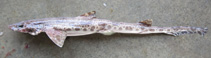 Proscyllium magnificum
Female Photo von T. Krajangdara et al
Bilder | Google Bild
Female Photo von T. Krajangdara et al
Klassifizierung / Names Namen | Synonyme | Catalog of Fishes(Gattung, Arten) | ITIS | CoL | WoRMS | Cloffa
Elasmobranchii (Haie und Rochen) (sharks and rays) > Carcharhiniformes (Ground sharks) > Proscylliidae (Finback catsharks)
Etymology: Proscyllium: pro (L.), in front of, probably referring to far forward placement of dorsal fin compared with Scyllium (=Scyliorhinus, Scyliorhinidae) (See ETYFish); magnificum: Latin for noble or splendid, referring to its “strikingly beautiful” color pattern (See ETYFish).
More on authors: Last & Vongpanich.
Etymology: Proscyllium: pro (L.), in front of, probably referring to far forward placement of dorsal fin compared with Scyllium (=Scyliorhinus, Scyliorhinidae) (See ETYFish); magnificum: Latin for noble or splendid, referring to its “strikingly beautiful” color pattern (See ETYFish).
More on authors: Last & Vongpanich.
Umwelt: Milieu / Klimazone / Tiefenbereich / Verbreitungsgebiet Ökologie
seewasser pelagic-oceanic; tiefenbereich ? - 144 m (Ref. 58071). Tropical
Verbreitung Territorien | FAO Gebiete | Ökosysteme | Vorkommen | Punkt Karte | Einführungen | Faunafri
Eastern Indian Ocean.
Größe / Gewicht / Alter
Kurzbeschreibung Bestimmungsschlüssel | Morphologie | Morphometrie
A slender finback catshark that is characterized by the following: second dorsal-fin apex over anal fin with its origin slightly forward of the anal-fin origin; interdorsal distance subequal to head length; snout to cloaca length more than twice (2.1-2.3 times) interdorsal distance; lower labial furrow more than twice (2.7-3.7 times) length of upper furrow; anterior nasal flaps with a greatly enlarged posterior lobe; internarial space only slightly shorter than nostril width; dorsal margin of caudal fin about twice (1.9-2 times) length of second dorsal fin; height of second dorsal fin about twice (1.9-2.1 times) height of anal fin; dorsal surface and sides with a striking color pattern consisting of numerous dark spots and blotches, some equal or large than eye diameter; white spots on body absent; monospondylous centra 38-39; total centra 140-143 (Ref. 58071).
Body shape (shape guide): elongated.
Body shape (shape guide): elongated.
Lebenszyklus und Paarungsverhalten Geschlechtsreife | Fortpflanzung | Ablaichen | Eier | Fruchtbarkeit | Larven
Hauptreferenz
Laden Sie Ihre Referenzen hoch | Referenzen | Koordinator : Compagno, Leonard J.V. | Partner
Last, P.R. and V. Vongpanich, 2004. A new finback catshark Proscyllium magnificum (Elasmobranchii: Proscylliidae) from the northeastern Indian Ocean. Phuket Mar. Biol. Center Res. Bull. (65):23-29. (Ref. 58071)
IUCN Rote Liste Status (Ref. 130435: Version 2025-2 (Global))
Gefährdung zunehmend (NT) (A2d); Date assessed: 20 May 2020
CITES
Not Evaluated
Bedrohung für Menschen
Harmless
Nutzung durch Menschen
FAO - Publication: search | FishSource |
Mehr Information
Trophische Ökologie
Lebensmittel (Beutetiere)
Nahrungszusammensetzung
Nahrungsaufnahme
Lebensmittelrationen
Räuber
Lebensmittel (Beutetiere)
Nahrungszusammensetzung
Nahrungsaufnahme
Lebensmittelrationen
Räuber
Ökologie
Ökologie
Ökologie
Populationsdynamik
Wachstumsparameter
Max. Alter/Größen
Länge-Gewicht-Rel.
Länge-Länge-Verhältnis.
Längenhäufigkeiten
Massenkonvertierung
Rekrutierung
Dichte
Wachstumsparameter
Max. Alter/Größen
Länge-Gewicht-Rel.
Länge-Länge-Verhältnis.
Längenhäufigkeiten
Massenkonvertierung
Rekrutierung
Dichte
Lebenszyklus
Fortpflanzung
Geschlechtsreife
Reifung/Kiemen rel.
Fruchtbarkeit
Ablaichen
Laichaggregationen
Eier
Eientwicklung
Larven
Larven Pop.Dyn.
Fortpflanzung
Geschlechtsreife
Reifung/Kiemen rel.
Fruchtbarkeit
Ablaichen
Laichaggregationen
Eier
Eientwicklung
Larven
Larven Pop.Dyn.
Anatomie
Kiemenoberfläche
Gehirn
Otolith
Kiemenoberfläche
Gehirn
Otolith
Physiologie
Körperliche Zusammensetzung
Nährstoffe
Sauerstoffverbrauch
Schwimmart
Schwimmgeschwindigkeit
Visuelle Pigmente
Fischgeräusche
Krankheiten und Parasiten
Toxizität (LC50s)
Körperliche Zusammensetzung
Nährstoffe
Sauerstoffverbrauch
Schwimmart
Schwimmgeschwindigkeit
Visuelle Pigmente
Fischgeräusche
Krankheiten und Parasiten
Toxizität (LC50s)
Genetik
Genom
Genetik
Heterozygotie
Vererbbarkeit
Genetische Vielfalt
Genom
Genetik
Heterozygotie
Vererbbarkeit
Genetische Vielfalt
Menschenbezogen
Aquakultur-Systeme
Aquakultur Profile
Zuchtlinien
Ciguatera-Fälle
Briefmarken, Münzen, Verschiedenes.
Aquakultur-Systeme
Aquakultur Profile
Zuchtlinien
Ciguatera-Fälle
Briefmarken, Münzen, Verschiedenes.
Tools
Zusatzinformationen
Download XML
Zusammenfassung | Punktdaten | Namen | Photos
Internet Quellen
AFORO (otoliths) | Aquatic Commons | BHL | Cloffa | Websites from users | FishWatcher Einträge suchen | CISTI | Catalog of Fishes: Gattung, Arten | DiscoverLife | ECOTOX | FAO - Publication: search | Faunafri | Fishipedia | Fishtrace | GloBI | Google Books | Google Scholar | Google | IGFA World Record | OneZoom | Open Tree of Life | Otolith Atlas of Taiwan Fishes | PubMed | Reef Life Survey | Socotra Atlas | TreeBase | Tree of Life | Wikipedia: Gehe zu, Suchen | | Zoobank | Zoologischer Rekord
Schätzungen auf der Grundlage von Modellen
|
Phylogenetischer Diversitätsindex (Ref. 82804) |
PD50 = 0.6328 [Uniqueness, from 0.5 = low to 2.0 = high]. |
| Bayesian length-weight | a=0.00282 (0.00110 - 0.00724), b=3.15 (2.93 - 3.37), in cm total length, based on LWR estimates for this (Sub)family-body shape (Ref. 93245). |
|
Trophische Ebene (Ref. 69278) |
4.0 ±0.6 se; based on size and trophs of closest relatives |
|
Anfälligkeit der Fischerei (Ref. 59153) |
Low to moderate vulnerability (25 of 100). 🛈 |