



Ventichthys biospeedoi Nielsen, Møller & Segonzac, 2006
East-Pacific ventbrotula
Hochladen Photos und videos
Google Bild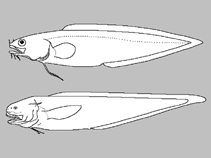 No image available for this species;
drawing shows typical species in Ophidiidae.
Google Bild
drawing shows typical species in Ophidiidae.
Klassifizierung / Names Namen | Synonyme | Catalog of Fishes(Gattung, Arten) | ITIS | CoL | WoRMS | Cloffa
> Ophidiiformes (Cusk eels) > Ophidiidae (Cusk-eels) > Neobythitinae
Etymology: Ventichthys: The word 'vent' refers to the hydrothermal vent and 'ichthys' to fish; biospeedoi: Named for the BIOSPEEDO expedition.
More on authors: Nielsen, Møller & Segonzac.
Etymology: Ventichthys: The word 'vent' refers to the hydrothermal vent and 'ichthys' to fish; biospeedoi: Named for the BIOSPEEDO expedition.
More on authors: Nielsen, Møller & Segonzac.
Umwelt: Milieu / Klimazone / Tiefenbereich / Verbreitungsgebiet Ökologie
seewasser bathydemersal; tiefenbereich ? - 2586 m (Ref. 57890). Deep-water
Verbreitung Territorien | FAO Gebiete | Ökosysteme | Vorkommen | Punkt Karte | Einführungen | Faunafri
Southeast Pacific: Southeast Pacific Rise on hydrothermal vent sites. High Seas only.
Größe / Gewicht / Alter
Kurzbeschreibung Bestimmungsschlüssel | Morphologie | Morphometrie
Rückenflossenweichstrahlen (insgesamt) : 80 - 89; Afterflossenweichstrahlen: 64 - 72; Wirbelzahl: 52 - 53. The species has a robust body; very small, overlapping scales on head and body; thick skin; posteriorly placed, enlarged kidneys; 4 lateral lines; dorsal fin origin above tip of pectorals; base of pelvic fin below hind margin of opercle; head broad with a blunt snout; strong opercular spine covered by thick skin; upper jaw ends just behind eye; teeth granular, one median basibranchial tooth patch; anterior gill arch with 10-11 long rakers; number of rays in dorsal fin 80-89, caudal fin 8, anal fin 64-72, pelvic fin 2, pectoral fin 24-25; number of vertebrae 16-17 + 36 (in total 52-53).
Cross section: compressed.
Cross section: compressed.
The holotype, a male with spindle-formed, unripe testes, does not contain any identifiable stomach contents while the paratype was eviscerated only leaving the strangely formed kidneys which may be an adaptation to the special conditions near the vents. The capture of the two specimens using baited trap indicates a necrophagous diet; specimens grazing on the bottom. The poorly developed teeth and the presence of 10-11 long gill rakers on the anterior arch indicate that it preys upon rather small food-items. The thick skin could be an adaptation to endure the high temperatures in the hydrothermal vent area. The same condition is found in another vent-fish Thermichthys hollisi. The presence of a male without an intromittant organ shows that it is oviparous. The vent site Oasis is composed of active black smokers covered with the tubeworm polychaete Alvinellaspp., large patches of mussels, clams and stalked cirripeds. A milky fluid diffuses from crevices and collapsed lava lakes, with clouds of swimming amphipods. The two specimens were collected next to such a hole surrounded by the mytilid mussel Bathymodiolus thermophilus Kenk & Wilson, 1985, the clam Calyptogena magnifica Boss & Turner, 1980, the stalked barnacle Neolepas cf. zevinae Newman, 1979, actinostolid sea-anemones (Chondrophellia-like), the bythograeid crab Bythograea thermydron Williams, 1980, the galatheid crab Munidopsis sp. And a recently described nematocarcinid shrimp, Nematocarcinus burukowskyi Komai & Segonzac, 2005. Other fish occur in this environment such as the synaphobranchid Ilyophis saldanhai Karmovskaya & Parin, 1999, the bythitid Thermichthys hollisi (Cohen et al., 1990) and an unidentified hagfish. Additional specimens were observed at other sites (Yaquina, Hobbs, and Gromit), between 2585 and 2840 m , at places with sometimes 10 or more individuals swimming in the shimmering vent fluids with temperatures between 2 and 7°C (Ref. 57890). Eggs may be oval and pelagic which may float in a gelatinous mass (Ref. 205).
Lebenszyklus und Paarungsverhalten Geschlechtsreife | Fortpflanzung | Ablaichen | Eier | Fruchtbarkeit | Larven
Hauptreferenz
Laden Sie Ihre Referenzen hoch | Referenzen | Koordinator | Partner
Nielsen, J.G., P.R. Møller and M. Segonzac, 2006. Ventichthys biospeedoi n. gen. et sp. (Teleostei, Ophidiidae) from a hydrothermal vent in the South East Pacific. Zootaxa 1247:13-24. (Ref. 57890)
IUCN Rote Liste Status (Ref. 130435: Version 2025-2 (Global))
Daten mangelhaft (DD) ; Date assessed: 15 August 2019
CITES
Not Evaluated
Bedrohung für Menschen
Harmless
Nutzung durch Menschen
FAO - Publication: search | FishSource |
Mehr Information
Trophische Ökologie
Lebensmittel (Beutetiere)
Nahrungszusammensetzung
Nahrungsaufnahme
Lebensmittelrationen
Räuber
Lebensmittel (Beutetiere)
Nahrungszusammensetzung
Nahrungsaufnahme
Lebensmittelrationen
Räuber
Populationsdynamik
Wachstumsparameter
Max. Alter/Größen
Länge-Gewicht-Rel.
Länge-Länge-Verhältnis.
Längenhäufigkeiten
Massenkonvertierung
Rekrutierung
Dichte
Wachstumsparameter
Max. Alter/Größen
Länge-Gewicht-Rel.
Länge-Länge-Verhältnis.
Längenhäufigkeiten
Massenkonvertierung
Rekrutierung
Dichte
Lebenszyklus
Fortpflanzung
Geschlechtsreife
Reifung/Kiemen rel.
Fruchtbarkeit
Ablaichen
Laichaggregationen
Eier
Eientwicklung
Larven
Larven Pop.Dyn.
Fortpflanzung
Geschlechtsreife
Reifung/Kiemen rel.
Fruchtbarkeit
Ablaichen
Laichaggregationen
Eier
Eientwicklung
Larven
Larven Pop.Dyn.
Anatomie
Kiemenoberfläche
Gehirn
Otolith
Kiemenoberfläche
Gehirn
Otolith
Physiologie
Körperliche Zusammensetzung
Nährstoffe
Sauerstoffverbrauch
Schwimmart
Schwimmgeschwindigkeit
Visuelle Pigmente
Fischgeräusche
Krankheiten und Parasiten
Toxizität (LC50s)
Körperliche Zusammensetzung
Nährstoffe
Sauerstoffverbrauch
Schwimmart
Schwimmgeschwindigkeit
Visuelle Pigmente
Fischgeräusche
Krankheiten und Parasiten
Toxizität (LC50s)
Genetik
Genom
Genetik
Heterozygotie
Vererbbarkeit
Genetische Vielfalt
Genom
Genetik
Heterozygotie
Vererbbarkeit
Genetische Vielfalt
Menschenbezogen
Aquakultur-Systeme
Aquakultur Profile
Zuchtlinien
Ciguatera-Fälle
Briefmarken, Münzen, Verschiedenes.
Aquakultur-Systeme
Aquakultur Profile
Zuchtlinien
Ciguatera-Fälle
Briefmarken, Münzen, Verschiedenes.
Tools
Zusatzinformationen
Download XML
Zusammenfassung | Punktdaten | Namen | Photos
Internet Quellen
AFORO (otoliths) | Aquatic Commons | BHL | Cloffa | Websites from users | FishWatcher Einträge suchen | CISTI | Catalog of Fishes: Gattung, Arten | DiscoverLife | ECOTOX | FAO - Publication: search | Faunafri | Fishipedia | Fishtrace | GloBI | Google Books | Google Scholar | Google | IGFA World Record | OneZoom | Open Tree of Life | Otolith Atlas of Taiwan Fishes | PubMed | Reef Life Survey | Socotra Atlas | TreeBase | Tree of Life | Wikipedia: Gehe zu, Suchen | World Records Freshwater Fishing | Zoobank | Zoologischer Rekord
Schätzungen auf der Grundlage von Modellen
Phylogenetischer Diversitätsindex (Ref. 82804): PD50 = 1.0000 [Uniqueness, from 0.5 = low to 2.0 = high].
Bayesian length-weight: a=0.00380 (0.00165 - 0.00876), b=3.14 (2.93 - 3.35), in cm total length, based on LWR estimates for this (Sub)family-body shape (Ref. 93245).
Trophische Ebene (Ref. 69278): 3.6 ±0.6 se; based on size and trophs of closest relatives
Widerstandsfähigkeit (Ref. 120179): mittel, Verdopplung der Population dauert 1,4 - 4,4 Jahre. (Preliminary K or Fecundity.).