



Maxillicosta meridianus Motomura, Last & Gomon, 2006
Southern gurnard perch
Adicionar sua observação em Fish Watcher
| Native range | All suitable habitat | Point map | Year 2050 |

|
| This map was computer-generated and has not yet been reviewed. |
| Maxillicosta meridianus AquaMaps Data sources: GBIF OBIS |
Carregue seu(sua) Fotos e vídeos
Imagem do Google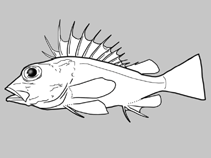 No image available for this species;
drawing shows typical species in Neosebastidae.
Imagem do Google
drawing shows typical species in Neosebastidae.
Classificação / Nomes Nomes comuns | Sinônimos | Catalog of Fishes(Gênero, Espécies) | ITIS | CoL | WoRMS | Cloffa
> Perciformes/Scorpaenoidei (Scorpionfishes) > Neosebastidae (Gurnard scorpionfishes)
Etymology: Maxillicosta: Latin, maxilla = jaw + Latin, costa, -ae = rib or rib like parts (Ref. 45335); meridianus: Name from Latin 'meridianus' meaning southern, referring to the southern distribution.
More on authors: Motomura, Last & Gomon.
Etymology: Maxillicosta: Latin, maxilla = jaw + Latin, costa, -ae = rib or rib like parts (Ref. 45335); meridianus: Name from Latin 'meridianus' meaning southern, referring to the southern distribution.
More on authors: Motomura, Last & Gomon.
Meio ambiente: milieu / Zona climática / intervalo de profundidade / faixa de distribuição Ecologia
marinhas demersal; intervalo de profundidade 10 - 137 m (Ref. 57438). Tropical
Distribuição Territórios | Áreas da FAO | Ecossistemas | Ocorrências | Mapa de pontos | Introduções | Faunafri
Southeastern Indian Ocean: Australia.
Tamanho / Peso / Idade
Descrição suscinta Chaves de identificação | Morfologia | Morfometria
This species is characterized by the following: pectoral-fin rays 21-24 (22) ; scales in longitudinal series 47-51 (49); pored lateral-line scales 27-29 (28); scale rows between last pelvic-fin ray bases 3 or 4 (3); scales above lateral line 2 or 3 (3), below 12-14 (13); scales between sixth dorsal-fin spine base and lateral line 3-5 (4); scales between last dorsal-fin spine and lateral line 4 or 5 (5); scales above lateral line behind head usually with no strong median ridge; central portion of inner ridge on ventral mandibular surface at the inner edge of dentary or closer to inner edge than to central ridge, no short ridge between posterior
portions of inner and central ridges; spinous points 0-6 on anterior margin of nasal spine, number decreasing with growth, spinous points 5-15 on entire nasal spine; spinous points 5-13 on surface of preocular spine; spines or distinct ridges absent on lateral margin of occipital pit between tympanic spine and origin of parietal spine base; ossified scale behind front edge of occipital pit between tympanic spines absent; dorsal surface of occipital pit smooth, no spines; spinous points 2 (rarely 1 or 3) at tip of upper opercular spine; posterior margin of maxilla extending slightly beyond a vertical through posterior margin of pupil; snout length 7.9-9.6 (8.6)% SL, upper-jaw length 19.1-22.2 (20.3)% SL, first anal-fin spine length 11.6-14.4 (13.1)% SL, second anal-fin spine length 18.4-22.5 (20.5)% SL, third anal-fin spine length 13.4-16.2 (14.7)% SL, and caudal-peduncle depth 7.8-9.0 (8.6)% SL; body without reticulate color pattern; caudal fin of preserved specimens usually without distinct melanin (Ref. 57438).
Observed to bury itself completely in the sand during the day, but are fully exposed at night. Prefers deeper sand channels, away from rubble or seagrasses (Ref. 57438).
Ciclo de vida ou comportamento de acasalamento Maturidade | Reprodução | Desova | Ovos | Fecundidade | Larvas
Referência principal
Carregar suas referências | Referências | Coordenador | Colaboradores
Motomura, H., P.R. Last and M.F. Gomon, 2006. A new species of the scorpionfish genus Maxillicosta from the Southeast coast of Australia, with a redescription of M. whitleyi (Scorpaeniformes: Neosebastidae). Copeia 2006(3):445-459. (Ref. 57438)
CITES
Not Evaluated
Ameaça para os humanos
Harmless
Uso pelos humanos
FAO - Publication: search | FishSource |
Mais informação
Ecologia Trófica
Itens alimentares (presas)
Composição da dieta
Consumo alimentar
Rações alimentares
Predadores
Itens alimentares (presas)
Composição da dieta
Consumo alimentar
Rações alimentares
Predadores
Ecologia
Ecologia
Ecologia
Dinâmica populacional
Parâmetros de crescimento
Idade máxima / tamanhos
Relação comprimento-peso.
Relação comprimento-comprimento.
Frequências de comprimento
Conversão de massa
Recrutamento
Abundância
Parâmetros de crescimento
Idade máxima / tamanhos
Relação comprimento-peso.
Relação comprimento-comprimento.
Frequências de comprimento
Conversão de massa
Recrutamento
Abundância
Ciclo de vida
Reprodução
Maturidade
Maturidade/Rel. das guelras
Fecundidade
Desova
Agregações de desova
Ovos
Desenvolvimento dos ovos
Larvas
Dinâmica larval
Reprodução
Maturidade
Maturidade/Rel. das guelras
Fecundidade
Desova
Agregações de desova
Ovos
Desenvolvimento dos ovos
Larvas
Dinâmica larval
Anatomia
Área branquial
Cérebro
Otólito
Área branquial
Cérebro
Otólito
Fisiologia
Composição corporal
Nutrientes
Consumo de oxigênio
Tipo de natação
Velocidade de natação
Pigmentos visuais
Som de peixe
Doenças e Parasitas
Toxicidade (LC50s)
Composição corporal
Nutrientes
Consumo de oxigênio
Tipo de natação
Velocidade de natação
Pigmentos visuais
Som de peixe
Doenças e Parasitas
Toxicidade (LC50s)
Genética
genoma
Genética
Heterozigosidade
Hereditariedade
Diversidade genética
genoma
Genética
Heterozigosidade
Hereditariedade
Diversidade genética
Relacionado a humanos
Sistemas de aquicultura
Perfis para aquacultura
Estirpes
Casos de Ciguatera
Selos, moedas, diversos.
Sistemas de aquicultura
Perfis para aquacultura
Estirpes
Casos de Ciguatera
Selos, moedas, diversos.
Ferramentas
Livro eletrônico | Guia de campo | Ferramenta auxiliar de frequências de comprimento | Ferramenta sobre a história de vida | Mapa de pontos |
Catch-MSY |
Relatórios especiais
Checar Manutenção em Aquário | Checar Planilhas de Fatos sobre as Espécies | Checar Planilhas de Fatos sobre Aquicultura
Baixar XML
Fontes da internet
AFORO (otoliths) | Aquatic Commons | BHL | Cloffa | Websites from users | Checar Observador de Peixes (FishWatcher) | CISTI | Catalog of Fishes: Gênero, Espécies | DiscoverLife | ECOTOX | FAO - Publication: search | Faunafri | Fishipedia | Fishtrace | GloBI | Google Books | Google Scholar | Google | IGFA World Record | OneZoom | Open Tree of Life | Otolith Atlas of Taiwan Fishes | PubMed | Reef Life Survey | Socotra Atlas | TreeBase | Árvore da vida | Wikipedia: Ir para, procura | World Records Freshwater Fishing | Zoobank | Registro zoológico
Estimativas baseadas em modelos
|
Índice de diversidade filogenética (Ref. 82804) |
PD50 = 0.5156 [Uniqueness, from 0.5 = low to 2.0 = high]. |
| Bayesian length-weight | a=0.00389 (0.00180 - 0.00842), b=3.12 (2.94 - 3.30), in cm total length, based on all LWR estimates for this body shape (Ref. 93245). |
|
Nível Trófico (Ref. 69278) |
3.4 ±0.3 se; based on size and trophs of closest relatives |
|
Vulnerabilidade da pesca (Ref. 59153) |
Low vulnerability (10 of 100). 🛈 |