



Oryzias marmoratus (Aurich, 1935)
Marmorated medaka
上傳你的 相片 和 影像
照片 | Google 影像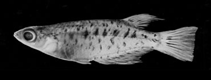 Oryzias marmoratus
Male 拍攝者 Parenti, L.R.
照片 | Google 影像
Male 拍攝者 Parenti, L.R.
分類 / 名稱 俗名 | 同種異名 | Catalog of Fishes(屬, 種) | ITIS | CoL | WoRMS | Cloffa
Teleostei > Beloniformes (Needle fishes) 頜針魚目 (Needle fishes) > Adrianichthyidae (Ricefishes) 異鱂科 (Ricefishes) > Oryziinae
Etymology: Oryzias: Greek, oryza = rice; because of the habitat used by this fish (Ref. 45335).
Etymology: Oryzias: Greek, oryza = rice; because of the habitat used by this fish (Ref. 45335).
環境: 環境 / 氣候帶 / 深度上下限 / 配送範圍 生態學
; 淡水 底中水層性; pH range: 7.5 - 8.5; 非遷移的. 熱帶; 22°C - 25°C (Ref. 31267)
分布 領土 | FAO區域 | 生態系 | 發現紀錄 | 分布圖 | 簡介 | Faunafri
Asia: Indonesia.
亞洲: 印尼。
亞洲: 印尼。
大小 / 重量 / 年齡
簡短描述 檢索表 | 型態特徵 | 形態測量圖
背的軟條 (總數) : 9 - 10; 臀鰭軟條: 22 - 25. This species is distinguished (from O. profundicola, O. loxolepis) by the following characters: abdominal vertebrae usually 12, total vertebrae 29-31; D 9-10, A 22-25; transverse scales 10-11; body depth at anal-fin origin 24.8-30.1% SL and at dorsal-fin origin 20.2-25.3% SL; caudal peduncle length 12.0-16.3% SL; distinct nuchal concavity; lateral scales are more-or-less aligned parallel to midlateral stripe; male with elongated-shaped dorsal fin without yellow margin (Ref. 133090).
Cross section: compressed.
顏色活著時, 雄魚有灰褐色的頭部與身體有擴散的深褐色的斑塊不規則地在身體上散佈。 一排 5-9 較大的斑塊約略不規則地組織了上方軸的斑紋永遠有。 眼藍色。 母魚有一個顏色淡的褐色頭部與身體有比較小的, 比較不顯著黑色的斑塊; 在軸的斑紋上面的一列斑塊是明顯的。 雌性的鰭透明的。 描述: 身體扁長形的, 延長。 口端位, 幾乎水平。 顎幾乎相等的。 在眼間骨區域中的頭部背面輪廓凸狀而且在後頸 (參考文獻 26687) 上具有一個顯著凹窪.
Cross section: compressed.
顏色活著時, 雄魚有灰褐色的頭部與身體有擴散的深褐色的斑塊不規則地在身體上散佈。 一排 5-9 較大的斑塊約略不規則地組織了上方軸的斑紋永遠有。 眼藍色。 母魚有一個顏色淡的褐色頭部與身體有比較小的, 比較不顯著黑色的斑塊; 在軸的斑紋上面的一列斑塊是明顯的。 雌性的鰭透明的。 描述: 身體扁長形的, 延長。 口端位, 幾乎水平。 顎幾乎相等的。 在眼間骨區域中的頭部背面輪廓凸狀而且在後頸 (參考文獻 26687) 上具有一個顯著凹窪.
Non-annual breeder. Is very difficult to maintain in aquarium (Ref. 27139). In 2013 and 2018, the collected and observed specimens were only during the day and at TanjungTimbala, slightly south of the type locality, and at Lengkona in Lake Towuti. This species is collected with O. loxolepis and O. profundicola that form schools in gently sloping, shallow (< 1.5 m) shore areas with large boulders and submerged wood over sand and gravel. Other taxa occurring in samples included Paratherina spp., Glossogobius flavipinnis, G. intermedius, Glossogobius sp., Mugilogobius rexi, M. latifrons, and Nomorhamphus megarrhamphus. In Lake Lantoa, it inhabits gently sloping, shallow shores (1 m depth) with a large area of plants on a muddy substratum. It swims in schools and was collected in association with Telmatherina celebensis and Glossogobius sp. (an undescribed lake endemic: HK, pers. obsv.). Some individuals were infested with parasitic copepods. In Lake Mahalona, it also inhabits gently sloping, shallow shores (1 m depth) with large boulders over a sand and gravel substratum, covered with aquatic vegetation. Often, it also forms schools and co-occurring with Tominanga aurea, Glossogobius sp. (as for Lake Towuti), Glossogobius mahalonensis, G. intermedius, M. rexi, and Mugilogobius cf. hitam (Ref. 133093).
非年度生殖者。 在水族館非常難以維持。 (參考文獻 27139)
非年度生殖者。 在水族館非常難以維持。 (參考文獻 27139)
生命週期和交配行為 成熟度 | 繁殖 | 產卵場 | 卵 | 孕卵數 | 仔魚
Egg clusters are carried by females under the ventral fin (Ref. 26687).亞洲: 印尼。
主要參考資料
上傳您的推薦信 | 參考文獻 | 合作者 : Seegers, Lothar | 合作者
Kottelat, M., A.J. Whitten, S.N. Kartikasari and S. Wirjoatmodjo, 1993. Freshwater fishes of Western Indonesia and Sulawesi. Periplus Editions, Hong Kong. 221 p. (Ref. 7050)
IUCN 瀕危狀態 (Ref. 130435: Version 2025-2 (Global))
近危 (NT) (B1b(i,ii,iii,iv)+2b(i,ii,iii,iv)); Date assessed: 13 June 2018
CITES
Not Evaluated
對人類具威脅
無害處的
人類使用
漁業: 商業性; 水族館: 商業性
FAO - Publication: search | FishSource |
更多資訊
工具
特別的報告
下載 XML
網路資源
AFORO (otoliths) | Aquatic Commons | BHL | Cloffa | Websites from users | 檢查 FishWatcher | CISTI | Catalog of Fishes: 屬, 種 | DiscoverLife | ECOTOX | FAO - Publication: search | Faunafri | Fishipedia | Fishtrace | GloBI | Google Books | Google Scholar | Google | IGFA World Record | OneZoom | Open Tree of Life | Otolith Atlas of Taiwan Fishes | PubMed | Reef Life Survey | Socotra Atlas | TreeBase | 樹狀分類階層 | Wikipedia: 去, 搜尋 | World Records Freshwater Fishing | 動物學的記錄
基於模型的估計
系統發育多樣性指數 (參考文獻 82804): PD50 = 0.5000 [Uniqueness, from 0.5 = low to 2.0 = high].
Bayesian length-weight: a=0.00479 (0.00190 - 0.01207), b=3.13 (2.91 - 3.35), in cm total length, based on LWR estimates for this (Sub)family-body shape (Ref. 93245).
營養階層 (參考文獻 69278): 3.4 ±0.4 se; based on size and trophs of closest relatives
回復力 (參考文獻 120179): 低的, 最小族群倍增時間4.5 - 14 年 (Assuming fec < 100, egg cluster of 13-15 eggs).