



Cetopsidium ferreirai Vari, Ferraris & de Pinna, 2005
Carregue seu(sua) Fotos e vídeos
Imagem do Google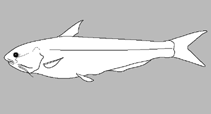 No image available for this species;
drawing shows typical species in Cetopsidae.
Imagem do Google
drawing shows typical species in Cetopsidae.
Classificação / Nomes Nomes comuns | Sinônimos | Catalog of Fishes(Gênero, Espécies) | ITIS | CoL | WoRMS | Cloffa
> Siluriformes (Catfishes) > Cetopsidae (Whale catfishes) > Cetopsinae
Etymology: Cetopsidium: From Cetopsis, the first genus proposed in subfamily Cetopsinae, and 'idium' meaning diminutive, referring to the relatively small body sizes of the members of the genus; ferreirai: Named for Efren J.G. Ferreira of the Instituto Nacional de Pesquisas da Amazonia (INPA), in recognition of his contributions to the knowledge of the fishes of the Brazilian Amazon.
Eponymy: Dr Efrem Jorge Gondim Ferreira (d: 1954) is a Brazilian ichthyologist, who is a Senior Researcher III at Instituto Nacional de Pesquisas da Amazônia, Manaus, and Professor of the Postgraduate Programme in Fresh Water Biology and Inland Fisheries. [...] (Ref. 128868), visit book page.
More on authors: Vari, Ferraris & dePinna.
Etymology: Cetopsidium: From Cetopsis, the first genus proposed in subfamily Cetopsinae, and 'idium' meaning diminutive, referring to the relatively small body sizes of the members of the genus; ferreirai: Named for Efren J.G. Ferreira of the Instituto Nacional de Pesquisas da Amazonia (INPA), in recognition of his contributions to the knowledge of the fishes of the Brazilian Amazon.
Eponymy: Dr Efrem Jorge Gondim Ferreira (d: 1954) is a Brazilian ichthyologist, who is a Senior Researcher III at Instituto Nacional de Pesquisas da Amazônia, Manaus, and Professor of the Postgraduate Programme in Fresh Water Biology and Inland Fisheries. [...] (Ref. 128868), visit book page.
More on authors: Vari, Ferraris & dePinna.
Meio ambiente: milieu / Zona climática / intervalo de profundidade / faixa de distribuição Ecologia
; Água doce bentopelágico. Tropical
Distribuição Territórios | Áreas da FAO | Ecossistemas | Ocorrências | Mapa de pontos | Introduções | Faunafri
South America: Rio Trombetas, left bank tributary of the lower rio Amazonas, Brazil.
Tamanho / Peso / Idade
Descrição suscinta Chaves de identificação | Morfologia | Morfometria
Raios dorsais (total) : 5 - 6; Raios anais : 23 - 24; Vértebras: 39 - 40. Distinguished from all its congeners, possibly except for Cetopsidium roae and C. minutum, by lacking distal filaments on the first rays of the dorsal and pectoral fins in adults males. Differs from C. minutum in the length of the pelvic fin by not reaching anal-fin origin. Further differs from C. morenoi in the overall form of the head, being not massive proportionally as a consequence of the less extensive development of the adductor mandibulae muscle onto the dorsal surface of head and with the snout distinctly rounded, and the less extensive dark pigmentation on the body (near absence of dark pigmentation on the lateral surface of body and the pigmentation limited to the middorsal region of body). Differs from C. orientale in the alignment of the dorsal and ventral profiles of the portion of the body posterior of the base of the dorsal fin (profiles converging posteriorly) and in the overall coloration (limited dark pigmentation located largely along the middorsal region of the body). Distinguished from C. pemon by having profile of head anteriorly rounded and by having proportional length of the snout, approximately 2 times diameter of the eye. Differs from C. roae in the position of the vent, proximate to the base of the anterior most anal-fin ray (Ref. 56045).
Body shape (shape guide): elongated.
Body shape (shape guide): elongated.
Ciclo de vida ou comportamento de acasalamento Maturidade | Reprodução | Desova | Ovos | Fecundidade | Larvas
Referência principal
Carregar suas referências | Referências | Coordenador : Ferraris, Jr., Carl J. | Colaboradores
Vari, R.P., C.J. Ferraris Jr. and M.C.C. de Pinna, 2005. The neotropical whale catfishes (Siluriformes: Cetopsidae: Cetopsinae), a revisionary study. Neotrop. Ichthyol. 3(2):127-238. (Ref. 56045)
Status na Lista Vermelha da UICN (Ref. 130435: Version 2025-2 (Global))
Quase ameaçada (NT) (B1a); Date assessed: 07 November 2018
CITES
Not Evaluated
Ameaça para os humanos
Harmless
Uso pelos humanos
FAO - Publication: search | FishSource |
Mais informação
Ecologia Trófica
Itens alimentares (presas)
Composição da dieta
Consumo alimentar
Rações alimentares
Predadores
Itens alimentares (presas)
Composição da dieta
Consumo alimentar
Rações alimentares
Predadores
Ecologia
Ecologia
Ecologia
Dinâmica populacional
Parâmetros de crescimento
Idade máxima / tamanhos
Relação comprimento-peso.
Relação comprimento-comprimento.
Frequências de comprimento
Conversão de massa
Recrutamento
Abundância
Parâmetros de crescimento
Idade máxima / tamanhos
Relação comprimento-peso.
Relação comprimento-comprimento.
Frequências de comprimento
Conversão de massa
Recrutamento
Abundância
Ciclo de vida
Reprodução
Maturidade
Maturidade/Rel. das guelras
Fecundidade
Desova
Agregações de desova
Ovos
Desenvolvimento dos ovos
Larvas
Dinâmica larval
Reprodução
Maturidade
Maturidade/Rel. das guelras
Fecundidade
Desova
Agregações de desova
Ovos
Desenvolvimento dos ovos
Larvas
Dinâmica larval
Anatomia
Área branquial
Cérebro
Otólito
Área branquial
Cérebro
Otólito
Fisiologia
Composição corporal
Nutrientes
Consumo de oxigênio
Tipo de natação
Velocidade de natação
Pigmentos visuais
Som de peixe
Doenças e Parasitas
Toxicidade (LC50s)
Composição corporal
Nutrientes
Consumo de oxigênio
Tipo de natação
Velocidade de natação
Pigmentos visuais
Som de peixe
Doenças e Parasitas
Toxicidade (LC50s)
Genética
genoma
Genética
Heterozigosidade
Hereditariedade
Diversidade genética
genoma
Genética
Heterozigosidade
Hereditariedade
Diversidade genética
Relacionado a humanos
Sistemas de aquicultura
Perfis para aquacultura
Estirpes
Casos de Ciguatera
Selos, moedas, diversos.
Sistemas de aquicultura
Perfis para aquacultura
Estirpes
Casos de Ciguatera
Selos, moedas, diversos.
Ferramentas
Livro eletrônico | Guia de campo | Ferramenta auxiliar de frequências de comprimento | Ferramenta sobre a história de vida | Mapa de pontos |
Catch-MSY |
Relatórios especiais
Checar Manutenção em Aquário | Checar Planilhas de Fatos sobre as Espécies | Checar Planilhas de Fatos sobre Aquicultura
Baixar XML
Fontes da internet
AFORO (otoliths) | Aquatic Commons | BHL | Cloffa | Websites from users | Checar Observador de Peixes (FishWatcher) | CISTI | Catalog of Fishes: Gênero, Espécies | DiscoverLife | ECOTOX | FAO - Publication: search | Faunafri | Fishipedia | Fishtrace | GloBI | Google Books | Google Scholar | Google | IGFA World Record | OneZoom | Open Tree of Life | Otolith Atlas of Taiwan Fishes | PubMed | Reef Life Survey | Socotra Atlas | TreeBase | Árvore da vida | Wikipedia: Ir para, procura | World Records Freshwater Fishing | Zoobank | Registro zoológico
Estimativas baseadas em modelos
Índice de diversidade filogenética (Ref. 82804): PD50 = 0.5078 [Uniqueness, from 0.5 = low to 2.0 = high].
Bayesian length-weight: a=0.00550 (0.00224 - 0.01349), b=3.13 (2.92 - 3.34), in cm total length, based on LWR estimates for this (Sub)family-body shape (Ref. 93245).
Nível Trófico (Ref. 69278): 3.3 ±0.4 se; based on size and trophs of closest relatives