



Hapalogenys sennin Iwatsuki & Nakabo, 2005
Long barbeled grunter
Hochladen Photos und videos
Google Bild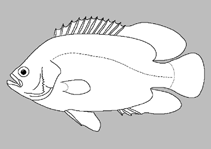 No image available for this species;
drawing shows typical species in Lobotidae.
Google Bild
drawing shows typical species in Lobotidae.
Klassifizierung / Names Namen | Synonyme | Catalog of Fishes(Gattung, Arten) | ITIS | CoL | WoRMS | Cloffa
> Acanthuriformes (Surgeonfishes) > Lobotidae (Tripletails)
Etymology: Hapalogenys: Greek, hapalos = soft * Greek, geny, -yos = face (Ref. 45335); sennin: Name from the Japanese mythology, 'sennin' (sen'nin), referring to the face with barbels and solitary habitat.
Etymology: Hapalogenys: Greek, hapalos = soft * Greek, geny, -yos = face (Ref. 45335); sennin: Name from the Japanese mythology, 'sennin' (sen'nin), referring to the face with barbels and solitary habitat.
Umwelt: Milieu / Klimazone / Tiefenbereich / Verbreitungsgebiet Ökologie
seewasser pelagic-neritic; tiefenbereich ? - 50 m (Ref. 56360). Temperate
Verbreitung Territorien | FAO Gebiete | Ökosysteme | Vorkommen | Punkt Karte | Einführungen | Faunafri
Northwest Pacific: Currently known only from southern Japan except in the Ryukyu and Ogasawara isalnds.
Größe / Gewicht / Alter
Geschlechtsreife: Lm ? range ? - ? cm
Max length : 29.6 cm SL (female)
Max length : 29.6 cm SL (female)
Kurzbeschreibung Bestimmungsschlüssel | Morphologie | Morphometrie
Rückenflossenstacheln (insgesamt) : 11; Rückenflossenweichstrahlen (insgesamt) : 16 - 18. Diagnosis. Distinguished from its congerners by the following: dorsal-fin rays XI, 16-18 (usually XI, 17); scales above lateral line 9-12 (usually 10 or 11), below 15-19 (usually 16 or 17); scales on maxilla absent; 10 pores on and behind chin, including one very smalei pore near each side of symphysis, two moderate sized pores anteroventrally on each dentary, a single large pore ventrally, midway along each dentary (usually obscured by dense papillae), and a single large pore ventrally at articulation of dentary (two posteriormost pores slit-like concave traces); cluster of short and long dense papillae and barbels on fleshy lower lip, its posterior part naked; shape of dorsal- and anal-fin rays strongly angulated, usually angular, anal more strong than dorsal; body uniformly dark brown, sometimes with two indistinct oblique dark bands, the first descending from nape to behind pectoral fin, the second from base of 7th-10th dorsal-fin spines, curving downward above or through lateral line (Ref. 56360).
Body shape (shape guide): short and / or deep; Cross section: compressed.
Body shape (shape guide): short and / or deep; Cross section: compressed.
The species is apparently restricted to river mouths and coastal rocky to sandy bottoms of less than 50 m depth. The smallest specimen (MUFS 22226, 46 mm SL) was collected in a river mouth, while larger specimens were captured by set net or small trawl between 5-50 m depth over rocky or sandy bottoms. Between 1960-1980, the species were observed by Miyazaki SCUBA divers to be solitary and common in small caves, holes, and under overhanging rocks along the Nichinan coast, Miyazaki, southeastern Kyushu Island, from late
summer to winter. However, in recent years (post 1990) the species has been only rarely observed (Ref. 56360).
Lebenszyklus und Paarungsverhalten Geschlechtsreife | Fortpflanzung | Ablaichen | Eier | Fruchtbarkeit | Larven
Hauptreferenz
Laden Sie Ihre Referenzen hoch | Referenzen | Koordinator | Partner
Iwatsuki, Y. and T. Nakabo, 2005. Redescription of Hapologenys nigripinnis (Schlegel in Temminck and Schlegel, 1843), a senior synonym of H. nitens Richardson, 1844, and a new species from Japan. Copeia 2005(4):854-867. (Ref. 56360)
CITES
Not Evaluated
Bedrohung für Menschen
Harmless
Nutzung durch Menschen
Fischereien: bycatch
FAO - Publication: search | FishSource |
Mehr Information
Trophische Ökologie
Lebensmittel (Beutetiere)
Nahrungszusammensetzung
Nahrungsaufnahme
Lebensmittelrationen
Räuber
Lebensmittel (Beutetiere)
Nahrungszusammensetzung
Nahrungsaufnahme
Lebensmittelrationen
Räuber
Populationsdynamik
Wachstumsparameter
Max. Alter/Größen
Länge-Gewicht-Rel.
Länge-Länge-Verhältnis.
Längenhäufigkeiten
Massenkonvertierung
Rekrutierung
Dichte
Wachstumsparameter
Max. Alter/Größen
Länge-Gewicht-Rel.
Länge-Länge-Verhältnis.
Längenhäufigkeiten
Massenkonvertierung
Rekrutierung
Dichte
Lebenszyklus
Fortpflanzung
Geschlechtsreife
Reifung/Kiemen rel.
Fruchtbarkeit
Ablaichen
Laichaggregationen
Eier
Eientwicklung
Larven
Larven Pop.Dyn.
Fortpflanzung
Geschlechtsreife
Reifung/Kiemen rel.
Fruchtbarkeit
Ablaichen
Laichaggregationen
Eier
Eientwicklung
Larven
Larven Pop.Dyn.
Anatomie
Kiemenoberfläche
Gehirn
Otolith
Kiemenoberfläche
Gehirn
Otolith
Physiologie
Körperliche Zusammensetzung
Nährstoffe
Sauerstoffverbrauch
Schwimmart
Schwimmgeschwindigkeit
Visuelle Pigmente
Fischgeräusche
Krankheiten und Parasiten
Toxizität (LC50s)
Körperliche Zusammensetzung
Nährstoffe
Sauerstoffverbrauch
Schwimmart
Schwimmgeschwindigkeit
Visuelle Pigmente
Fischgeräusche
Krankheiten und Parasiten
Toxizität (LC50s)
Genetik
Genom
Genetik
Heterozygotie
Vererbbarkeit
Genetische Vielfalt
Genom
Genetik
Heterozygotie
Vererbbarkeit
Genetische Vielfalt
Menschenbezogen
Aquakultur-Systeme
Aquakultur Profile
Zuchtlinien
Ciguatera-Fälle
Briefmarken, Münzen, Verschiedenes.
Aquakultur-Systeme
Aquakultur Profile
Zuchtlinien
Ciguatera-Fälle
Briefmarken, Münzen, Verschiedenes.
Tools
Zusatzinformationen
Download XML
Zusammenfassung | Punktdaten | Namen | Photos
Internet Quellen
AFORO (otoliths) | Aquatic Commons | BHL | Cloffa | Websites from users | FishWatcher Einträge suchen | CISTI | Catalog of Fishes: Gattung, Arten | DiscoverLife | ECOTOX | FAO - Publication: search | Faunafri | Fishipedia | Fishtrace | GloBI | Google Books | Google Scholar | Google | IGFA World Record | OneZoom | Open Tree of Life | Otolith Atlas of Taiwan Fishes | PubMed | Reef Life Survey | Socotra Atlas | TreeBase | Tree of Life | Wikipedia: Gehe zu, Suchen | World Records Freshwater Fishing | Zoobank | Zoologischer Rekord
Schätzungen auf der Grundlage von Modellen
Phylogenetischer Diversitätsindex (Ref. 82804): PD50 = 0.5039 [Uniqueness, from 0.5 = low to 2.0 = high].
Bayesian length-weight: a=0.01905 (0.00861 - 0.04217), b=3.01 (2.81 - 3.21), in cm total length, based on LWR estimates for this (Sub)family-body shape (Ref. 93245).
Trophische Ebene (Ref. 69278): 3.9 ±0.6 se; based on size and trophs of closest relatives
Widerstandsfähigkeit (Ref. 120179): hoch, Verdopplung der Population dauert weniger als 15 Monate. (Preliminary K or Fecundity.).