



Mastacembelus polli Vreven, 2005
Ladda upp din foton och Videor
Google image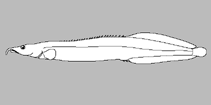 No image available for this species;
drawing shows typical species in Mastacembelidae.
Google image
drawing shows typical species in Mastacembelidae.
Klassificering / Namn Populärnamn | synonymer | Catalog of Fishes(Släkte, Arter) | ITIS | CoL | WoRMS | Cloffa
> Synbranchiformes (Spiny eels) > Mastacembelidae (Spiny eels)
Etymology: Mastacembelus: Greek, mastax, -agos = bite + Greek, emballo = to throw oneself (Ref. 45335); polli: Named in honor of Prof. Dr. Poll, a famous Belgian ichthyologist who pioneered ichthyological studies on Lake Tanganyika (Ref. 56055).
Eponymy: Dr Max Fernand Leon Poll (1908–1991) was a Belgian ichthyologist, and ‘connoisseur of the fish fauna’. [...] (Ref. 128868), visit book page.
Etymology: Mastacembelus: Greek, mastax, -agos = bite + Greek, emballo = to throw oneself (Ref. 45335); polli: Named in honor of Prof. Dr. Poll, a famous Belgian ichthyologist who pioneered ichthyological studies on Lake Tanganyika (Ref. 56055).
Eponymy: Dr Max Fernand Leon Poll (1908–1991) was a Belgian ichthyologist, and ‘connoisseur of the fish fauna’. [...] (Ref. 128868), visit book page.
Miljö: miljö / Klimatzon / djupintervall / distributionsområde Ekologi
; sötvatten bottenlevande. Tropical
Utbredning Territorier | FAO områden | Ekosystem | Förekomster | Prickkarta | Utplanteringar | Faunafri
Africa: endemic to and widely distributed in Lake Tanganyika (Ref. 56055).
Storlek / Vikt / Ålder
Kort beskrivning Bestämningsnycklar | Morfologi | Morfometri
Taggstrålar i ryggfenan (totalt) : 22 - 29; Mjukstrålar i ryggfenan (totalt) : 68 - 87; Taggstrålar i analfenan: 2; Mjukstrålar i analfenan: 70 - 98; Ryggkotor: 72 - 84. The species has protruding eyes, a small rostral appendage, a protruding lower jaw, a pointed caudal fin and a more elongated pectoral-fin shape (Ref. 56055). Posterior angle of lips is situated below the region from the middle from the eye up to a distance of about one-third of the diameter behind posterior border of eye (Ref. 56055). Upper corner of gill opening and dorsal edge of pectoral-fin base approximately at same level, clearly anterior to ventral edge of pectoral-fin base; dorsal edge of pectoral-fin base situated above upper corner of the gill opening (Ref. 56055). Lateral line continuous from posterior border of head up to one-third or half of distance between head and anus, discontinuous more posteriorly (Ref. 56055). Preanal length always shorter than postanal length; distance from anterior border of snout to last externally visible dorsal spine always longer than distance from anterior border of snout to last externally visible anal spine, and as a result origin of soft dorsal fin always posterior compared to origin of soft anal fin (Ref. 56055). Dorsal spines increasing in size from first to last (Ref. 56055). One well-developed, externally visible anal spine; a very small almost entirely reduced spine, hidden under the skin, can be present (Ref. 56055). Preopercular and preorbital spines are absent (Ref. 56055).
It has a uniformly light brown overall background colour with numerous small, round, dark brown spots on the dorsal part of head, body and tail (Ref. 56055). Background colour lighter, more yellowish white on lips, ventral region of head, belly and most ventral part of tail (Ref. 56055). Pectoral fins whitish transparent without spots; dorsal, caudal and anal fins also whitish transparent (Ref. 56055).
Body shape (shape guide): eel-like.
Body shape (shape guide): eel-like.
Coastal in distribution; habitat is rocky bottom, flagstone, rock slides and pebbles (Ref. 56055).
Livscykel och parningsbeteende Könsmognad | Reproduktion | Lek | Ägg | Fekunditet | Larver
Huvudreferens
Ladda upp dina referenser | referenser | Koordinator | Medarbetare
Vreven, E.J., 2005. Redescription of Mastacembelus ophidium Günther, 1893 (Synbranchiformes: Mastacembelidae) and description of a new spiny eel from Lake Tanganyika. J. Nat. Hist. 39(18):1539-1560. (Ref. 56055)
Status på IUCN:s rödlista (Ref. 130435: Version 2025-2 (Global))
Least Concern (LC) ; Date assessed: 21 February 2025
CITES
Not Evaluated
Hot mot människor
Harmless
Mänskliga användningsområden
FAO - Publication: search | FishSource |
Ytterligare information
Trofisk ekologi
Livsmedelsartiklar (preys)
Födosammansättning
Födointag
Matransoner
Predatorer
Livsmedelsartiklar (preys)
Födosammansättning
Födointag
Matransoner
Predatorer
Populationsdynamik
Tillväxtparametrar
Max. åldrar / storlekar
Längd-vikt rel.
Längd-längd rel.
Längd-frekvenser
Massakonvertering
Rekrytering
Abundans
Tillväxtparametrar
Max. åldrar / storlekar
Längd-vikt rel.
Längd-längd rel.
Längd-frekvenser
Massakonvertering
Rekrytering
Abundans
Livscykel
Reproduktion
Könsmognad
Mognad/Gills rel.
Fekunditet
Lek
Lekande aggregat
Ägg
Utveckling av ägg
Larver
Larvdynamik
Reproduktion
Könsmognad
Mognad/Gills rel.
Fekunditet
Lek
Lekande aggregat
Ägg
Utveckling av ägg
Larver
Larvdynamik
Anatomi
Gälyta
Hjärna
Otolit
Gälyta
Hjärna
Otolit
Fysiologi
Kroppssammansättning
Näringsämnen
Syreförbrukning
Typ av simning
Simhastighet
Visuella pigment
Ljud från fisk
Sjukdomar & Parasiter
Toxicitet (LC50)
Kroppssammansättning
Näringsämnen
Syreförbrukning
Typ av simning
Simhastighet
Visuella pigment
Ljud från fisk
Sjukdomar & Parasiter
Toxicitet (LC50)
Genetik
Genom
Genetik
Heterozygositet
Ärftlighet
Genetisk mångfald
Genom
Genetik
Heterozygositet
Ärftlighet
Genetisk mångfald
Människorelaterad
Vattenbrukssystem
Vattenbruksprofiler
Avelslinjer
Ciguatera-fall
Frimärken, mynt, diverse.
Vattenbrukssystem
Vattenbruksprofiler
Avelslinjer
Ciguatera-fall
Frimärken, mynt, diverse.
Verktyg
Särskilda rapporter
Kontrollera för underhåll av akvarium | Kontrollera om det finns faktablad om arter | Kontrollera om det finns faktablad om vattenbruk
Ladda ner XML
Internet-källor
AFORO (otoliths) | Aquatic Commons | BHL | Cloffa | Websites from users | Check FishWatcher | CISTI | Catalog of Fishes: Släkte, Arter | DiscoverLife | ECOTOX | FAO - Publication: search | Faunafri | Fishipedia | Fishtrace | GloBI | Google Books | Google Scholar | Google | IGFA World Record | OneZoom | Open Tree of Life | Otolith Atlas of Taiwan Fishes | PubMed | Reef Life Survey | Socotra Atlas | TreeBase | Tree of Life | Wikipedia: Go, sök | World Records Freshwater Fishing | Zoobank | Zoologiskt register
Uppskattningar baserade på modeller
Index för fylogenetisk mångfald (Ref. 82804): PD50 = 0.5000 [Uniqueness, from 0.5 = low to 2.0 = high].
Bayesian length-weight: a=0.00269 (0.00129 - 0.00562), b=2.94 (2.76 - 3.12), in cm total length, based on LWR estimates for this (Sub)family-body shape (Ref. 93245).
Trofisk nivå (Ref. 69278): 3.6 ±0.6 se; based on size and trophs of closest relatives
Resiliens (Ref. 120179): Hög, lägsta populationsfördubblingstid mindre än 15 månader (Preliminary K or Fecundity.).