



Paedocypris micromegethes Kottelat, Britz, Tan & Witte, 2006
Hochladen Photos und videos
Bilder | Google Bild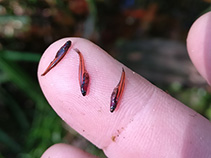 Paedocypris micromegethes
Photo von Petersen, P.
Bilder | Google Bild
Photo von Petersen, P.
Klassifizierung / Names Namen | Synonyme | Catalog of Fishes(Gattung, Arten) | ITIS | CoL | WoRMS | Cloffa
> Cypriniformes (Carps) > Paedocyprididae (Tiny carps)
Etymology: Paedocypris: Name from the Greek words 'Paideios' meaning children and 'Cypris' for Venus, common suffix for cyprinid genera; gender feminine; micromegethes: Micromegethes (Greek), small in size; a noun in apposition.
More on authors: Kottelat, Britz, Tan & Witte.
Etymology: Paedocypris: Name from the Greek words 'Paideios' meaning children and 'Cypris' for Venus, common suffix for cyprinid genera; gender feminine; micromegethes: Micromegethes (Greek), small in size; a noun in apposition.
More on authors: Kottelat, Britz, Tan & Witte.
Umwelt: Milieu / Klimazone / Tiefenbereich / Verbreitungsgebiet Ökologie
; süßwasser benthopelagisch. Tropical
Verbreitung Territorien | FAO Gebiete | Ökosysteme | Vorkommen | Punkt Karte | Einführungen | Faunafri
Southeast Asia: Malaysia.
Größe / Gewicht / Alter
Geschlechtsreife: Lm ? range ? - ? cm
Max length : 1.2 cm SL Männchen/unbestimmt; (Ref. 56152); 1.1 cm SL (female)
Max length : 1.2 cm SL Männchen/unbestimmt; (Ref. 56152); 1.1 cm SL (female)
Kurzbeschreibung Bestimmungsschlüssel | Morphologie | Morphometrie
Paedocypris progenetica is distinguished from Paedocypris micromegethes by: a smaller maximum size (male 9.8mm, versus 11.6; female 10.3mm, versus 11.4), keratinized pad in front of male pelvic fins as a projecting knob (versus flat to slightly swollen), breeding tubercles on the dentary arranged in a straight row, without forming a cluster (versus forming a cluster of up to five closely set individual tubercles, subdistally on the lateral side of the dentary, supported by a conspicuous lateral bony extension), pelvic fins of female vestigial, or often missing (versus smaller than in male but similarly shaped), presence of pre-anal-fin-fold in female (a character unique among teleosts; versus absent in both sexes), dense small chromatophores in deep layer on abdomen appearing as a continuous patch, tiny black vermiculations on belly from throat to anus, including on male's pre-pelvic keratinized knob (versus large superficial, isolated chromatophores on belly from throat to anus, absent on male's keratinized pad), numerous small, contiguous chromatophores on middorsal line, organized in 3-5 rows, forming a broad stripe (versus few large isolated chromatophores, forming 1-3 irregular rows), pelvic-fin rays plain brown (versus with rows of spots).
Recorded from peat swamps (Ref. 84801).
Lebenszyklus und Paarungsverhalten Geschlechtsreife | Fortpflanzung | Ablaichen | Eier | Fruchtbarkeit | Larven
Hauptreferenz
Laden Sie Ihre Referenzen hoch | Referenzen | Koordinator | Partner
Kottelat, M., R. Britz, H.H. Tan and K.-E. Witte, 2005. Paedocypris, a new genus of Southeast Asian cyprinid fish with a remarkable sexual dimorphism, comprises the world's smallest vertebrate. Proc. Royal Soc. Biol. Sci. 273:895-899. (Ref. 56152)
IUCN Rote Liste Status (Ref. 130435: Version 2025-2 (Global))
Verwundbar (VU) (B1ab(i,ii,iii,iv)+2ab(i,ii,iii,iv)); Date assessed: 29 January 2019
CITES
Not Evaluated
Bedrohung für Menschen
Harmless
Nutzung durch Menschen
Fischereien: nicht kommerziell
FAO - Publication: search | FishSource |
Mehr Information
Trophische Ökologie
Lebensmittel (Beutetiere)
Nahrungszusammensetzung
Nahrungsaufnahme
Lebensmittelrationen
Räuber
Lebensmittel (Beutetiere)
Nahrungszusammensetzung
Nahrungsaufnahme
Lebensmittelrationen
Räuber
Ökologie
Ökologie
Ökologie
Populationsdynamik
Wachstumsparameter
Max. Alter/Größen
Länge-Gewicht-Rel.
Länge-Länge-Verhältnis.
Längenhäufigkeiten
Massenkonvertierung
Rekrutierung
Dichte
Wachstumsparameter
Max. Alter/Größen
Länge-Gewicht-Rel.
Länge-Länge-Verhältnis.
Längenhäufigkeiten
Massenkonvertierung
Rekrutierung
Dichte
Lebenszyklus
Fortpflanzung
Geschlechtsreife
Reifung/Kiemen rel.
Fruchtbarkeit
Ablaichen
Laichaggregationen
Eier
Eientwicklung
Larven
Larven Pop.Dyn.
Fortpflanzung
Geschlechtsreife
Reifung/Kiemen rel.
Fruchtbarkeit
Ablaichen
Laichaggregationen
Eier
Eientwicklung
Larven
Larven Pop.Dyn.
Anatomie
Kiemenoberfläche
Gehirn
Otolith
Kiemenoberfläche
Gehirn
Otolith
Physiologie
Körperliche Zusammensetzung
Nährstoffe
Sauerstoffverbrauch
Schwimmart
Schwimmgeschwindigkeit
Visuelle Pigmente
Fischgeräusche
Krankheiten und Parasiten
Toxizität (LC50s)
Körperliche Zusammensetzung
Nährstoffe
Sauerstoffverbrauch
Schwimmart
Schwimmgeschwindigkeit
Visuelle Pigmente
Fischgeräusche
Krankheiten und Parasiten
Toxizität (LC50s)
Genetik
Genom
Genetik
Heterozygotie
Vererbbarkeit
Genetische Vielfalt
Genom
Genetik
Heterozygotie
Vererbbarkeit
Genetische Vielfalt
Menschenbezogen
Aquakultur-Systeme
Aquakultur Profile
Zuchtlinien
Ciguatera-Fälle
Briefmarken, Münzen, Verschiedenes.
Aquakultur-Systeme
Aquakultur Profile
Zuchtlinien
Ciguatera-Fälle
Briefmarken, Münzen, Verschiedenes.
Tools
Zusatzinformationen
Download XML
Zusammenfassung | Punktdaten | Namen | Photos
Internet Quellen
AFORO (otoliths) | Aquatic Commons | BHL | Cloffa | Websites from users | FishWatcher Einträge suchen | CISTI | Catalog of Fishes: Gattung, Arten | DiscoverLife | ECOTOX | FAO - Publication: search | Faunafri | Fishipedia | Fishtrace | GloBI | Google Books | Google Scholar | Google | IGFA World Record | OneZoom | Open Tree of Life | Otolith Atlas of Taiwan Fishes | PubMed | Reef Life Survey | Socotra Atlas | TreeBase | Tree of Life | Wikipedia: Gehe zu, Suchen | World Records Freshwater Fishing | Zoobank | Zoologischer Rekord
Schätzungen auf der Grundlage von Modellen
Phylogenetischer Diversitätsindex (Ref. 82804): PD50 = 0.7500 [Uniqueness, from 0.5 = low to 2.0 = high].
Bayesian length-weight: a=0.00389 (0.00180 - 0.00842), b=3.12 (2.94 - 3.30), in cm total length, based on all LWR estimates for this body shape (Ref. 93245).
Trophische Ebene (Ref. 69278): 3.0 ±0.2 se; based on size and trophs of closest relatives