



Envoyez vos Photos et vidéos
Images | Images Google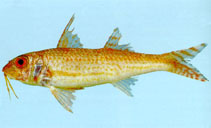 Upeneus guttatus
Photo de Khalaf, M.A.
Images | Images Google
Photo de Khalaf, M.A.
Classification / Noms Noms communs | Synonymes | Catalog of Fishes(Genre, Espèce) | ITIS | CoL | WoRMS | Cloffa
> Mulliformes (Goatfishes) > Mullidae (Goatfishes)
Etymology: Upeneus: Greek, ypene, -es = upper lip (Ref. 45335).
More on author: Day.
Etymology: Upeneus: Greek, ypene, -es = upper lip (Ref. 45335).
More on author: Day.
Taxonomic Remarks
FishBase common name changed from Two-tone goatfish to Twotone goatfish (Uiblein et al., 2024: Ref. 130857).
Environnement : milieu / zone climatique / profondeur / gamme de distribution Écologie
marin démersal; profondeur 8 - 165 m (Ref. 98481). Tropical
Distribution Territoires | Zones FAO | Écosystèmes | Occurrences | Carte par point | Introductions | Faunafri
Indo-West Pacific: from S Mozambique and the Red Sea to Japan, N Australia and New Caledonia.
Longueur à la première maturité / Taille / Poids / Âge
Description synthétique Clés d'identification | Morphologie | Morphométrie
Épines dorsales (Total) : 7; Rayons mous dorsaux (Total) : 9. This species is distinguished by the following characters: D VII + 9; pectoral fins 12-15; gill rakers 5-8 + 16-19 = 23-26. Measurements as %SL for adults: body depth at first dorsal fin origin 21-26 and at anus 18-22; caudal-peduncle depth 9.3-11; maximum head depth 18-22 and through eye 15-18; head length 26-29; snout length 9.4-12; orbit length 5.9-8.5; upper jaw length 9.5-12; barbel length 16-20; caudal-fin length 27-31; anal-fin height 15-19; pelvic-fin length 19-22; pectoral-fin length 19-22; first dorsal-fin height 20-25, at least one of the first 3 spines disproportionally higher; second dorsal-fin height 14-18; total oblique bars on caudal fin 7-16; upper caudal-fin lobe with 5-6 (rarely 4) reddish bars with 4-5 (rarely 3) bars distally from fork and one bar close to fin lobe base, of similar width or narrower than the pale interspaces between bars; there are 2-10 often faint, rather short and/or irregularly arranged red bars on ventral margin of lower caudal-fin lobe, sometimes extending to dorsal half of lobe or connecting to a red stripe which covers the lobe dorsally to two-thirds of its width at maximum; the caudal-fin lobe bars and stripe fade away after death and only traces retained in preserved fish; when fresh, barbels yellow rarely white; body colour may be variable, often white or rose below lateral line, covered by red pigmentation above lateral line which may also reach down ventrally and to head, sometimes forming red patches or blotches; body raely with a faint red or red-orange mid-lateral stripe from behind eye to caudal-fin base; when preserved, the body is pale brown and not dorsally darkened (Ref. 83903).
Body shape (shape guide): fusiform / normal; Cross section: compressed.
Body shape (shape guide): fusiform / normal; Cross section: compressed.
Cycle de vie et comportement reproducteur Maturité | Reproduction | Frai | Œufs | Fécondité | Larves
Référence principale
Téléchargez vos références | Références | Coordinateur : Randall, John E. | Collaborateurs
Uiblein, F. and P.C. Heemstra, 2010. A taxonomic review of the Western Indian Ocean goatfishes of the genus Upeneus (Family Mullidae), with descriptions of four new species. Smithiana 11:35-71. (Ref. 83903)
Statut dans la liste rouge de l'IUCN (Ref. 130435: Version 2025-2 (Global))
Préoccupation mineure (LC) ; Date assessed: 13 August 2019
CITES
Not Evaluated
Menace pour l'homme
Harmless
Utilisations par l'homme
FAO - Publication: search | FishSource |
Plus d'informations
Écologie trophique
Aliments (proies)
Composition du régime alimentaire
Consommation alimentaire
Rations alimentaires
Prédateurs
Aliments (proies)
Composition du régime alimentaire
Consommation alimentaire
Rations alimentaires
Prédateurs
Dynamique des populations
Paramètres de croissance
Âges / tailles maximales
Longueur-poids rel.
Rel. longueur-longueur.
Fréquences de longueurs
Conversion de masse
Recrutement
Abondance
Paramètres de croissance
Âges / tailles maximales
Longueur-poids rel.
Rel. longueur-longueur.
Fréquences de longueurs
Conversion de masse
Recrutement
Abondance
Anatomie
Surface branchiale
Cerveau
Otolithe
Surface branchiale
Cerveau
Otolithe
Physiologie
Composition corporelle
Nutriments
Consommation d'oxygène
Type de natation
Vitesse de nage
Pigments visuels
Son de poisson
Maladies et parasites
Toxicité (CL50)
Composition corporelle
Nutriments
Consommation d'oxygène
Type de natation
Vitesse de nage
Pigments visuels
Son de poisson
Maladies et parasites
Toxicité (CL50)
Génétique
génôme
Génétique
Hétérozygotie
Héritabilité
Diversité génétique
génôme
Génétique
Hétérozygotie
Héritabilité
Diversité génétique
Liées à l'homme
Systèmes d'aquaculture
Profils d'aquaculture
Souches
Cas de ciguatera
Timbres, pièces de monnaie, divers
Systèmes d'aquaculture
Profils d'aquaculture
Souches
Cas de ciguatera
Timbres, pièces de monnaie, divers
Outils
E-book | Guide de terrain | Clés d'identification | Générateur de fréquences de longueur | Outil de dynamique de population | Carte par point |
Capture-MSY |
Articles particuliers
Télécharger en XML
Sources Internet
AFORO (otoliths) | Aquatic Commons | BHL | Cloffa | Websites from users | FishWatcher | CISTI | Catalog of Fishes: Genre, Espèce | DiscoverLife | ECOTOX | FAO - Publication: search | Faunafri | Fishipedia | Fishtrace | GloBI | Google Books | Google Scholar | Google | IGFA World Record | OneZoom | Open Tree of Life | Otolith Atlas of Taiwan Fishes | PubMed | Reef Life Survey | Socotra Atlas | TreeBase | Arbre de Vie | Wikipedia: aller à, chercher | World Records Freshwater Fishing | Zoological Record
Estimations basées sur des modèles
Indice de diversité phylogénétique (Réf. 82804): PD50 = 0.5000 [Uniqueness, from 0.5 = low to 2.0 = high].
Bayesian length-weight: a=0.01122 (0.00653 - 0.01928), b=3.06 (2.91 - 3.21), in cm total length, based on LWR estimates for this species & Genus-body shape (Ref. 93245).
Niveau trophique (Réf. 69278): 3.5 ±0.0 se; based on diet studies.
Résilience (Réf. 120179): Haut, temps minimum de doublement de population inférieur à 15 mois (Fecundity=14,000).