



Rhamdia guasarensis DoNascimiento, Provenzano & Lundberg, 2004
Ladda upp din foton och Videor
Bilder | Google image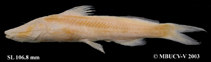 Rhamdia guasarensis
Bild av DoNascimiento, C.
Bilder | Google image
Bild av DoNascimiento, C.
Klassificering / Namn Populärnamn | synonymer | Catalog of Fishes(Släkte, Arter) | ITIS | CoL | WoRMS | Cloffa
> Siluriformes (Catfishes) > Heptapteridae (Three-barbeled catfishes)
Etymology: Rhamdia: Brazilian vernacular name, Nhamdia/Jamdia (Ref. 45335); guasarensis: Named for Río Guasare, parent stream of the subterranean waters in which this endemic catfish species lives.
Etymology: Rhamdia: Brazilian vernacular name, Nhamdia/Jamdia (Ref. 45335); guasarensis: Named for Río Guasare, parent stream of the subterranean waters in which this endemic catfish species lives.
Miljö: miljö / Klimatzon / djupintervall / distributionsområde Ekologi
; sötvatten bottenlevande. Tropical
Utbredning Territorier | FAO områden | Ekosystem | Förekomster | Prickkarta | Utplanteringar | Faunafri
South America: Venezuela.
Storlek / Vikt / Ålder
Kort beskrivning Bestämningsnycklar | Morfologi | Morfometri
Taggstrålar i ryggfenan (totalt) : 1; Mjukstrålar i ryggfenan (totalt) : 6; Mjukstrålar i analfenan: 12. This species differs from its congeners by having a concave dorsal head profile (vs. convex or straight); frontal bones broadly sutured to each other anterior to small, circular remnant foramen of anterior cranial fontanelle that is anteriorly adjacent to epiphyseal bar (vs. frontals separated by anterior fontanelle widely open from mesethmoid to epiphyseal bar). It differs from all epigean Rhamdia by the following troglomorphic characters: eyes absent, complete depigmentation, widened cutaneous pores of the cephalic laterosensory system, preoperculomandibular sensory canal forming wide fossae in the dentary and preopercle (vs. narrow pores and canals). Further, this species can be distinguished from other Rhamdia species by the following set of characters: pectoral fins with a spine and ten branched rays (vs. modally eight or nine soft rays in other species); both lobes of the caudal fin pointed (vs. at least one lobe rounded); caudal skeleton with three hypural plates, PH; 1 + 2; 3 + 4 + 5 (vs. Modally four PH; 1 + 2; 3 + 4; 5 in the other species, except R. laukidi and R. jequitinhonha) (Ref. 80467).
Body shape (shape guide): elongated; Cross section: compressed.
Body shape (shape guide): elongated; Cross section: compressed.
The cave where the fish was collected is near the margin of Río Guasare and is the source of a spring during seasonal rains; its lower conduit has a 280 m course, 2-3 m wide and 1-2 m high, narrowly communicating with the access gallery. The underground river is permanently fed by a spring about 60 m into the lower gallery. At the time the collection was made, the average depth of the water course was 1.5 m with deeper pools along its course where the catfishes were observed (Ref. 80467).
Livscykel och parningsbeteende Könsmognad | Reproduktion | Lek | Ägg | Fekunditet | Larver
Huvudreferens
Ladda upp dina referenser | referenser | Koordinator : Bockmann, Flavio | Medarbetare
DoNascimiento, C., F. Provenzano and J.G. Lundberg, 2004. Rhamdia guasarensis (Siluriformes: Heptapteridae) a new species of cave catfish from the Sierra de Perija´, northwestern Venezuela. Proc. Biol. Soc. Wash. 117(4):564-574. (Ref. 80467)
Status på IUCN:s rödlista (Ref. 130435: Version 2025-2 (Global))
Critically Endangered (CR) (B2ab(iii)); Date assessed: 07 August 2019
CITES
Not Evaluated
Hot mot människor
Harmless
Mänskliga användningsområden
Fiskeri: saknar intresse
FAO - Publication: search | FishSource |
Ytterligare information
Trofisk ekologi
Livsmedelsartiklar (preys)
Födosammansättning
Födointag
Matransoner
Predatorer
Livsmedelsartiklar (preys)
Födosammansättning
Födointag
Matransoner
Predatorer
Ekologi
Ekologi
Ekologi
Populationsdynamik
Tillväxtparametrar
Max. åldrar / storlekar
Längd-vikt rel.
Längd-längd rel.
Längd-frekvenser
Massakonvertering
Rekrytering
Abundans
Tillväxtparametrar
Max. åldrar / storlekar
Längd-vikt rel.
Längd-längd rel.
Längd-frekvenser
Massakonvertering
Rekrytering
Abundans
Livscykel
Reproduktion
Könsmognad
Mognad/Gills rel.
Fekunditet
Lek
Lekande aggregat
Ägg
Utveckling av ägg
Larver
Larvdynamik
Reproduktion
Könsmognad
Mognad/Gills rel.
Fekunditet
Lek
Lekande aggregat
Ägg
Utveckling av ägg
Larver
Larvdynamik
Anatomi
Gälyta
Hjärna
Otolit
Gälyta
Hjärna
Otolit
Fysiologi
Kroppssammansättning
Näringsämnen
Syreförbrukning
Typ av simning
Simhastighet
Visuella pigment
Ljud från fisk
Sjukdomar & Parasiter
Toxicitet (LC50)
Kroppssammansättning
Näringsämnen
Syreförbrukning
Typ av simning
Simhastighet
Visuella pigment
Ljud från fisk
Sjukdomar & Parasiter
Toxicitet (LC50)
Genetik
Genom
Genetik
Heterozygositet
Ärftlighet
Genetisk mångfald
Genom
Genetik
Heterozygositet
Ärftlighet
Genetisk mångfald
Människorelaterad
Vattenbrukssystem
Vattenbruksprofiler
Avelslinjer
Ciguatera-fall
Frimärken, mynt, diverse.
Vattenbrukssystem
Vattenbruksprofiler
Avelslinjer
Ciguatera-fall
Frimärken, mynt, diverse.
Verktyg
Särskilda rapporter
Kontrollera för underhåll av akvarium | Kontrollera om det finns faktablad om arter | Kontrollera om det finns faktablad om vattenbruk
Ladda ner XML
Internet-källor
AFORO (otoliths) | Aquatic Commons | BHL | Cloffa | Websites from users | Check FishWatcher | CISTI | Catalog of Fishes: Släkte, Arter | DiscoverLife | ECOTOX | FAO - Publication: search | Faunafri | Fishipedia | Fishtrace | GloBI | Google Books | Google Scholar | Google | IGFA World Record | OneZoom | Open Tree of Life | Otolith Atlas of Taiwan Fishes | PubMed | Reef Life Survey | Socotra Atlas | TreeBase | Tree of Life | Wikipedia: Go, sök | World Records Freshwater Fishing | Zoobank | Zoologiskt register
Uppskattningar baserade på modeller
Index för fylogenetisk mångfald (Ref. 82804): PD50 = 0.5000 [Uniqueness, from 0.5 = low to 2.0 = high].
Bayesian length-weight: a=0.00813 (0.00379 - 0.01743), b=2.97 (2.79 - 3.15), in cm total length, based on LWR estimates for this (Sub)family-body shape (Ref. 93245).
Trofisk nivå (Ref. 69278): 3.4 ±0.4 se; based on size and trophs of closest relatives
Resiliens (Ref. 120179): Mellan, lägsta populationsfördubblingstid 1,4-4,4 år (Preliminary K or Fecundity.).