



Ecsenius caeruliventris Springer & Allen, 2004
Bluebelly blenny
Carica il tuo foto e Video
Immagini | Google image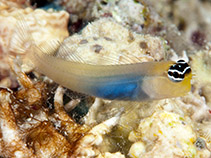 Ecsenius caeruliventris
Immagine di Ryanskiy, A.
Immagini | Google image
Immagine di Ryanskiy, A.
Classificazione / Nomi Nomi Comuni | Sinonimi | Catalog of Fishes(Genere, Specie) | ITIS | CoL | WoRMS | Cloffa
> Blenniiformes (Blennies) > Blenniidae (Combtooth blennies) > Salariinae
Etymology: Ecsenius: Greek, exenios, -os, -on = uncontrolled, immoderate; caeruliventris: Name from the Latin word 'caeruleus (= sky blue) and 'ventris' ( = belly), referring to the blue abdominal area; noun in apposition.
Etymology: Ecsenius: Greek, exenios, -os, -on = uncontrolled, immoderate; caeruliventris: Name from the Latin word 'caeruleus (= sky blue) and 'ventris' ( = belly), referring to the blue abdominal area; noun in apposition.
Ambiente: milieu / zona climatica / distribuzione batimetrica / gamma di distribuzione Ecologia
marino demersale; distribuzione batimetrica 3 - 5 m (Ref. 54476). Tropical
Distribuzione Territories | Aree FAO | Ecosistemi | Presenze | Mappa dei ritrovamenti | Introduzioni | Faunafri
Western Pacific: northeastern coast of Sulawesi, Indonesia.
Dimensione / Peso / Età
Maturità: Lm ? range ? - ? cm
Max length : 2.4 cm SL maschio/sesso non determinato; (Ref. 54476); 2.4 cm SL (female)
Max length : 2.4 cm SL maschio/sesso non determinato; (Ref. 54476); 2.4 cm SL (female)
Breve descrizione Chiavi di identificazione | Morfologia | Morfometria
Diagnosis: This species of the Prooculis group has a body without alternating dark and pale stripes or distinct dark spots; there is a dark stripe extending posteriorly from orbital margin across head and variably for short distance onto body anteriorly. In life, the dark post-orbital stripe is bordered ventrally by bright white stripe; other bright markings on head, white with at most a very faint tinge of yellow; belly bluish (Ref. 54476).
Body shape (shape guide): fusiform / normal.
Body shape (shape guide): fusiform / normal.
This is one of the smallest species of Ecsenius, female at 2.37 cm SL having well-developed, apparently ripe, ovaries. The 1.56 cm SL male has well-developed dentary teeth, including obvious posterior canines; where in most Ecsenius species, at this size, the posterior canines are not present and the number of other dentary teeth does not appear to have been completely established (Ref. 54476). Oviparous. Eggs are demersal and adhesive (Ref. 205), and are attached to the substrate via a filamentous, adhesive pad or pedestal (Ref. 94114). Larvae are planktonic, often found in shallow, coastal waters (Ref. 94114).
Ciclo vitale e comportamento di accoppiamento Maturità | Riproduzione | Deposizione | Uova | Fecondità | Larve
Oviparous, distinct pairing (Ref. 205).
Riferimento principale
Caricare le referenze | Bibliografia | Coordinatore : Williams, Jeffrey T. | Collaboratori
Springer, V.G. and G.R. Allen, 2004. Ecsenius caeruliventris and E. shirleyae, two new species of blenniid fishes from Indonesia, and new distribution records for other species of Ecsenius. Zootaxa 791:1-12. (Ref. 54476)
Stato della Lista Rossa IUCN (Ref. 130435: Version 2025-2 (Global))
Least Concern (LC) ; Date assessed: 24 March 2009
CITES
Not Evaluated
Minaccia per l'uomo
Harmless
Usi umani
FAO - Publication: search | FishSource |
Informazioni ulteriori
Ecologia trofica
Articoli alimentari (prede)
Alimentazione
Consumo di cibo
Razioni alimentari
Predatori
Articoli alimentari (prede)
Alimentazione
Consumo di cibo
Razioni alimentari
Predatori
Ecologia
Ecologia
Ecologia
Dinamica della popolazione
Parametri di crescita
Età massima / dimensioni massime
Rapporto lunghezza-peso.
Lunghezza-lunghezza rel.
Lunghezza-frequenze
Conversione di massa
Reclutamento
Abbondanza
Parametri di crescita
Età massima / dimensioni massime
Rapporto lunghezza-peso.
Lunghezza-lunghezza rel.
Lunghezza-frequenze
Conversione di massa
Reclutamento
Abbondanza
Ciclo di vita
Riproduzione
Maturità
Maturità/Gli occhielli sono relativi.
Fecondità
Deposizione
Aggregazioni riproduttive
Uova
Sviluppo delle uova
Larve
Dinamica popolazioni larvali
Riproduzione
Maturità
Maturità/Gli occhielli sono relativi.
Fecondità
Deposizione
Aggregazioni riproduttive
Uova
Sviluppo delle uova
Larve
Dinamica popolazioni larvali
Anatomia
Area branchiale
Cervello
Otolite
Area branchiale
Cervello
Otolite
Fisiologia
Composizione corporea
Nutrienti
Consumo di ossigeno
Tipo di nuoto
Velocità di nuoto
Pigmenti visivi
Suono del pesce
Malattie e parassiti
Tossicità (LC50)
Composizione corporea
Nutrienti
Consumo di ossigeno
Tipo di nuoto
Velocità di nuoto
Pigmenti visivi
Suono del pesce
Malattie e parassiti
Tossicità (LC50)
Genetica
Genome
Genetica
Eterozigosi
Ereditarietà
Diversità genetica
Genome
Genetica
Eterozigosi
Ereditarietà
Diversità genetica
Legato all'uomo
Sistemi di acquacoltura
Profili di acquacoltura
Varietà
Casi di Ciguatera
Francobolli, monete, materiale vario.
Sistemi di acquacoltura
Profili di acquacoltura
Varietà
Casi di Ciguatera
Francobolli, monete, materiale vario.
Strumenti
Libro elettronico | Giuda pratica | Generatore frequenze di lunghezza | Strumento Parametri Biologici | Mappa dei ritrovamenti |
Cattura-MSY |
Rapporti speciali
Controllo della manutenzione dell'acquario | Verificare la presenza di schede informative sulle specie | Verifica delle schede informative sull'acquacoltura
Scarica XML
Fonti Internet
AFORO (otoliths) | Aquatic Commons | BHL | Cloffa | Websites from users | Check FishWatcher | CISTI | Catalog of Fishes: Genere, Specie | DiscoverLife | ECOTOX | FAO - Publication: search | Faunafri | Fishipedia | Fishtrace | GloBI | Google Books | Google Scholar | Google | IGFA World Record | OneZoom | Open Tree of Life | Otolith Atlas of Taiwan Fishes | PubMed | Reef Life Survey | Socotra Atlas | TreeBase | Tree of Life | Wikipedia: Go, ricerca | World Records Freshwater Fishing | Zoobank | Record zoologico
Stime basate su modelli
Indice di diversità filogenetica (Fonte Biblio. 82804): PD50 = 0.5000 [Uniqueness, from 0.5 = low to 2.0 = high].
Bayesian length-weight: a=0.01047 (0.00463 - 0.02370), b=2.98 (2.79 - 3.17), in cm total length, based on LWR estimates for this (Sub)family-body shape (Ref. 93245).
Resilienza (Fonte Biblio. 120179): Alto, tempo minimo di raddoppiamento della popolazione meno di 15 mesi (Preliminary K or Fecundity.).