



Apionichthys sauli Ramos, 2003
Hochladen Photos und videos
Google Bild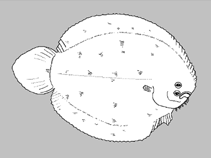 No image available for this species;
drawing shows typical species in Achiridae.
Google Bild
drawing shows typical species in Achiridae.
Klassifizierung / Names Namen | Synonyme | Catalog of Fishes(Gattung, Arten) | ITIS | CoL | WoRMS | Cloffa
> Pleuronectiformes (Flatfishes) > Achiridae (American soles)
Etymology: Apionichthys: Greek, apion = pear + Greek, ichthys = fish; it also exists "a-pion", no fatty (Ref. 45335); sauli: Named after William G. Saul, one of the collectors of the type material and former curator of the fish collection of the Academy of Natural Science of Philadelphia.
Eponymy: William ‘Bill’ G Saul (d: 1944) was collection manager of the Ichthyology Department of the Academy of Drexel University; formerly known as the Academy of Natural Sciences of Philadelphia (1972–1999). [...] (Ref. 128868), visit book page.
Etymology: Apionichthys: Greek, apion = pear + Greek, ichthys = fish; it also exists "a-pion", no fatty (Ref. 45335); sauli: Named after William G. Saul, one of the collectors of the type material and former curator of the fish collection of the Academy of Natural Science of Philadelphia.
Eponymy: William ‘Bill’ G Saul (d: 1944) was collection manager of the Ichthyology Department of the Academy of Drexel University; formerly known as the Academy of Natural Sciences of Philadelphia (1972–1999). [...] (Ref. 128868), visit book page.
Umwelt: Milieu / Klimazone / Tiefenbereich / Verbreitungsgebiet Ökologie
; süßwasser demersal. Tropical
Verbreitung Territorien | FAO Gebiete | Ökosysteme | Vorkommen | Punkt Karte | Einführungen | Faunafri
South America: Rio Metica, a tributary of Rio Meta, and Rio Guarico, Orinoco basin.
Größe / Gewicht / Alter
Kurzbeschreibung Bestimmungsschlüssel | Morphologie | Morphometrie
Rückenflossenstacheln (insgesamt) : 0; Rückenflossenweichstrahlen (insgesamt) : 58 - 64; Afterflossenstacheln: 0; Afterflossenweichstrahlen: 42 - 47; Wirbelzahl: 34 - 35. Body outline almost perfectly ovoid (dorsal and anal fin included); eyes widely separated; vertical dark lines conspicuous and crossed by a pair of longitudinal dark stripes bordering lateral line, forming a typical reticulate pattern over the brown background; body and fins have irregular dark blotches of different sizes, most of them approximately the size of the interorbital space, and minor blotches scattered among them; absence of scales on the interorbital space; reticulate color pattern over the brown background with small blotches; nostril diameter smaller than orbital diameter; and caudal fin lanceolate (Ref. 49504).
Body shape (shape guide): short and / or deep.
Body shape (shape guide): short and / or deep.
Lebenszyklus und Paarungsverhalten Geschlechtsreife | Fortpflanzung | Ablaichen | Eier | Fruchtbarkeit | Larven
Hauptreferenz
Laden Sie Ihre Referenzen hoch | Referenzen | Koordinator : Ramos, Robson T.C. | Partner
Ramos, R.T.C., 2003. Systematic review of Apionichthys (Pleuronectiformes: Achiridae), with description of four new species. Ichthyol. Explor. Freshwat. 14(2):97-126. (Ref. 49504)
IUCN Rote Liste Status (Ref. 130435: Version 2025-2 (Global))
nicht bedroht (LC) ; Date assessed: 04 March 2021
CITES
Not Evaluated
Bedrohung für Menschen
Harmless
Nutzung durch Menschen
FAO - Publication: search | FishSource |
Mehr Information
Trophische Ökologie
Lebensmittel (Beutetiere)
Nahrungszusammensetzung
Nahrungsaufnahme
Lebensmittelrationen
Räuber
Lebensmittel (Beutetiere)
Nahrungszusammensetzung
Nahrungsaufnahme
Lebensmittelrationen
Räuber
Ökologie
Ökologie
Ökologie
Populationsdynamik
Wachstumsparameter
Max. Alter/Größen
Länge-Gewicht-Rel.
Länge-Länge-Verhältnis.
Längenhäufigkeiten
Massenkonvertierung
Rekrutierung
Dichte
Wachstumsparameter
Max. Alter/Größen
Länge-Gewicht-Rel.
Länge-Länge-Verhältnis.
Längenhäufigkeiten
Massenkonvertierung
Rekrutierung
Dichte
Lebenszyklus
Fortpflanzung
Geschlechtsreife
Reifung/Kiemen rel.
Fruchtbarkeit
Ablaichen
Laichaggregationen
Eier
Eientwicklung
Larven
Larven Pop.Dyn.
Fortpflanzung
Geschlechtsreife
Reifung/Kiemen rel.
Fruchtbarkeit
Ablaichen
Laichaggregationen
Eier
Eientwicklung
Larven
Larven Pop.Dyn.
Anatomie
Kiemenoberfläche
Gehirn
Otolith
Kiemenoberfläche
Gehirn
Otolith
Physiologie
Körperliche Zusammensetzung
Nährstoffe
Sauerstoffverbrauch
Schwimmart
Schwimmgeschwindigkeit
Visuelle Pigmente
Fischgeräusche
Krankheiten und Parasiten
Toxizität (LC50s)
Körperliche Zusammensetzung
Nährstoffe
Sauerstoffverbrauch
Schwimmart
Schwimmgeschwindigkeit
Visuelle Pigmente
Fischgeräusche
Krankheiten und Parasiten
Toxizität (LC50s)
Genetik
Genom
Genetik
Heterozygotie
Vererbbarkeit
Genetische Vielfalt
Genom
Genetik
Heterozygotie
Vererbbarkeit
Genetische Vielfalt
Menschenbezogen
Aquakultur-Systeme
Aquakultur Profile
Zuchtlinien
Ciguatera-Fälle
Briefmarken, Münzen, Verschiedenes.
Aquakultur-Systeme
Aquakultur Profile
Zuchtlinien
Ciguatera-Fälle
Briefmarken, Münzen, Verschiedenes.
Tools
E-Book | Feldführer | Bestimmungsschlüssel | Längenhäufigkeits Tool | Lebensdaten Tool | Punkt Karte |
Catch-MSY |
Zusatzinformationen
Download XML
Zusammenfassung | Punktdaten | Namen | Photos
Internet Quellen
AFORO (otoliths) | Aquatic Commons | BHL | Cloffa | Websites from users | FishWatcher Einträge suchen | CISTI | Catalog of Fishes: Gattung, Arten | DiscoverLife | ECOTOX | FAO - Publication: search | Faunafri | Fishipedia | Fishtrace | GloBI | Google Books | Google Scholar | Google | IGFA World Record | OneZoom | Open Tree of Life | Otolith Atlas of Taiwan Fishes | PubMed | Reef Life Survey | Socotra Atlas | TreeBase | Tree of Life | Wikipedia: Gehe zu, Suchen | World Records Freshwater Fishing | Zoobank | Zoologischer Rekord
Schätzungen auf der Grundlage von Modellen
Phylogenetischer Diversitätsindex (Ref. 82804): PD50 = 0.5078 [Uniqueness, from 0.5 = low to 2.0 = high].
Bayesian length-weight: a=0.01380 (0.00635 - 0.03000), b=3.08 (2.90 - 3.26), in cm total length, based on LWR estimates for this (Sub)family-body shape (Ref. 93245).
Trophische Ebene (Ref. 69278): 3.2 ±0.5 se; based on size and trophs of closest relatives
Widerstandsfähigkeit (Ref. 120179): hoch, Verdopplung der Population dauert weniger als 15 Monate. (Preliminary K or Fecundity.).