



Petrocephalus sullivani Lavoué, Hopkins & Kamdem Toham, 2004
Uploaden van uw Foto's en video's
Google afbeelding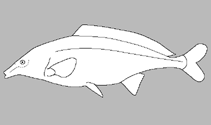 No image available for this species;
drawing shows typical species in Mormyridae.
Google afbeelding
drawing shows typical species in Mormyridae.
Classificatie / Namen Lokale namen | Synoniemen | Catalog of Fishes(Genus, Soort(en)) | ITIS | CoL | WoRMS | Cloffa
> Osteoglossiformes (Bony tongues) > Mormyridae (Elephantfishes)
Etymology: Petrocephalus: Latin, petra = stone + Greek, kephale = head (Ref. 45335); sullivani: This species is dedicated to John P. Sullivan, colleague and friend of the authors, in recognition of his contributions to the systematics of the Mormyridae.
Eponymy: Dr John P Sullivan (d: 1965) is an ichthyologist who is (2013–present) a Curatorial Affiliate at Cornell University, Museum of Vertebrates Ithaca, NY, USA where he had previously been a visiting fellow (2009–2013). [...] (Ref. 128868), visit book page.
Etymology: Petrocephalus: Latin, petra = stone + Greek, kephale = head (Ref. 45335); sullivani: This species is dedicated to John P. Sullivan, colleague and friend of the authors, in recognition of his contributions to the systematics of the Mormyridae.
Eponymy: Dr John P Sullivan (d: 1965) is an ichthyologist who is (2013–present) a Curatorial Affiliate at Cornell University, Museum of Vertebrates Ithaca, NY, USA where he had previously been a visiting fellow (2009–2013). [...] (Ref. 128868), visit book page.
Milieu: milieu / Klimaatzone / Diepte / verspreidingsgebied Ecologie
; zoet water benthopelagisch. Tropical
Verspreiding Gebieden | FAO regio's | Ecosystemen | Voorkomen | Verspreidingskaart | Introducties | Faunafri
Africa: Widespread in Gabon. It has been collected from the Ogooué basin (excepting its most upper and lower reaches), the Ntem and Ivindo basins, and the Nyanga basin. On numerous occasions, the authors collected this species together with P. simus (Ref. 52344).
Grootte / Gewicht / Leeftijd
Korte beschrijving Determinatiesleutels | Morfologie | Morfometrie
Petrocephalus sullivani is distinguished from all other Petrocephalus species from Gabon by the following characters: 20 to 25 branched rays in the dorsal fin and 24 to 30 in the anal fin; 14 to 20 scales (average 17.5) between the anterior base of the anal fin and the lateral line; mouth clearly inferior (distance between anterior extremityof th esnout and corner of the mouth between 2.7 and 4.4 times in head length; mouth opens under the posterior half of the eye, whereas in P. simus and P. balayi it opens under the anterior half of the eye); large eye (diameter of the eye between 3.0 and 4.1 times in head length, average 3.6); and no sub-dorsal black spot. The EOD is short (216 ms mean duration) with a peak FFT frequency of 9597 Hz. The EOD presents a prominent third phase (P3) with an amplitude of 12.8% of peak-to-peak height. Eye relatively large. Eye diameter between 3.0 and 4.1 times in head length (average 3.5) (Ref. 52344).
Body shape (shape guide): fusiform / normal; Cross section: compressed.
Body shape (shape guide): fusiform / normal; Cross section: compressed.
Levenscyclus en paargedrag Maturiteit | Voortplanting | Paaien | Eieren | Fecunditeit | Larven
Hoofdreferentie
Upload uw referenties | Referenties | Coördinator | Medewerkers
Lavoué, S., C.D. Hopkins and A. Kamdem Toham, 2004. The Petrocephalus (Pisces, Osteoglossomorpha, Mormyridae) of Gabon, Central Africa, with the description of a new species. Zoosystema 26(3):511-535. (Ref. 52344)
Status op de Rode Lijst van het IUCN (Ref. 130435: Version 2025-2 (Global))
Niet bedreigd (LC) ; Date assessed: 16 February 2009
CITES
Not Evaluated
Gevaar voor de mens
Harmless
Gebruik door de mens
FAO - Publication: search | FishSource |
Meer informatie
Trofische ecologie
Voedsel (prooien)
Dieetsamenstelling
Voedselconsumptie
Voedselrantsoenen
Predatoren
Voedsel (prooien)
Dieetsamenstelling
Voedselconsumptie
Voedselrantsoenen
Predatoren
Ecologie
Ecologie
Ecologie
Populatiedynamica
Groeiparameters
Max. leeftijden / maten
Lengte-gewicht rel.
Lengte-lengte rel.
Lengtefrequenties
Massaconversie
Rekrutering
Abundantie
Groeiparameters
Max. leeftijden / maten
Lengte-gewicht rel.
Lengte-lengte rel.
Lengtefrequenties
Massaconversie
Rekrutering
Abundantie
Levenscyclus
Voortplanting
Maturiteit
Rijpheid/kieuwen rel.
Fecunditeit
Paaien
Paaibestanden
Eieren
Ontwikkeling van de eieren
Larven
Larvale populatiedynamiek
Voortplanting
Maturiteit
Rijpheid/kieuwen rel.
Fecunditeit
Paaien
Paaibestanden
Eieren
Ontwikkeling van de eieren
Larven
Larvale populatiedynamiek
Anatomie
Kieuwoppervlak
Hersenen
Otoliet
Kieuwoppervlak
Hersenen
Otoliet
Fysiologie
Lichaamssamenstelling
Voedingsstoffen
Zuurstofverbruik
Type zwemmen
Zwemsnelheid
Visuele pigmenten
Vis geluid
Ziekten en parasieten
Toxiciteit (LC50)
Lichaamssamenstelling
Voedingsstoffen
Zuurstofverbruik
Type zwemmen
Zwemsnelheid
Visuele pigmenten
Vis geluid
Ziekten en parasieten
Toxiciteit (LC50)
Genetica
genoom
Genetica
Heterozygositeit
Erfelijkheid
Genetische diversiteit
genoom
Genetica
Heterozygositeit
Erfelijkheid
Genetische diversiteit
Menselijk gerelateerd
Aquacultuursystemen
Aquacultuurprofielen
Kweeklijnen
Ciguatera gevallen
Postzegels, munten, diversen.
Aquacultuursystemen
Aquacultuurprofielen
Kweeklijnen
Ciguatera gevallen
Postzegels, munten, diversen.
Tools
E-boek | Veldgids | Determinatiesleutels | Lengtefrequentie Tool | Levenscyclus tool | Verspreidingskaart |
Vangst-MSY |
Speciale rapporten
Bekijk gegevens voor het houden in een aquarium | Bekijk Fact Sheets voor de soort | Bekijk Aquacultuur Fact Sheets
Download XML
Internetbronnen
AFORO (otoliths) | Aquatic Commons | BHL | Cloffa | Websites from users | Bekijk FishWatcher | CISTI | Catalog of Fishes: Genus, Soort(en) | DiscoverLife | ECOTOX | FAO - Publication: search | Faunafri | Fishipedia | Fishtrace | GloBI | Google Books | Google Scholar | Google | IGFA World Record | OneZoom | Open Tree of Life | Otolith Atlas of Taiwan Fishes | PubMed | Reef Life Survey | Socotra Atlas | TreeBase | Tree of Life | Wikipedia: ga naar, zoek | World Records Freshwater Fishing | Zoobank | Zoological Record
Schattingen op basis van modellen
Fylogenetische diversiteitsindex (Ref. 82804): PD50 = 0.5000 [Uniqueness, from 0.5 = low to 2.0 = high].
Bayesian length-weight: a=0.01549 (0.00672 - 0.03569), b=2.87 (2.69 - 3.05), in cm total length, based on LWR estimates for this Genus-body shape (Ref. 93245).
Trofisch niveau (Ref. 69278): 3.2 ±0.4 se; based on size and trophs of closest relatives
Weerstandsvermogen (Ref. 120179): Hoog, minimale populatieverdubbelingstijd minder dan 15 maanden (Preliminary K or Fecundity.).