



Pangasianodon gigas Chevey, 1931
Mekong giant catfish
Adicionar o seu Fotografias e vídeos
Fotografias | Selos, moedas, diversos. | Imagem do Google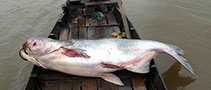 Pangasianodon gigas
Fotografia de Jean-Francois Helias / Fishing Adventures Thailand
Fotografias | Selos, moedas, diversos. | Imagem do Google
Fotografia de Jean-Francois Helias / Fishing Adventures Thailand
Classificação / Nomes Nomes comuns | Sinónimos | Catalog of Fishes(Género, Espécies) | ITIS | CoL | WoRMS | Cloffa
> Siluriformes (Catfishes) > Pangasiidae (Shark catfishes)
Etymology: Pangasianodon: The Vietnamese name of a fish + Greek, odous = teeth (Ref. 45335).
Eponymy: Gigas was a giant in Greek mythology, the child of Uranus and Gaea. The name is applied to taxa that are giants of their kind. (Ref. 128868), visit book page.
Etymology: Pangasianodon: The Vietnamese name of a fish + Greek, odous = teeth (Ref. 45335).
Eponymy: Gigas was a giant in Greek mythology, the child of Uranus and Gaea. The name is applied to taxa that are giants of their kind. (Ref. 128868), visit book page.
Ambiente: milieu / zona climática / intervalo de profundidade / gama de distribuição Ecologia
; Água doce bentopelágico; potamódromo (Ref. 131118). Tropical
Distribuição Territórios | Áreas FAO | Ecossistemas | Ocorrências | Mapa dos pontos | Introduções | Faunafri
Asia: endemic to the Mekong basin where it has become rare due to overexploitation.
Tamanho / Peso / Idade
Maturidade: Lm ? range ? - ? cm
Max length : 300 cm TL macho/indeterminado; (Ref. 30857); 235.0 cm SL (female); peso máx. Publicado: 350.0 kg (Ref. 43281); Idade máx. registada: 10 anos (Ref. 116372)
Max length : 300 cm TL macho/indeterminado; (Ref. 30857); 235.0 cm SL (female); peso máx. Publicado: 350.0 kg (Ref. 43281); Idade máx. registada: 10 anos (Ref. 116372)
Descrição breve Chaves de identificação | Morfologia | Morfometria
Espinhos dorsais (total) : 2; Raios dorsais moles (total) : 7 - 8; Raios anais moles: 35; Vértebras: 48. Body without stripes; posterior nostril located near anterior nostril; 7 branched dorsal-fin rays; gill rakers rudimentary or absent; fins grey, never black (Ref. 12693). The center of the eye above the horizontal line through the mouth angle in juveniles; eye totally below the level of mouth angle in subadults and adults. The maxillary and mandibulary pairs of barbels well developed in juveniles; mandibulary barbels become rudimentary in subadults and adults (Ref. 9448). Gigantic size; oral teeth and gill rakers present in small juveniles, absent at about 30-50 cm SL; dorsal, pelvic and pectoral fins without filamentous extensions (Ref. 43281). Distinguished from other large catfish in the Mekong by its lack of teeth and the almost complete absence of barbels (Ref. 2686)
Body shape (shape guide): elongated; Cross section: circular.
Body shape (shape guide): elongated; Cross section: circular.
Facultative air-breathing (Ref. 126274); A migratory species (Ref. 37772) which occurs in medium to large-sized rivers (Ref. 12975). Adults feed on detritus and algae on the bottom (Ref. 58784); feeds only on vegetation in the river but takes other food in captivity; little is known on its general pattern of life and migratory journeys for spawning (Ref. 2686). Shows one of the fastest growth rates of any fish in the world, reaching 150 to 200 kg in 6 years (Ref. 12693). Cited in the Guinness Book of Records as largest freshwater fish (Ref. 6472). Marketed fresh (Ref. 12693). Maximum length of 300 cm needs confirmation. Threatened due to over harvesting and habitat loss (Ref. 58490).
Ciclo de vida e comportamento de acasalamento Maturidade | Reprodução | Desova | Ovos | Fecundidade | Larvas
Referência principal
Carregar as suas referências | Referências | Coordenador | Colaboradores
Roberts, T.R. and C. Vidthayanon, 1991. Systematic revision of the Asian catfish family Pangasiidae, with biological observations and descriptions of three new species. Proc. Acad. Nat. Sci. Philad. 143:97-144. (Ref. 7432)
Categoria na Lista Vermelha da IUCN (Ref. 130435: Version 2025-2 (Global))
Criticamente ameaçada (CR) (A4abcd); Date assessed: 13 April 2011
Ameaça para o homem
Harmless
Utilização humana
Pescarias: espécies comerciais; Aquacultura: experimental
FAO - Publication: search | FishSource |
Mais informação
Ecologia Trófica
Produtos alimentares (presas)
Composição da dieta
Consumo alimentar
Rações alimentares
Predadores
Produtos alimentares (presas)
Composição da dieta
Consumo alimentar
Rações alimentares
Predadores
Dinâmica das populações
Parâmetros de crescimento
Idades / tamanhos máximos
Comprimento-peso rel.
Comprimento-comprimento rel.
Frequência de comprimento
Conversão de massa
Recrutamento
Abundância
Parâmetros de crescimento
Idades / tamanhos máximos
Comprimento-peso rel.
Comprimento-comprimento rel.
Frequência de comprimento
Conversão de massa
Recrutamento
Abundância
Ciclo de vida
Reprodução
Maturidade
Maturidade/Rel. das guelras
Fecundidade
Desova
Agregações de desova
Ovos
Desenvolvimento dos ovos
Larvas
Dinâmica larvar
Reprodução
Maturidade
Maturidade/Rel. das guelras
Fecundidade
Desova
Agregações de desova
Ovos
Desenvolvimento dos ovos
Larvas
Dinâmica larvar
Anatomia
Área branquial
Cérebro
Otólitos
Área branquial
Cérebro
Otólitos
Fisiologia
Composição corporal
Nutrientes
Consumo de oxigénio
Tipo de natação
Velocidade de natação
Pigmentos visuais
Som de peixe
Doenças e Parasitas
Toxicidade (LC50s)
Composição corporal
Nutrientes
Consumo de oxigénio
Tipo de natação
Velocidade de natação
Pigmentos visuais
Som de peixe
Doenças e Parasitas
Toxicidade (LC50s)
Relacionado com o ser humano
Sistemas de aquacultura
Perfis para aquacultura
Estirpes
Casos de Ciguatera
Selos, moedas, diversos.
Sistemas de aquacultura
Perfis para aquacultura
Estirpes
Casos de Ciguatera
Selos, moedas, diversos.
Ferramentas
E-book | Guia de campo | Ferramenta auxiliar de frequências de comprimento | Ferramenta sobre a história de vida | Mapa dos pontos |
Captura-MSY |
Relatórios especiais
Descarregue XML
Fontes da internet
AFORO (otoliths) | Alien/Invasive Species database | Aquatic Commons | BHL | Cloffa | Websites from users | Consultar FishWatcher | CISTI | Catalog of Fishes: Género, Espécies | DiscoverLife | ECOTOX | FAO - Publication: search | Faunafri | Fishipedia | Fishtrace | GloBI | Google Books | Google Scholar | Google | IGFA World Record | OneZoom | Open Tree of Life | Otolith Atlas of Taiwan Fishes | PubMed | Reef Life Survey | Socotra Atlas | TreeBase | Árvore da vida | Wikipedia: ir para, procurar | World Records Freshwater Fishing | Zoobank | Registo zoológico
Estimativas baseadas em modelos
Índice de diversidade filogenética (Ref. 82804): PD50 = 0.7500 [Uniqueness, from 0.5 = low to 2.0 = high].
Bayesian length-weight: a=0.00776 (0.00387 - 0.01555), b=3.14 (2.96 - 3.32), in cm total length, based on LWR estimates for this species & (Sub)family-body (Ref. 93245).
Nível Trófico (Ref. 69278): 2.3 ±0.17 se; based on food items.
Generation time: 12.9 ( na - na) years. Estimated as median ln(3)/K based on 1 growth studies.
Resiliência (Ref. 120179): Baixo, tempo mínimo de duplicação da população 4,5 - 14 anos (Assuming tm=5-10; K=0.085).