



Lamprologus teugelsi Schelly & Stiassny, 2004
Envoyez vos Photos et vidéos
Images | Images Google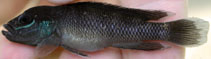 Lamprologus teugelsi
Photo de Stiassny, M.L.J.
Images | Images Google
Photo de Stiassny, M.L.J.
Classification / Noms Noms communs | Synonymes | Catalog of Fishes(Genre, Espèce) | ITIS | CoL | WoRMS | Cloffa
> Cichliformes (Cichlids, convict blennies) > Cichlidae (Cichlids) > Pseudocrenilabrinae
Etymology: Lamprologus: Greek, lampros = light + Greek, lagos = hare (Ref. 45335); teugelsi: Named in memory of Guy Teugels, for his leadership in the field of African ichthyology and his commitment to the training and support of African ichthyologists (Ref. 52248).
Eponymy: Dr Guy G Teugels (1954–2003) was a Belgian ichthyologist. [...] (Ref. 128868), visit book page.
Etymology: Lamprologus: Greek, lampros = light + Greek, lagos = hare (Ref. 45335); teugelsi: Named in memory of Guy Teugels, for his leadership in the field of African ichthyology and his commitment to the training and support of African ichthyologists (Ref. 52248).
Eponymy: Dr Guy G Teugels (1954–2003) was a Belgian ichthyologist. [...] (Ref. 128868), visit book page.
Environnement : milieu / zone climatique / profondeur / gamme de distribution Écologie
; eau douce benthopélagique. Tropical
Distribution Territoires | Zones FAO | Écosystèmes | Occurrences | Carte par point | Introductions | Faunafri
Africa: Pool Malebo (= Stanley Pool) and the lower Congo River rapids near Inga, in Democratic Republic of the Congo (Ref. 52248).
Taille / Poids / Âge
Description synthétique Clés d'identification | Morphologie | Morphométrie
Épines dorsales (Total) : 17 - 19; Rayons mous dorsaux (Total) : 8 - 9; Épines anales: 5 - 6; Rayons mous anaux: 6 - 7; Vertèbres: 30 - 32. Relatively stout, deep-bodied species, especially as adults (Ref. 52248). Head length 31.0-33.8% of standard length (Ref. 52248). Jaws are isognathous, but with lower lip sometimes protruding slightly; both outer and inner row teeth uniscupid and sharply pointed (Ref. 52248). Lower pharyngeal jaw is wider than long, and straight or slightly interdigitating along ventral suture; usually with 20-24 teeth in most posterior tooth row (Ref. 52248). Gill rakers are moderately elongate and non-denticulate (Ref. 52248). Spines in dorsal and anal fin are gradually increasing in length posteriorly; filamentous extensions of both fins are extending beyond caudal fin base (Ref. 52248). Caudal fin is moderately large and rounded rather than paddle shaped, never appearing subacuminate, with 14 branched rays (Ref. 52248). Pectoral fins are short, not reaching vertical through anus (Ref. 52248). Second pelvic fin ray is longest in fin in both sexes, but not reaching vertical through anus (Ref. 52248). Flank scales are large, ctenoid and regularly imbricating; cheek and chest naked, belly with small scales; nape predominantly scaleless to dorsal fin origin; dorsal and anal fins scaleless, small scales over proximal half of caudal fin (Ref. 52248). The base body coloration is light gray, with six wide, irregular, dark bars on flanks separated by thinner, whitish blotches (Ref. 52248). Dorsal, anal, and caudal fins are darkly pigmented, lacking obvious maculae; dorsal fin with light yellow margin, caudal fin with reddish margin restricted to dorsal edge (Ref. 52248). Preserved specimens are yellowish brown, with darker dorsal, anal and pelvic fins and head (Ref. 52248). Individual flank scales have a dark pigment distributed uniformly along exposed posterior margin, creating intersecting rows of thin, oblique bands of pigment that present the appearance of a chain-link fence or chain-mail (Ref. 52248).
Body shape (shape guide): fusiform / normal.
Body shape (shape guide): fusiform / normal.
Cycle de vie et comportement reproducteur Maturité | Reproduction | Frai | Œufs | Fécondité | Larves
Référence principale
Téléchargez vos références | Références | Coordinateur : Kullander, Sven O. | Collaborateurs
Schelly, R.C. and M.L.J. Stiassny, 2004. Revision of the Congo River Lamprologus Schilthuis, 1891 (Teleostei: Cichlidae), with descriptions of two new species. Am. Mus. Novit. 3451:40 p. (Ref. 52248)
Statut dans la liste rouge de l'IUCN (Ref. 130435: Version 2025-2 (Global))
Vulnérable (VU) (D2); Date assessed: 16 February 2009
CITES
Not Evaluated
Menace pour l'homme
Harmless
Utilisations par l'homme
FAO - Publication: search | FishSource |
Plus d'informations
Écologie trophique
Aliments (proies)
Composition du régime alimentaire
Consommation alimentaire
Rations alimentaires
Prédateurs
Aliments (proies)
Composition du régime alimentaire
Consommation alimentaire
Rations alimentaires
Prédateurs
Écologie
Écologie
Écologie
Dynamique des populations
Paramètres de croissance
Âges / tailles maximales
Longueur-poids rel.
Rel. longueur-longueur.
Fréquences de longueurs
Conversion de masse
Recrutement
Abondance
Paramètres de croissance
Âges / tailles maximales
Longueur-poids rel.
Rel. longueur-longueur.
Fréquences de longueurs
Conversion de masse
Recrutement
Abondance
Cycle de vie
Reproduction
Maturité
Maturité/épines rel.
Fécondité
Frai
Agrégats de frai
Œufs
Développement de l'œuf
Larves
Dynamique des populations larvaires
Reproduction
Maturité
Maturité/épines rel.
Fécondité
Frai
Agrégats de frai
Œufs
Développement de l'œuf
Larves
Dynamique des populations larvaires
Anatomie
Surface branchiale
Cerveau
Otolithe
Surface branchiale
Cerveau
Otolithe
Physiologie
Composition corporelle
Nutriments
Consommation d'oxygène
Type de natation
Vitesse de nage
Pigments visuels
Son de poisson
Maladies et parasites
Toxicité (CL50)
Composition corporelle
Nutriments
Consommation d'oxygène
Type de natation
Vitesse de nage
Pigments visuels
Son de poisson
Maladies et parasites
Toxicité (CL50)
Génétique
génôme
Génétique
Hétérozygotie
Héritabilité
Diversité génétique
génôme
Génétique
Hétérozygotie
Héritabilité
Diversité génétique
Liées à l'homme
Systèmes d'aquaculture
Profils d'aquaculture
Souches
Cas de ciguatera
Timbres, pièces de monnaie, divers
Systèmes d'aquaculture
Profils d'aquaculture
Souches
Cas de ciguatera
Timbres, pièces de monnaie, divers
Outils
E-book | Guide de terrain | Générateur de fréquences de longueur | Outil de dynamique de population | Carte par point |
Capture-MSY |
Articles particuliers
Télécharger en XML
Sources Internet
AFORO (otoliths) | Aquatic Commons | BHL | Cloffa | Websites from users | FishWatcher | CISTI | Catalog of Fishes: Genre, Espèce | DiscoverLife | ECOTOX | FAO - Publication: search | Faunafri | Fishipedia | Fishtrace | GloBI | Google Books | Google Scholar | Google | IGFA World Record | OneZoom | Open Tree of Life | Otolith Atlas of Taiwan Fishes | PubMed | Reef Life Survey | Socotra Atlas | TreeBase | Arbre de Vie | Wikipedia: aller à, chercher | World Records Freshwater Fishing | Zoobank | Zoological Record
Estimations basées sur des modèles
Indice de diversité phylogénétique (Réf. 82804): PD50 = 0.5000 [Uniqueness, from 0.5 = low to 2.0 = high].
Bayesian length-weight: a=0.01445 (0.00671 - 0.03113), b=2.99 (2.82 - 3.16), in cm total length, based on LWR estimates for this (Sub)family-body shape (Ref. 93245).
Niveau trophique (Réf. 69278): 3.8 ±0.5 se; based on size and trophs of closest relatives
Résilience (Réf. 120179): Haut, temps minimum de doublement de population inférieur à 15 mois (Preliminary K or Fecundity.).