This website uses cookies to enhance your browsing experience and ensure the functionality of our site. For more detailed information about the types of cookies we use and how we protect your privacy, please visit our Privacy Information page.
×
Cookie Settings
This website uses different types of cookies to enhance your experience. Please select your preferences below:
> Cypriniformes (Carps) > Cyprinidae (Minnows or carps) > Smiliogastrinae
Etymology: Dawkinsia:Named for Richard Dawkins, for his contribution to the public understanding of science and, in particular, of evolutionary science. Eponymy: Dr Clinton Richard Dawkins (d: 1941) is an ethologist and evolutionary biologist who was Professor for Public Understanding of Science (1995–2008) at Oxford, which had awarded both his bachelor’s degree (1962) and his doctorate (1966) and where he [...] (Ref. 128868), visit book page.
Environnement : milieu / zone climatique / profondeur / gamme de distribution Écologie
Asia: restricted to the eastern slopes of the Knuckles Hills in the Kalu River at Pallegama, Sri Lanka at elevations of 300-500 m. Very rare and the only known existing population is in imminent danger of extinction due to the siltation of the Kalu caused by gem mining upstream.
Taille / Poids / Âge
Maturité: Lm? range ? - ? cm Max length : 10.0 cm TL mâle / non sexé; (Ref. 6028)
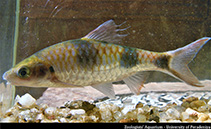
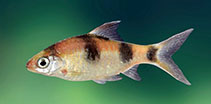
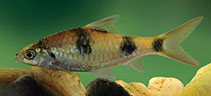
Adults of Puntius srilankensis are distinguished from P. filamentosus, P. singhala and P. assimilis by possessing a prominent black markings on body anterior to anal-fin origin. They differ from P. exclamatio by the absence of an elongate, tear-shaped black blotch above and anal fin; from P. arulius and P. tambraparniei by having mouth inferior and lower lip medially absent ( vs. mouth subterminal, lower lip entire) (Ref. 55036).
Body shape (shape guide): fusiform / normal.
A mid-water fish found in areas of rapidly flowing water with pebbly substrate (not found in silty substrate). With a clearly defined territory (of several square meters) and without lateral spatial preferences. Individuals of the same size often form loose schools. Presently not available in sufficient numbers to be exported by the aquarium trade.
Cycle de vie et comportement reproducteur Maturité | Reproduction | Frai | Œufs | Fécondité | Larves
Dynamique des populations Paramètres de croissance Âges / tailles maximales Longueur-poids rel. Rel. longueur-longueur. Fréquences de longueurs Conversion de masse Recrutement Abondance
Cycle de vie Reproduction Maturité Maturité/épines rel. Fécondité Frai Agrégats de frai Œufs Développement de l'œuf Larves Dynamique des populations larvaires
Physiologie Composition corporelle Nutriments Consommation d'oxygène Type de natation Vitesse de nage Pigments visuels Son de poisson Maladies et parasites Toxicité (CL50)
Indice de diversité phylogénétique (Réf. 82804): PD50 = 0.5001 [Uniqueness, from 0.5 = low to 2.0 = high].
Bayesian length-weight: a=0.01072 (0.00504 - 0.02277), b=3.02 (2.84 - 3.20), in cm total length, based on LWR estimates for this (Sub)family-body shape (Ref. 93245).
Niveau trophique (Réf. 69278): 2.7 ±0.1 se; based on size and trophs of closest relatives
Résilience (Réf. 120179): Haut, temps minimum de doublement de population inférieur à 15 mois (Preliminary K or Fecundity.).
Vulnérabilité de la pêche (Ref. 59153): Low vulnerability (10 of 100). 🛈