



Aphyocharax yekwanae Willink, Chernoff & Machado-Allison, 2003
Hochladen Photos und videos
Google Bild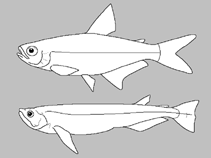 No image available for this species;
drawing shows typical species in Characidae.
Google Bild
drawing shows typical species in Characidae.
Klassifizierung / Names Namen | Synonyme | Catalog of Fishes(Gattung, Arten) | ITIS | CoL | WoRMS | Cloffa
> Characiformes (Characins) > Characidae (Characins; tetras) > Aphyocharacinae
Etymology: Aphyocharax: Greek, aphye, -es, sardine, anchovy + Greek, charax = a marine fish; diminutive (Ref. 45335); yekwanae: Named for the Ye'Kwana tribe that lives and oversees most of the Río Caura basin.
Eponymy: This species is named after the Ye’Kwana people (also ‘Ye-kuana’ – see above). They live in and oversee most of the Río Caura basin, Brazil. They are well known for their “…fervid desire to protect and manage their home territory and its environment.” (Ref. 128868), visit book page.
Etymology: Aphyocharax: Greek, aphye, -es, sardine, anchovy + Greek, charax = a marine fish; diminutive (Ref. 45335); yekwanae: Named for the Ye'Kwana tribe that lives and oversees most of the Río Caura basin.
Eponymy: This species is named after the Ye’Kwana people (also ‘Ye-kuana’ – see above). They live in and oversee most of the Río Caura basin, Brazil. They are well known for their “…fervid desire to protect and manage their home territory and its environment.” (Ref. 128868), visit book page.
Umwelt: Milieu / Klimazone / Tiefenbereich / Verbreitungsgebiet Ökologie
; süßwasser pelagisch. Tropical
Verbreitung Territorien | FAO Gebiete | Ökosysteme | Vorkommen | Punkt Karte | Einführungen | Faunafri
South America: Venezuela.
Größe / Gewicht / Alter
Kurzbeschreibung Bestimmungsschlüssel | Morphologie | Morphometrie
Rückenflossenweichstrahlen (insgesamt) : 9; Afterflossenweichstrahlen: 15 - 17; Wirbelzahl: 36 - 37. Body with bright red coloration, from vertical through second to fifth branched anal-fin ray to vertical through apex of fork in caudal fin; adipose and posterior 2/3 of anal fin red. This coloration is believed to be autapomorphic. Distal margin of anal fin clear. Maxillary teeth 11-16; incompletely toothed maxilla (Ref. 49521).
Body shape (shape guide): fusiform / normal; Cross section: compressed.
Body shape (shape guide): fusiform / normal; Cross section: compressed.
Common in the lee side of islands and protected backwaters of the main river channel; sand with some rocks bottom. Also collected near mouths of streams where it could be muddy and covered with terrestrial plant leaves. Aquatic vegetation almost always absent; water clear to moderately turbid (Ref. 49521).
Lebenszyklus und Paarungsverhalten Geschlechtsreife | Fortpflanzung | Ablaichen | Eier | Fruchtbarkeit | Larven
Hauptreferenz
Laden Sie Ihre Referenzen hoch | Referenzen | Koordinator | Partner
Willink, P.W., B. Chernoff, A. Machado-Allison, F. Provenzano and P. Petry, 2003. Aphyocharax yekwanae, a new species of bloodfin tetra (Teleostei: Characiformes: Characidae) from the Guyana Shield of Venezuela. Ichthyol. Explor. Freshwat. 14(1):1-8. (Ref. 49521)
IUCN Rote Liste Status (Ref. 130435: Version 2025-2 (Global))
Verwundbar (VU) (B1ab(iii)+2ab(iii)); Date assessed: 18 August 2017
CITES
Not Evaluated
Bedrohung für Menschen
Harmless
Nutzung durch Menschen
FAO - Publication: search | FishSource |
Mehr Information
Trophische Ökologie
Lebensmittel (Beutetiere)
Nahrungszusammensetzung
Nahrungsaufnahme
Lebensmittelrationen
Räuber
Lebensmittel (Beutetiere)
Nahrungszusammensetzung
Nahrungsaufnahme
Lebensmittelrationen
Räuber
Populationsdynamik
Wachstumsparameter
Max. Alter/Größen
Länge-Gewicht-Rel.
Länge-Länge-Verhältnis.
Längenhäufigkeiten
Massenkonvertierung
Rekrutierung
Dichte
Wachstumsparameter
Max. Alter/Größen
Länge-Gewicht-Rel.
Länge-Länge-Verhältnis.
Längenhäufigkeiten
Massenkonvertierung
Rekrutierung
Dichte
Lebenszyklus
Fortpflanzung
Geschlechtsreife
Reifung/Kiemen rel.
Fruchtbarkeit
Ablaichen
Laichaggregationen
Eier
Eientwicklung
Larven
Larven Pop.Dyn.
Fortpflanzung
Geschlechtsreife
Reifung/Kiemen rel.
Fruchtbarkeit
Ablaichen
Laichaggregationen
Eier
Eientwicklung
Larven
Larven Pop.Dyn.
Anatomie
Kiemenoberfläche
Gehirn
Otolith
Kiemenoberfläche
Gehirn
Otolith
Physiologie
Körperliche Zusammensetzung
Nährstoffe
Sauerstoffverbrauch
Schwimmart
Schwimmgeschwindigkeit
Visuelle Pigmente
Fischgeräusche
Krankheiten und Parasiten
Toxizität (LC50s)
Körperliche Zusammensetzung
Nährstoffe
Sauerstoffverbrauch
Schwimmart
Schwimmgeschwindigkeit
Visuelle Pigmente
Fischgeräusche
Krankheiten und Parasiten
Toxizität (LC50s)
Genetik
Genom
Genetik
Heterozygotie
Vererbbarkeit
Genetische Vielfalt
Genom
Genetik
Heterozygotie
Vererbbarkeit
Genetische Vielfalt
Menschenbezogen
Aquakultur-Systeme
Aquakultur Profile
Zuchtlinien
Ciguatera-Fälle
Briefmarken, Münzen, Verschiedenes.
Aquakultur-Systeme
Aquakultur Profile
Zuchtlinien
Ciguatera-Fälle
Briefmarken, Münzen, Verschiedenes.
Tools
Zusatzinformationen
Download XML
Zusammenfassung | Punktdaten | Namen | Photos
Internet Quellen
AFORO (otoliths) | Aquatic Commons | BHL | Cloffa | Websites from users | FishWatcher Einträge suchen | CISTI | Catalog of Fishes: Gattung, Arten | DiscoverLife | ECOTOX | FAO - Publication: search | Faunafri | Fishipedia | Fishtrace | GloBI | Google Books | Google Scholar | Google | IGFA World Record | OneZoom | Open Tree of Life | Otolith Atlas of Taiwan Fishes | PubMed | Reef Life Survey | Socotra Atlas | TreeBase | Tree of Life | Wikipedia: Gehe zu, Suchen | World Records Freshwater Fishing | Zoobank | Zoologischer Rekord
Schätzungen auf der Grundlage von Modellen
Phylogenetischer Diversitätsindex (Ref. 82804): PD50 = 0.5005 [Uniqueness, from 0.5 = low to 2.0 = high].
Bayesian length-weight: a=0.01122 (0.00514 - 0.02450), b=3.04 (2.87 - 3.21), in cm total length, based on all LWR estimates for this body shape (Ref. 93245).
Trophische Ebene (Ref. 69278): 3.4 ±0.4 se; based on size and trophs of closest relatives