



Paraplotosus muelleri (Klunzinger, 1879)
Kimberley catfish
Beobachtung melden im Fish Watcher
| Native range | All suitable habitat | Point map | Year 2050 |

|
| This map was computer-generated and has not yet been reviewed. |
| Paraplotosus muelleri AquaMaps Data sources: GBIF OBIS |
Hochladen Photos und videos
Google Bild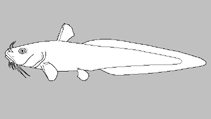 No image available for this species;
drawing shows typical species in Plotosidae.
Google Bild
drawing shows typical species in Plotosidae.
Klassifizierung / Names Namen | Synonyme | Catalog of Fishes(Gattung, Arten) | ITIS | CoL | WoRMS | Cloffa
> Siluriformes (Catfishes) > Plotosidae (Eeltail catfishes)
Etymology: Paraplotosus: Greek, para = in the side of + Greek, plotos = swimming (Ref. 45335).
Eponymy: Baron Dr Sir Ferdinand Jacob Heinrich von Müller (1825–1896) was a German-born Australian botanist, geographer, explorer, physician, and naturalist. [...] (Ref. 128868), visit book page.
More on author: Klunzinger.
Etymology: Paraplotosus: Greek, para = in the side of + Greek, plotos = swimming (Ref. 45335).
Eponymy: Baron Dr Sir Ferdinand Jacob Heinrich von Müller (1825–1896) was a German-born Australian botanist, geographer, explorer, physician, and naturalist. [...] (Ref. 128868), visit book page.
More on author: Klunzinger.
Umwelt: Milieu / Klimazone / Tiefenbereich / Verbreitungsgebiet Ökologie
seewasser riff-verbunden; tiefenbereich 0 - 8 m (Ref. 31103). Tropical
Verbreitung Territorien | FAO Gebiete | Ökosysteme | Vorkommen | Punkt Karte | Einführungen | Faunafri
Indo-West Pacific: northwestern Australia and the adjacent Northern Territory.
Größe / Gewicht / Alter
Kurzbeschreibung Bestimmungsschlüssel | Morphologie | Morphometrie
Rückenflossenstacheln (insgesamt) : 1; Rückenflossenweichstrahlen (insgesamt) : 97 - 110; Afterflossenstacheln: 0; Afterflossenweichstrahlen: 80 - 95. Differs from P. albilabris in having a taller dorsal fin and larger eye (Ref. 31103). Differs from Paraplotosus butleri in having a shorter dorsal fin and shorter nasal barbels, rounded pectoral fin shape, fewer procurrent caudal fin rays, and fewer gill rakers. Brown in color, belly area and ventral surface of head whitish (Ref. 31103).
Body shape (shape guide): elongated.
Body shape (shape guide): elongated.
Restricted to turbid coastal reefs of mainland Australia and nearby islands (Ref. 31103). Presumably nocturnal (Ref. 31103). Feeds on gastropod mollusks and crustaceans (Ref. 31103).
Lebenszyklus und Paarungsverhalten Geschlechtsreife | Fortpflanzung | Ablaichen | Eier | Fruchtbarkeit | Larven
Hauptreferenz
Laden Sie Ihre Referenzen hoch | Referenzen | Koordinator | Partner
Allen, G.R., 1998. A review of the marine catfish genus Paraplotosus (Plotosidae) with the description of a new species from north-western Australia. Raf. Bull. Zool. 46(1):123-134. (Ref. 31103)
CITES
Not Evaluated
Bedrohung für Menschen
Harmless
Nutzung durch Menschen
FAO - Publication: search | FishSource |
Mehr Information
Trophische Ökologie
Lebensmittel (Beutetiere)
Nahrungszusammensetzung
Nahrungsaufnahme
Lebensmittelrationen
Räuber
Lebensmittel (Beutetiere)
Nahrungszusammensetzung
Nahrungsaufnahme
Lebensmittelrationen
Räuber
Populationsdynamik
Wachstumsparameter
Max. Alter/Größen
Länge-Gewicht-Rel.
Länge-Länge-Verhältnis.
Längenhäufigkeiten
Massenkonvertierung
Rekrutierung
Dichte
Wachstumsparameter
Max. Alter/Größen
Länge-Gewicht-Rel.
Länge-Länge-Verhältnis.
Längenhäufigkeiten
Massenkonvertierung
Rekrutierung
Dichte
Lebenszyklus
Fortpflanzung
Geschlechtsreife
Reifung/Kiemen rel.
Fruchtbarkeit
Ablaichen
Laichaggregationen
Eier
Eientwicklung
Larven
Larven Pop.Dyn.
Fortpflanzung
Geschlechtsreife
Reifung/Kiemen rel.
Fruchtbarkeit
Ablaichen
Laichaggregationen
Eier
Eientwicklung
Larven
Larven Pop.Dyn.
Anatomie
Kiemenoberfläche
Gehirn
Otolith
Kiemenoberfläche
Gehirn
Otolith
Physiologie
Körperliche Zusammensetzung
Nährstoffe
Sauerstoffverbrauch
Schwimmart
Schwimmgeschwindigkeit
Visuelle Pigmente
Fischgeräusche
Krankheiten und Parasiten
Toxizität (LC50s)
Körperliche Zusammensetzung
Nährstoffe
Sauerstoffverbrauch
Schwimmart
Schwimmgeschwindigkeit
Visuelle Pigmente
Fischgeräusche
Krankheiten und Parasiten
Toxizität (LC50s)
Genetik
Genom
Genetik
Heterozygotie
Vererbbarkeit
Genetische Vielfalt
Genom
Genetik
Heterozygotie
Vererbbarkeit
Genetische Vielfalt
Menschenbezogen
Aquakultur-Systeme
Aquakultur Profile
Zuchtlinien
Ciguatera-Fälle
Briefmarken, Münzen, Verschiedenes.
Aquakultur-Systeme
Aquakultur Profile
Zuchtlinien
Ciguatera-Fälle
Briefmarken, Münzen, Verschiedenes.
Tools
Zusatzinformationen
Download XML
Zusammenfassung | Punktdaten | Namen | Photos
Internet Quellen
AFORO (otoliths) | Aquatic Commons | BHL | Cloffa | Websites from users | FishWatcher Einträge suchen | CISTI | Catalog of Fishes: Gattung, Arten | DiscoverLife | ECOTOX | FAO - Publication: search | Faunafri | Fishipedia | Fishtrace | GloBI | Google Books | Google Scholar | Google | IGFA World Record | OneZoom | Open Tree of Life | Otolith Atlas of Taiwan Fishes | PubMed | Reef Life Survey | Socotra Atlas | TreeBase | Tree of Life | Wikipedia: Gehe zu, Suchen | World Records Freshwater Fishing | Zoologischer Rekord
Schätzungen auf der Grundlage von Modellen
Bevorzugte Temperatur (Ref. 123201): 25.2 - 29.2, mean 28 °C (based on 531 cells).
Phylogenetischer Diversitätsindex (Ref. 82804): PD50 = 0.6250 [Uniqueness, from 0.5 = low to 2.0 = high].
Bayesian length-weight: a=0.00468 (0.00210 - 0.01040), b=3.06 (2.86 - 3.26), in cm total length, based on LWR estimates for this (Sub)family-body shape (Ref. 93245).
Trophische Ebene (Ref. 69278): 3.4 ±0.54 se; based on food items.
Widerstandsfähigkeit (Ref. 120179): hoch, Verdopplung der Population dauert weniger als 15 Monate. (Preliminary K or Fecundity.).
Nährstoffe (Ref. 124155): Calcium = 79.5 [34.0, 159.0] mg/100g; Iron = 0.652 [0.377, 1.185] mg/100g; Protein = 17 [15, 19] %; Omega3 = 0.0896 [, ] g/100g; Selenium = 24.3 [12.8, 55.1] μg/100g; VitaminA = 97.5 [32.1, 276.2] μg/100g; Zinc = 1.4 [0.9, 2.0] mg/100g (wet weight);