This website uses cookies to enhance your browsing experience and ensure the functionality of our site. For more detailed information about the types of cookies we use and how we protect your privacy, please visit our Privacy Information page.
×
Cookie Settings
This website uses different types of cookies to enhance your experience. Please select your preferences below:
> Ovalentaria/misc (Various families in series Ovalentaria) > Pomacentridae (Damselfishes) > Pomacentrinae
Etymology: Pomacentrus:Greek, poma, -atos = cover, operculum + Greek, kentron = sting (Ref. 45335); limosus:From the Latin for muddy, in reference to the silty habitat where this species occurs (Ref. 31101).
Environnement : milieu / zone climatique / profondeur / gamme de distribution Écologie
marin démersal; profondeur 8 - 10 m (Ref. 31101). Tropical
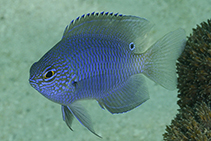
Épines dorsales (Total) : 13; Rayons mous dorsaux (Total) : 15; Épines anales: 2; Rayons mous anaux: 15 - 16. Tubed lateral line scales 18; pale grey without conspicuous markings, except for membranous tips of dorsal spines black and juvenile with black ocellus at base of soft dorsal fin (Ref. 31101). Caudal fin emarginate (Ref. 31101).
Adults are observed around rock outcrops with flat silt-sand bottom (Ref. 31101). Oviparous, distinct pairing during breeding (Ref. 205). Eggs are demersal and adhere to the substrate (Ref. 205). Males guard and aerate the eggs (Ref. 205). Diurnal species (Ref. 52881).
Cycle de vie et comportement reproducteur Maturité | Reproduction | Frai | Œufs | Fécondité | Larves
Oviparous, distinct pairing during breeding (Ref. 205). Eggs are demersal and adhere to the substrate (Ref. 205). Males guard and aerate the eggs (Ref. 205).
Dynamique des populations Paramètres de croissance Âges / tailles maximales Longueur-poids rel. Rel. longueur-longueur. Fréquences de longueurs Conversion de masse Recrutement Abondance
Cycle de vie Reproduction Maturité Maturité/épines rel. Fécondité Frai Agrégats de frai Œufs Développement de l'œuf Larves Dynamique des populations larvaires
Physiologie Composition corporelle Nutriments Consommation d'oxygène Type de natation Vitesse de nage Pigments visuels Son de poisson Maladies et parasites Toxicité (CL50)
Température préférée (Réf. 123201): 18 - 28.4, mean 26.2 °C (based on 339 cells).
Indice de diversité phylogénétique (Réf. 82804): PD50 = 0.5000 [Uniqueness, from 0.5 = low to 2.0 = high].
Bayesian length-weight: a=0.02399 (0.01134 - 0.05074), b=2.98 (2.81 - 3.15), in cm total length, based on LWR estimates for this Genus-body shape (Ref. 93245).
Niveau trophique (Réf. 69278): 2.8 ±0.3 se; based on size and trophs of closest relatives
Résilience (Réf. 120179): Haut, temps minimum de doublement de population inférieur à 15 mois (Preliminary K or Fecundity.).
Vulnérabilité de la pêche (Ref. 59153): Low vulnerability (10 of 100). 🛈