This website uses cookies to enhance your browsing experience and ensure the functionality of our site. For more detailed information about the types of cookies we use and how we protect your privacy, please visit our Privacy Information page.
×
Cookie Settings
This website uses different types of cookies to enhance your experience. Please select your preferences below:
> Ovalentaria/misc (Various families in series Ovalentaria) > Pomacentridae (Damselfishes) > Pomacentrinae
Etymology: Amblyglyphidodon:Greek, amblys = darkness + Greek, glyphis = carved + Greek, odous = teeth (Ref. 45335); indicus:Name from Latin 'indicus', of India, for its geographical distribution which is confined to the Indian Ocean and adjacent Red Sea. More on authors: Allen & Randall.
Meio ambiente: milieu / Zona climática / intervalo de profundidade / faixa de distribuição Ecologia
marinhas associadas(os) a recifes; intervalo de profundidade 2 - 15 m (Ref. 46206). Tropical
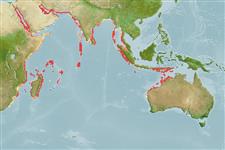
Indian Ocean: from the Gulf of Aqaba, Red Sea, the Maldives to the Andaman Sea, off northern tip of Sumatra at Weh I, (Indonesia) and coast of Thailand.
Tamanho / Peso / Idade
Maturidade: Lm? range ? - ? cm Max length : 8.3 cm SL macho/indeterminado; (Ref. 28618)
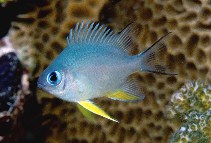
Espinhos dorsais (total) : 8; Raios dorsais (total) : 11 - 13; Espinhos anais: 2; Raios anais : 13 - 14; Vértebras: 26. This species is distinguished by the following characters: D XIII,11-13 (usually 12); A II,13 (rarely 14); pectoral rays 17-18; tubed lateral-line scales 15-18; gill rakers 7-8 + 18-20 = 25-28); body depth 1.5-1.7 in SL; teeth incisiform and in a single row; scaled suborbital; predorsal scales extending well before the nostrils, nearly to base of upper lip; colouration silvery grading to yellowish white on the belly and lower sides; the back and dorsal part of head is mainly green; with a broad, vertically elongate greenish streak on each body scale; rear edges of preopercle and upper half of opercle are dusky grey; median fins translucent to greenish white, the lower and upper edge of caudal fin narrowly blackish; pelvic fins pale yellow to white; pectoral fins are translucent with small dark spot at base of uppermost rays (Ref. 82240). Body shape (shape guide): short and / or deep; Cross section: compressed.
Presumed to be reef-associated (Ref. 206). Found in shallow waters on branching Acropora corals of inshore and outer reefs. Dead branches of corals serve as nests (Ref. 90102). Oviparous, distinct pairing during breeding (Ref. 205). Eggs are demersal and adhere to the substrate (Ref. 205). Males guard and aerate the eggs (Ref. 205). Distribution allopatric except eastern Andaman Sea where its similar species A. leucogaster is rarely found (Ref. 90102).
Ciclo de vida ou comportamento de acasalamento Maturidade | Reprodução | Desova | Ovos | Fecundidade | Larvas
Oviparous, distinct pairing during breeding (Ref. 205). Eggs are demersal and adhere to the substrate (Ref. 205). Males guard and aerate the eggs (Ref. 205).
Allen, G.R. and J.E. Randall, 2002. A review of the leucogaster species complex of the Indo-Pacific pomacentrid genus Amblyglyphidodon, with descriptions of two new species. aqua, J. Ichthyol. Aquat. Biol. 5(4):139-152. (Ref. 82240)
Status na Lista Vermelha da UICN (Ref. 130435: Version 2025-2 (Global))
Ciclo de vida Reprodução Maturidade Maturidade/Rel. das guelras Fecundidade Desova Agregações de desova Ovos Desenvolvimento dos ovos Larvas Dinâmica larval
Fisiologia Composição corporal Nutrientes Consumo de oxigênio Tipo de natação Velocidade de natação Pigmentos visuais Som de peixe Doenças e Parasitas Toxicidade (LC50s)
Temperatura preferida (Ref. 123201): 24.8 - 29.1, mean 27.4 °C (based on 464 cells).
Índice de diversidade filogenética (Ref. 82804): PD50 = 0.5005 [Uniqueness, from 0.5 = low to 2.0 = high].
Bayesian length-weight: a=0.02344 (0.01149 - 0.04783), b=2.98 (2.80 - 3.16), in cm total length, based on LWR estimates for this (Sub)family-body shape (Ref. 93245).
Nível Trófico (Ref. 69278): 2.7 ±0.3 se; based on size and trophs of closest relatives
Resiliência (Ref. 120179): Elevada, tempo mínimo de duplicação da população menor que 15 meses (Preliminary K or Fecundity.).
Vulnerabilidade da pesca (Ref. 59153): Low vulnerability (10 of 100). 🛈